



















|
Listen to article
|
The Law Rebuilt
Enforced Paternity, Funded Provision, and Care Instead of Arrest
Forensic classification: Legal, human-rights, and public-health analysis; documentary synthesis.
Volume II’s seventh part left the law where it found it — a borrowed prohibition that jailed the woman, spared the man, and drove the whole matter into the dark. Part 28 rebuilds it. The task is not to write a sermon into the statute book but to make the law do what the prohibition never could: protect the coming child by protecting the woman who carries it, and place the legal weight where the moral weight belongs. A law rebuilt on the logic of this series would look very different from the one Nigeria and much of the region now keeps.
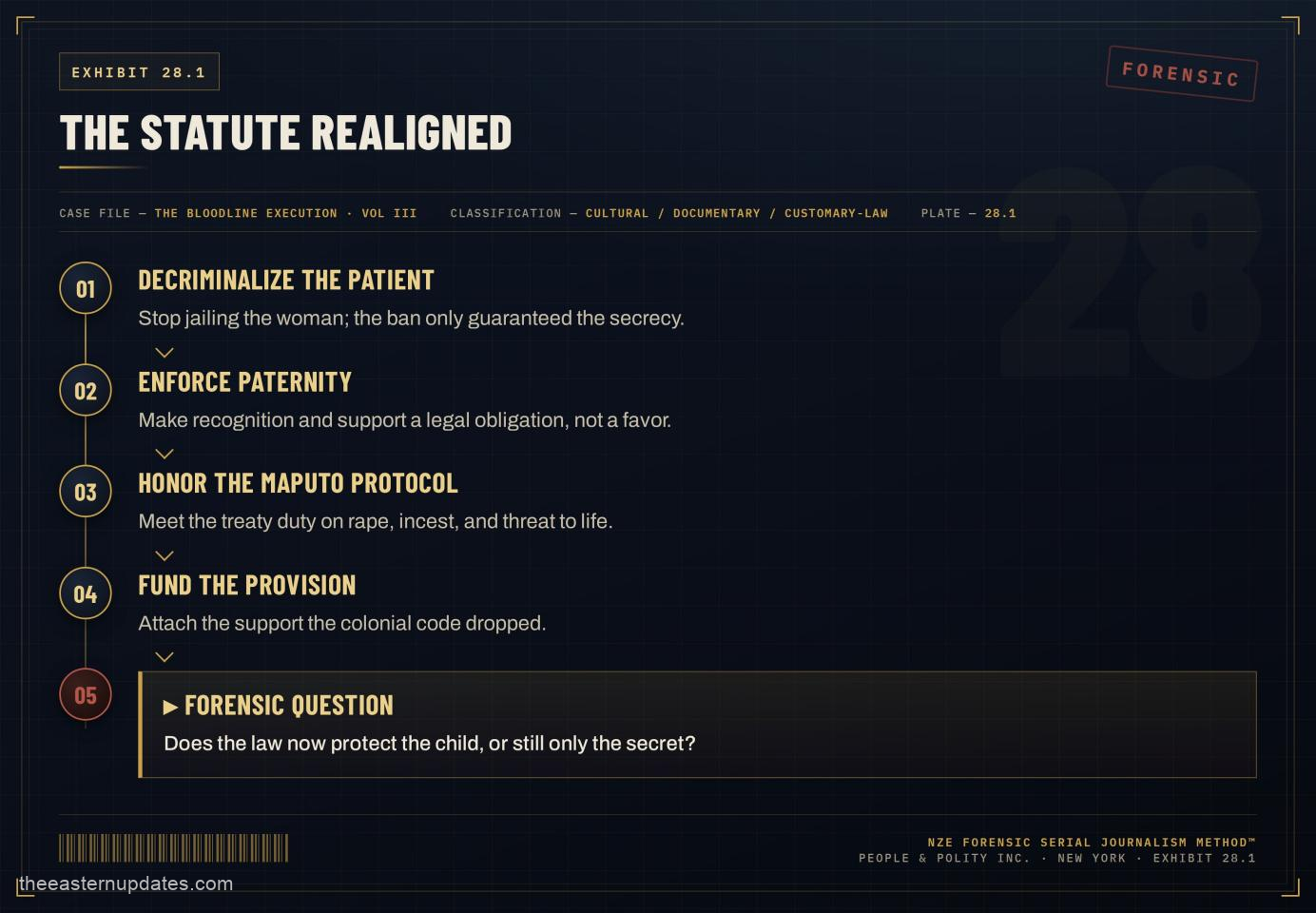
The first move is the one the evidence has demanded since Volume II: stop jailing the woman. A statute that criminalizes the patient does not reduce abortion; it guarantees the secrecy that kills her, and it turns the clinic into a place of danger rather than care (Bankole et al., 2015; Ganatra et al., 2017). Decriminalizing the woman does not declare abortion good. It recognizes instead that a threatened prison sentence has never yet talked a frightened girl out of a pregnancy — it has only talked her out of the hospital. A law that wants women alive removes the penalty that keeps them from care (World Health Organization, 2022). This is the floor, and Volume III has argued it from the first page: whatever a society decides about the morality of abortion, it cannot decide to let women die of secrecy.
A second move carries what the whole series has been building toward, and it is the piece almost entirely missing from the present law: enforce the man. The statute polices the woman’s womb and says next to nothing about the father’s duty; it is a law obsessed with the moment of ending and silent on the years of abandoning. A rebuilt law reverses the emphasis. It makes paternity a legal fact that can be established and not privately denied, and it makes support — the provision of Part 22 — an enforceable obligation rather than a favor a man may grant or withhold. The old customary order compelled the man through kin and community; a modern law can compel him through the courts. A society serious about the coming child would spend at least as much statutory energy on the father who abandons it as on the mother who, abandoned, ends it.
Read also: The Bloodline Execution — Part 27
Third comes an obligation the region has already accepted. Much of Africa has ratified the Maputo Protocol, which binds states to permit abortion in cases of sexual assault, rape, incest, and threat to the woman’s life or health (Ngwena, 2010). A rebuilt law honors that duty rather than evading it, because a statute that forces a raped child to carry, or a dying woman to die, has surrendered any claim to be defending life. Meeting the treaty forms one test of the law’s honesty rather than the whole of the reform — whether it is willing to be merciful in the cases where mercy is least deniable (Cook & Dickens, 2003).
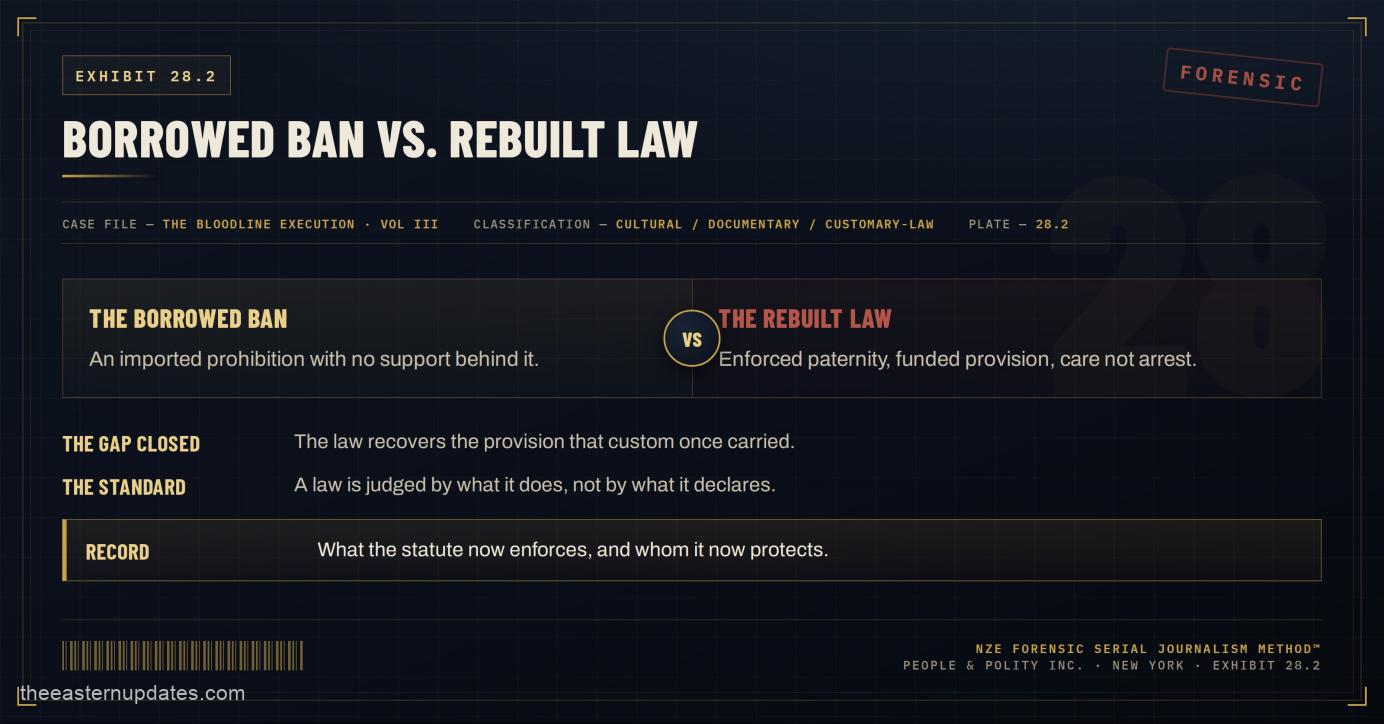
Closing the gap Volume II named comes fourth: the colonial statute borrowed the prohibition and dropped the provision. A rebuilt law attaches the provision back — antenatal and maternal care, support for the pregnant girl, the funding of the net that Parts 23 and 24 described. A prohibition with no support is a trap; a support system with no prohibition is a mercy; the reform this series argues moves the law decisively from the first toward the second (Okonofua, 2006; Guttmacher Institute, 2022). The point is not to legislate custom back into being — that cannot be done and should not be tried — but to make the law carry, in modern form, the one thing custom carried that the imported code discarded: the obligation to provide.
Traditionalists will say that a law which decriminalizes the woman has surrendered the coming child; reformers will say that a law which enforces paternity has smuggled patriarchy back through the courthouse door. Both are answered by the shape of the whole reform. To the first: the child is protected here far better than by a prohibition that kills its mother without lowering the number of abortions — protected by the man made to provide, the woman kept alive and supported, the pregnancy made possible to carry. To the second: enforcing a man’s duty to provide does the opposite of restoring his dominion over a woman. It refuses him the exit that dominion never had to earn. A law that makes a man pay and stay, while leaving the woman free, is not the old patriarchy. It is its inversion.
Read also: The Bloodline Execution — Part 26
Part 28 is built from the legal, human-rights, and public-health record, cited in the docket. The forensic question is the one Volume II left open and Volume III now answers: does the law protect the child, or does it only guarantee the secret? A rebuilt law, with the patient decriminalized, the father enforced, the treaty honored, and the provision funded, protects the child by keeping the mother alive and the man accountable, which is the only protection that has ever actually worked.
Forensic Diagram Set
Evidence Docket
THE STANDING RECORD
Each claim advanced in this installment rests on a seven-source record held on file and verified for authorship, place of publication, and identifier. In keeping with the practice of this series, those records are not printed part by part. The consolidated Evidence Docket — the complete Standing Record for every installment of every volume, set out in full APA form — will be published at the close of the entire publication, so that the reader may weigh the whole file at once rather than a fragment at a time. Sources are named inline throughout, and any reader may test a claim against them before that docket appears.
Full bibliographic entries are not repeated here. Every source cited above is compiled once, in APA 7 form and alphabetically by author, in the Standing Record at the close of this volume and in the reference section of the PDF edition, each entry carrying a note of the parts that cited it and of the setting in which its fieldwork was conducted.