


















|
Listen to article
|
The Cleansing as Restoration
Turning a Rite of Shame Into a Structure of Return, and Making It Fall on the Man
Forensic classification: Cultural and religious record; documentary analysis; customary-law context.
This series promised, three volumes ago, that it would follow the cleansing to its end, and Part 26 keeps the promise. Volume II recovered the customary belief that the womb could be gravely wronged and, in the same breath, the belief that the wrong could be lifted — that a person and a family, having done or suffered a grave thing, could be made right with the earth and the ancestors and received back. Part 26 completes the thread by asking what that belief becomes when it is rebuilt honestly: not a brand laid on a woman, but a path home walked by everyone who owes the debt.
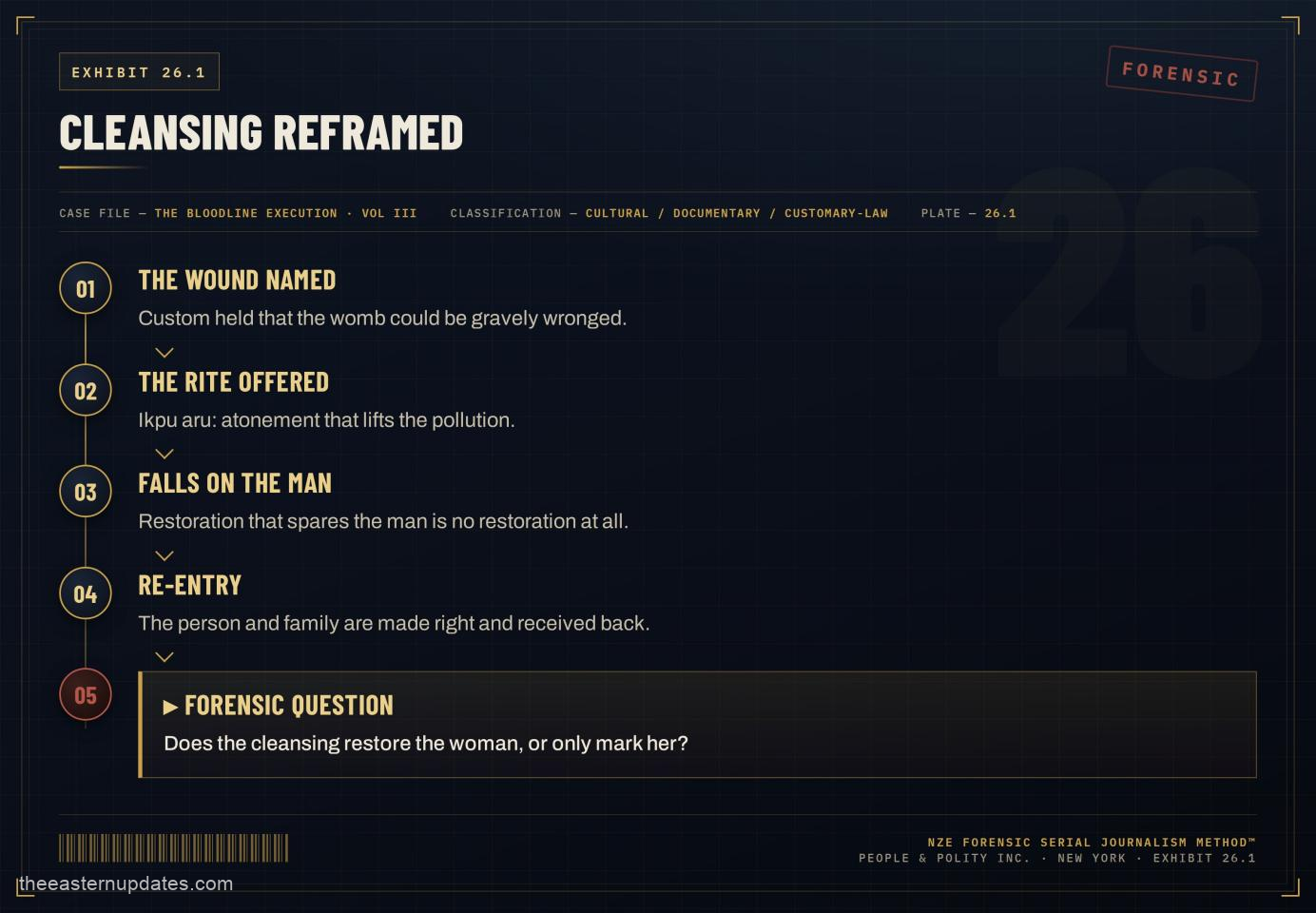
In Igbo custom the rites of atonement, ikpu aru and its kin, answered the pollution of an abomination not with permanent exile but with a structured, witnessed return; the offense was named, the atonement made, the balance with Ala and the ancestors restored, and the person received back into the community (Arinze, 1970; Ikenga-Metuh, 1981; Ilogu, 1974). The logic is worth stating precisely, because the modern imagination hears the word cleansing and expects only shaming. The customary rite did contain judgment, but its purpose was not to fix the offender permanently in disgrace; it was to move a person through the wrong and out the other side, back among their people. A people who believed a thing could be gravely wrong also believed the wrong need not be the end of a life (Mbiti, 1969; Fortes, 1959).
Read more: The Bloodline Execution — Part 25
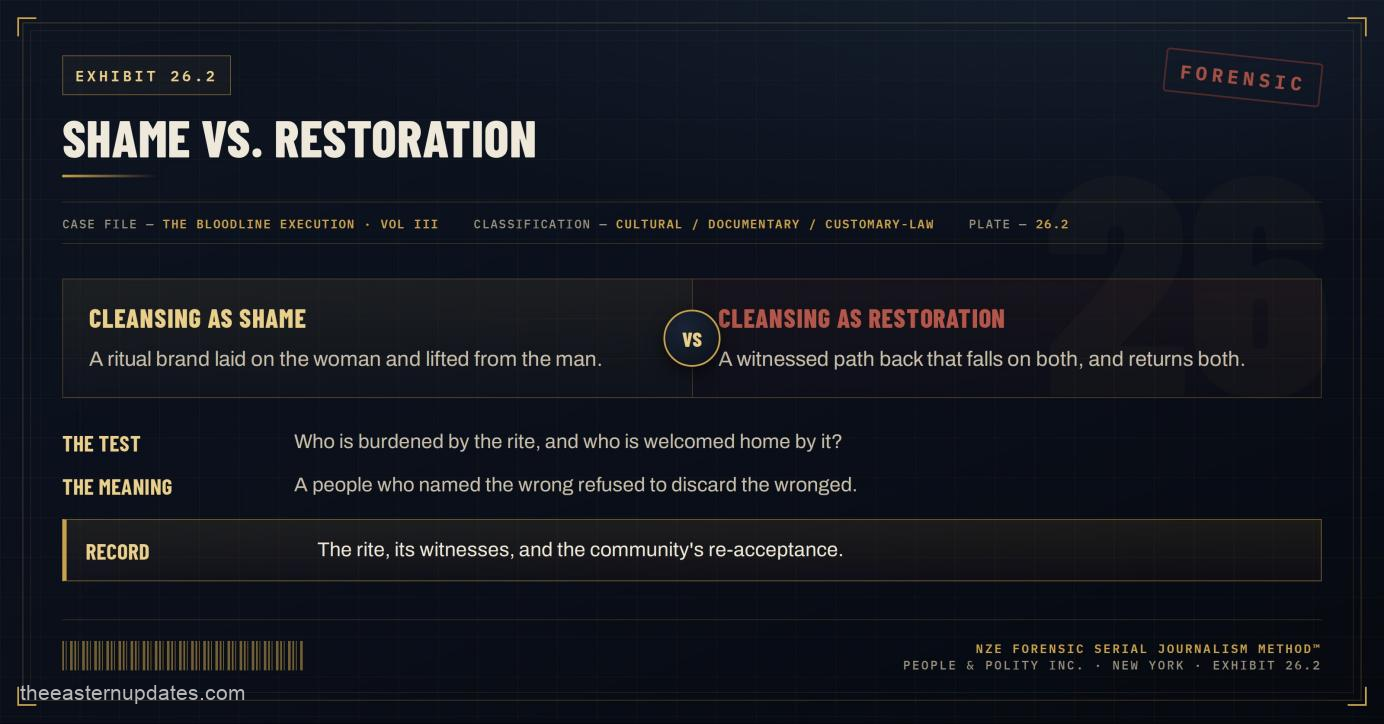
It would be false to present this as it too often was. The burden of purity in many societies fell hardest on women; a rite meant to restore could be turned into one that marked, and a girl could be cleansed in form and diminished in fact while the man who fathered the wrong walked untouched. Volume II said this plainly and Part 26 says it again, because it is the hinge of the whole matter. A cleansing that falls on the woman and spares the man amounts to the counterfeit wearing a sacred face, and this series prosecutes it as sharply as it prosecutes the abandoning man himself. The recovery of cleansing is worth nothing if it recovers the old injustice along with the old mercy.
So the restoration takes the customary logic and corrects its aim. What it keeps is the structure the modern world lacks entirely: a witnessed, communal path by which a person broken by this chain is not written off but named, atoned for where atonement is owed, and received back. What it changes is where the weight falls. In the restored cleansing the man stands not as a spectator to the woman’s shame but as the first to be summoned, because his was the first debt. The atonement he owes is the atonement of Part 22 made moral as well as material — recognition, provision, and presence, offered before the community as the price of his return. And the woman, far from bearing the rite alone, is its chief beneficiary: the one the community is charged to welcome home rather than to mark. A people who could name an abomination without flinching and still refuse to discard a human being left the modern world a template for exactly what it does worst — the return of those it would rather forget.
Read also: The Bloodline Execution — Part 24
The objection will come from two sides. The secular reader will ask why ritual belongs in a program of restoration at all; the devout reader will ask whether reframing a sacred rite is not simply inventing a new one. To the first: the rite is offered here as documented culture and as a social structure of return, whose communal, witnessed form does work that private guilt and public silence cannot, whatever one makes of its metaphysics. To the second: the reframing changes not the rite’s substance but its aim — insisting that it fall on the man and restore the woman — which is a correction the tradition’s own logic of justice can bear, since a rite of restoration that restored only the powerful was always a corruption of itself. The series does not ask anyone to believe; it asks that a culture’s real wisdom about return be recovered without its real injustice.
Part 26 is assembled from the religious and ethnographic record, cited in the docket, and handled throughout as documented belief. The forensic question is the test of every cleansing, old or rebuilt: does it restore the woman, or only mark her — and does it summon the man, or excuse him? A rite that returns both is restoration. A rite that brands one and spares the other is the counterfeit, and the restoration refuses it.
Forensic Diagram Set
Evidence Docket
THE STANDING RECORD
Each claim advanced in this installment rests on a seven-source record held on file and verified for authorship, place of publication, and identifier. In keeping with the practice of this series, those records are not printed part by part. The consolidated Evidence Docket — the complete Standing Record for every installment of every volume, set out in full APA form — will be published at the close of the entire publication, so that the reader may weigh the whole file at once rather than a fragment at a time. Sources are named inline throughout, and any reader may test a claim against them before that docket appears.
Full bibliographic entries are not repeated here. Every source cited above is compiled once, in APA 7 form and alphabetically by author, in the Standing Record at the close of this volume and in the reference section of the PDF edition, each entry carrying a note of the parts that cited it and of the setting in which its fieldwork was conducted.