





















|
Listen to article
|
Safe Care and the End of the Back Room
Family Planning, Post-Abortion Care, and Meeting the Woman With Care Rather Than Arrest
Forensic classification: Public-health record; documentary analysis; customary-law context.
Every part of the restoration so far has worked to keep a woman out of the back room by removing the pressures that drive her there. Part 25 addresses what must exist for the woman the earlier parts did not reach in time — and, more broadly, the medical care whose absence Volume II identified as the thing that actually kills. The restoration would be incomplete, and dishonest, if it built recognition and provision and left the clinic out. The evidence is plain that the deaths are made of unsafety and the absence of care; the restoration answers with care.
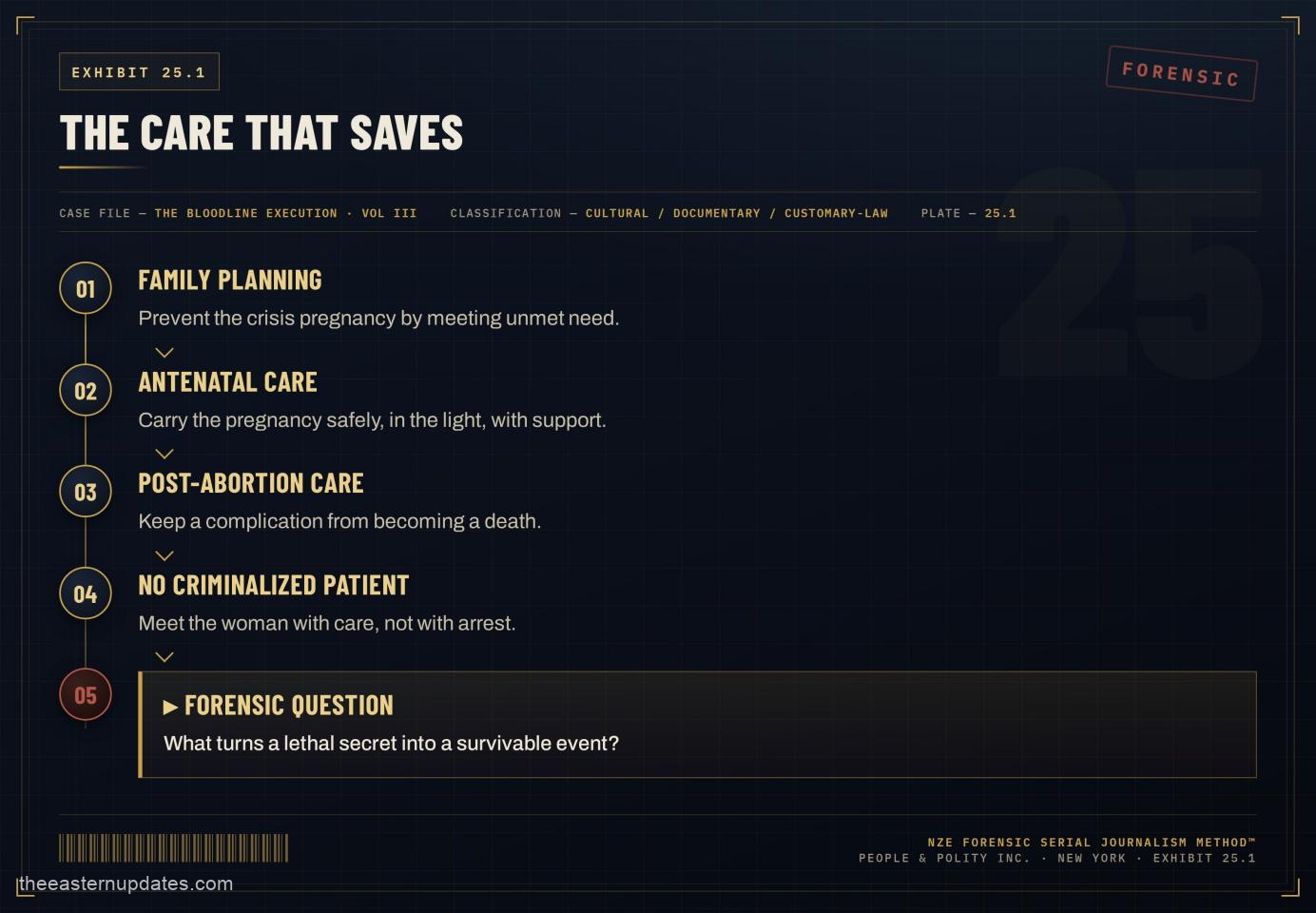
The first and least contested piece is prevention. A great many crisis pregnancies never need to occur, and the means to prevent them are well established: access to family planning that meets the large unmet need across the region. Where women can plan whether and when to conceive, the number of unintended pregnancies falls, and with it the number of desperate ones (Sully et al., 2020). This is not a marginal effect. The modeling of reproductive-health investment is consistent that meeting unmet need for contraception is among the most cost-effective interventions available, preventing unintended pregnancies, unsafe abortions, and maternal deaths together (Sully et al., 2020; World Health Organization, 2022). Prevention is the cheapest care, and it belongs at the front of the restoration.
Read also: The Bloodline Execution — Part 24
For the woman who is pregnant and, given the recognition and provision the earlier parts supply, is able to carry, the restoration means antenatal and maternal care that brings the pregnancy safely into the light, the routine skilled care whose absence remains a leading cause of maternal death across the region (Say et al., 2014; World Health Organization, 2022). The whole thrust of Volumes II and III is to make carrying possible where it is wanted, by removing the abandonment and poverty that made it impossible; safe maternal care is the medical half of that promise.
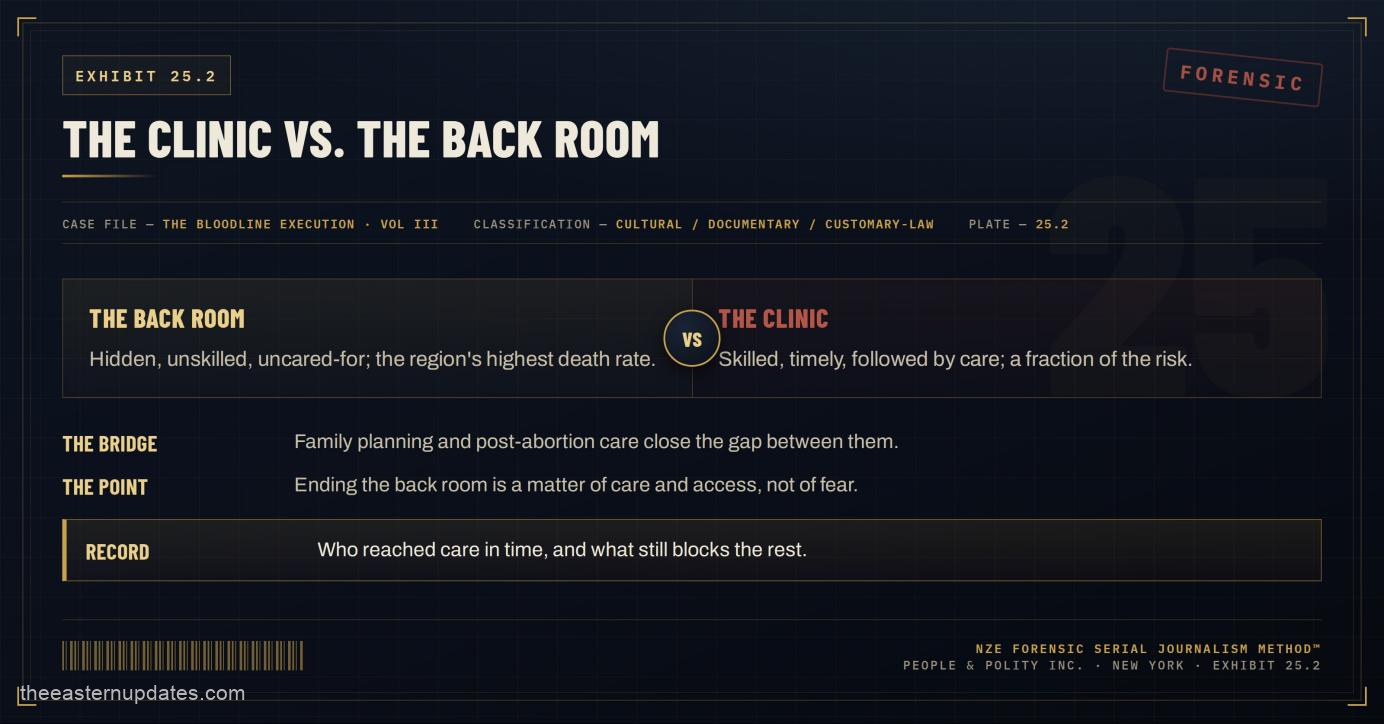
And for the woman who has ended a pregnancy, or attempted to, the restoration means the piece the criminalized system withholds and the one that most directly saves lives: post-abortion care. Volume II’s hardest figure was the estimated hundreds of thousands of Nigerian women who suffered complications and never reached treatment, kept away by fear of arrest and shame (Bankole et al., 2015). Post-abortion care — the treatment of complications and the provision of follow-up, offered without interrogation or punishment — is what turns a complication into a survivable event rather than a death (Grimes et al., 2006). Its logic takes no position on the morality of abortion. What it refuses is to let a woman die of a treatable injury because she fears the people who should be saving her. A restoration serious about keeping women alive meets the woman with care, not with a cell.
Read also: The Bloodline Execution — Part 23
Here the restoration states plainly what the evidence requires and what an honest series cannot dodge. The data are consistent that the deaths track unsafety, and that the safety of abortion rises where it is not clandestine (Ganatra et al., 2017). This series has made its own argument about the deeper remedy — that the surest way to reduce abortion is to remove the abandonment and provide the support that drive it, not to prohibit it, which Volume II showed does not work and does kill. But whatever a society decides about its law, the woman in front of the clinic tonight must not be left to die of secrecy. Post-abortion care and safe maternal care are owed her now, under any law, and the restoration insists on them as the floor beneath every other reform (Guttmacher Institute, 2022).
Part 25 is built from the public-health and epidemiological record, cited in the docket. The forensic question is the one the whole volume has been circling: what turns a lethal secret into a survivable event? The answer is care — prevention before the crisis, skilled care through the pregnancy, and treatment after — offered to the woman rather than withheld from her. The back room ends not when a law is passed but when a woman can reach care without fear. Building that reach is the work of this part.
Forensic Diagram Set
Evidence Docket
THE STANDING RECORD
Each claim advanced in this installment rests on a seven-source record held on file and verified for authorship, place of publication, and identifier. In keeping with the practice of this series, those records are not printed part by part. The consolidated Evidence Docket — the complete Standing Record for every installment of every volume, set out in full APA form — will be published at the close of the entire publication, so that the reader may weigh the whole file at once rather than a fragment at a time. Sources are named inline throughout, and any reader may test a claim against them before that docket appears.
Full bibliographic entries are not repeated here. Every source cited above is compiled once, in APA 7 form and alphabetically by author, in the Standing Record at the close of this volume and in the reference section of the PDF edition, each entry carrying a note of the parts that cited it and of the setting in which its fieldwork was conducted.