
















|
Listen to article
|
What the record predicts
Promises describe an ambition; the first acts of government reveal a method. Part 14 asks what Agbaso’s experience may mean for financial disclosure, appointments, public services and the handling of disagreement.
“An oath grants authority. It cannot teach judgment.”
Taking office makes ordinary decisions urgent, regardless of the hopes and promises that preceded the oath. Salaries fall due, contractors submit claims, hospitals need supplies and damaged roads remain dangerous while revenue forecasts are still being discussed. Any promise of competent government must eventually reach such ordinary problems. Martin Agbaso’s background in finance and enterprise makes the demands of money, staffing and execution relevant to his candidacy; his experience of political conflict makes the quality of advice and institutional restraint equally important. A forecast about his governing style should therefore be expressed in conditions capable of examination. Financial judgment would need to appear in transparent accounts, an employer’s experience in capable appointments, and political resilience in respect for lawful disagreement. Such habits become public facts through actual decisions, and citizens should have a way to measure them from the beginning of an administration.
At the first budget briefing
Imagine the first briefing after a new governor takes office. Revenue projections arrive with unpaid invoices, salary obligations, debt-service schedules and projects authorized before the election. The pressure to announce a new program is immediate, but some of the state’s money has effectively been promised already. Useful financial judgment begins with establishing which receipts are available, which remain expectations and which liabilities cannot lawfully be postponed. Agbaso’s commercial experience makes this a natural subject for scrutiny, given the need for cash discipline in a functioning enterprise. Public finance, however, brings obligations that a business owner cannot simply discontinue: schools, emergency care, public safety and statutory commitments to residents. Competence would be shown by bringing those realities into one accessible account before making fresh promises. [1][2]
A credible administration should make its opening figures available in a form residents can understand: cash actually held, debt service, pension and salary obligations, unpaid contracts and the assumptions behind projected revenue. Debt Management Office returns supply a useful official reference, while state accounts must provide the fuller picture. [5] Once the baseline is published, improvement has a measurable starting point. Without it, political claims about fiscal recovery remain difficult to distinguish from changes in the way numbers are presented.
Read also: Power Did Not Build Him — The Agbaso Record, Vol. II Part 13
A first-year promise, measured
Agbaso’s June 2026 declaration promises measurable improvement during the first year. A pledge with a deadline is worth taking seriously because citizens can demand a record of what was attempted, completed and paid for. [6] Roads offer an immediate example: a signed contract should remain a contract in official reporting until completed work has been properly certified. Health services call for medicines, staffing and dependable facilities beyond a new building or ribbon-cutting ceremony. Farmers need reliable access to inputs, power, transport and markets if public agricultural policy is to survive past its launch. A disciplined first-year program would state the condition inherited, the action funded, the official responsible and the date of independent assessment. Those details can reveal delays early enough for correction and make success visible without relying on political advertising.
Experience with financial decisions creates reasonable expectations of attention to costs and deadlines, especially from someone who has worked under institutional standards and operated businesses. It provides no advance record of delivery in government. Accomplishments would have to be demonstrated through completed works, lawful expenditure and services that continue functioning after the announcement has been forgotten.
Appointments reveal more than résumés
Early appointments often determine the character of a government before its formal program has begun. A commissioner chosen primarily for loyalty may be unwilling to challenge an unaffordable proposal; one appointed for competence needs a clear mandate and enough independence to explain uncomfortable facts. Agbaso’s experience in party coalitions and leadership disputes makes this issue particularly relevant. He has seen how personal authority can become contested, and an effective executive would need to distinguish trust from unquestioning agreement. [7][8][9] Commissioners would be accountable for their portfolios, while permanent secretaries and other career officials must retain the professional space to preserve legal procedure and institutional memory. Good information reaches a governor only when those empowered to supply it can speak without fear of becoming political opponents.
An audit that identifies a failure or a court ruling that rejects a preferred legal position is part of government, rather than a personal affront to the executive. A useful response explains the error, changes the decision when necessary and leaves a public record of the correction. Such conduct would provide an especially revealing measure of Agbaso’s temperament. Political experience counts most when it produces respect for officials and institutions whose duty is to say what power may lawfully do.
Citizens are not customers
Government meets needs that cannot be evaluated as ordinary commercial transactions. A business may close an unprofitable branch; a clinic serving a remote community carries a public duty that does not disappear with weak demand or limited purchasing power. Agbaso’s experience could contribute knowledge of costs, supply chains and operational delay, but a public program would be answerable to law and to residents outside his customer or political networks. Agriculture illustrates the difference. Earlier reporting associated him with farming and training, and those activities are part of his public business history. [4] An effective state policy would reach producers across Imo with practical access to electricity, transport, storage, financing and markets, including farmers without a personal connection to the administration. Commercial insight would be useful where it improves that wider service.
Investment promises deserve equally exact reporting. A signed memorandum is different from money received, just as a training certificate is different from a job that lasts. Governors should publish outcomes in terms the public can check: funds disbursed, facilities in use, producers served and durable employment. Agbaso’s financial and business record provides a reasonable basis for examining how he proposes to make those distinctions. Their successful application would belong to the performance of an administration, measured after its decisions take effect.
Read also: Power Did Not Build Him — The Agbaso Record, Vol. II Part 12
What decisions will disclose
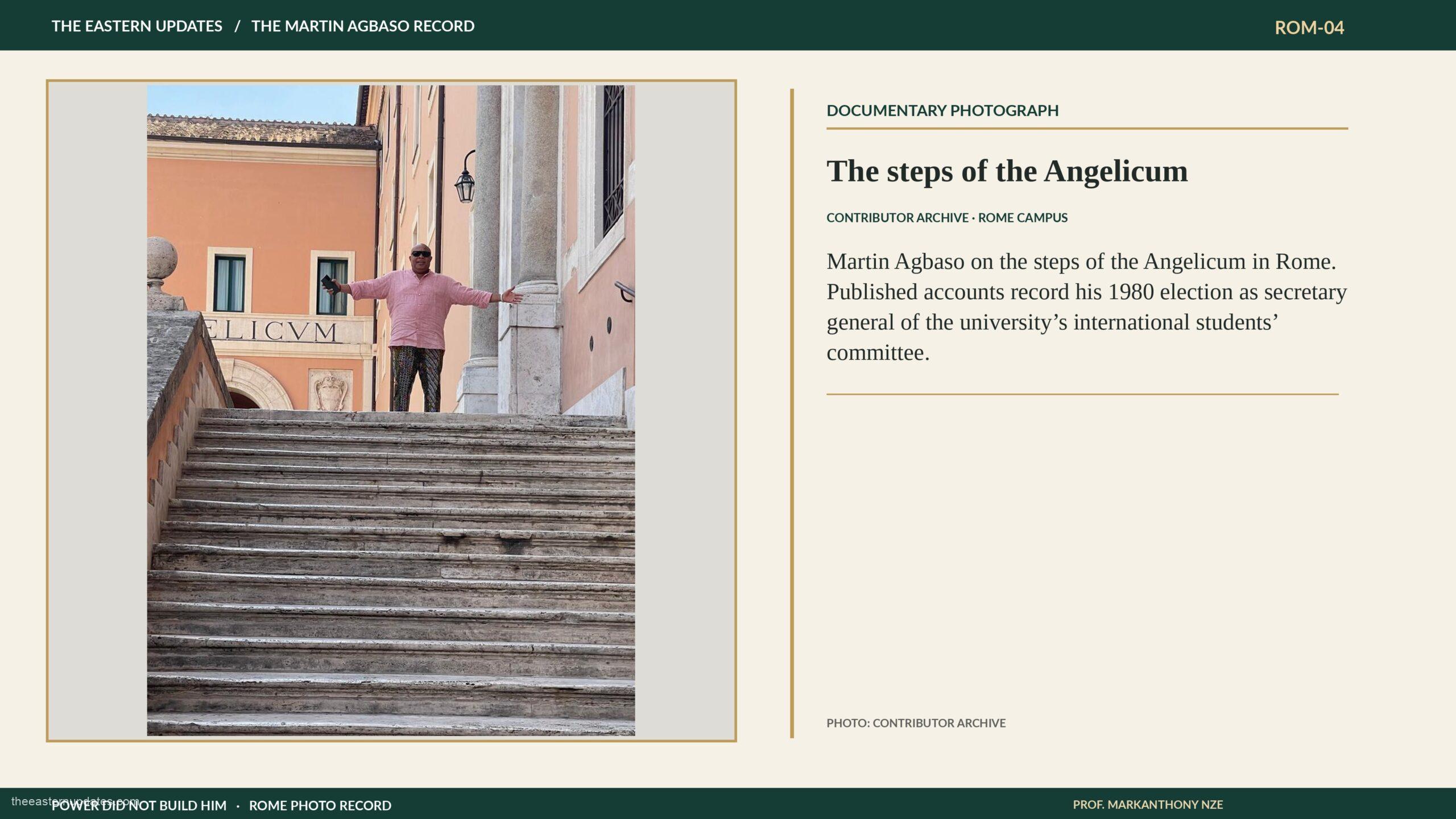
A photograph from Agbaso’s later return to the Angelicum adds a personal note to this chapter. Standing on the university steps, he revisits a place associated with his student years and the beginning of his professional preparation. The image connects the earlier educational journey with his continued public presence. Its place here is biographical, while the governing questions surrounding him concern budgets, institutional responsibility and the practical results expected from a public officeholder. [1][2]
History offers questions that deserve answers through conduct. Financial experience raises expectations about transparent budgets and the management of liabilities. Political disagreement makes the willingness to hear qualified criticism another relevant test. Neither type of experience supplies a verdict on what a future administration would accomplish. For Imo, the more useful prospect is a government prepared to publish its opening financial position, appoint capable commissioners, announce deadlines honestly and correct failing programs in time for citizens to see the difference. Agbaso’s record gives those expectations a substantive basis for examination. Should he govern, his case would be strengthened or weakened by the quality of the public results, rather than by the familiarity of his résumé or the strength of a campaign’s language.
References
[1] Nwafor. (2017, April 5). Chief Martin Agbaso MFR: A journey on courage and leadership. Vanguard.
[2] Nwafor. (2021, April 5). Chief Martin Agbaso: 62 cheers for Ochoudo. Vanguard.
[3] Nwosu, N. (2023, March 23). Race for Douglas House. ThisDay.
[4] Medeme, O. (2021, June 26). Martin Agbaso empowers Nigerian youths with agribusiness. Independent.
[5] Debt Management Office. (2026). Sub-national debts: States and FCT domestic debt stock as at June 30, 2026.
[6] Agbaso, M. (2026, June 21). A mandate delayed, not denied: My renewed commitment to the service of Ndi Imo [Signed statement].
[7] Aziken, E. (2013, December 17). Imo: The story of Okorocha’s betrayal, by Agbaso. Vanguard.
[8] Njoku, L. (2017, August 17). Appeal court restores Oye as APGA’s national chairman. The Guardian Nigeria.
[9] Onochie, B. C. (2018, July 14). APGA: Supreme Court affirms Oye as national chairman. The Guardian Nigeria.
Source note: dated press accounts identify the public chronology; official fiscal returns provide a financial starting point; court judgments are read for their findings. The Rome photo record accompanies the manuscript as a documentary account of Agbaso’s early study years and later visit to the Angelicum.