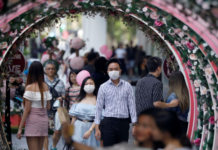



















Singapore’s Government Technology Agency, known as GovTech, has launched a state-run dating service for unmarried public officers aged 21 to 35, pairing participants with a single prospective partner selected through a mathematical formula designed to create stable matches. The pilot, called FirstDate, comes as Singapore confronts a record-low birthrate. Singapore
Participants verify their identities through Singpass, Singapore’s national digital identity system, and complete a survey covering interests, habits and values. Instead of the repeated swiping common on commercial dating apps, FirstDate presents each participant with one match at a time. Both people receive a text message when a pairing is made and have 72 hours to decide whether to connect.
The Eastern Update has gathered that profiles are visible only to the person selected as a match, while contact details are exchanged only if both participants agree. GovTech has also said public officers will not be matched with colleagues from their own agency. Sign-ups for the pilot closed Monday, and officials have not said whether the service will be expanded beyond the trial.
Read Also: Under-16 Social Media Ban Takes Effect In Indonesia
The matching system is based on the Gale-Shapley algorithm, developed by mathematicians David Gale and Lloyd Shapley. The work later formed part of the research recognized with the 2012 Nobel Memorial Prize in Economic Sciences. Versions of the algorithm are used to match students with schools and medical graduates with residency programs.
GovTech said the FirstDate idea emerged from an internal hackathon after staff questioned whether having access to a larger pool of possible partners necessarily made it easier to find a compatible one. The concept became public in April, when the agency surveyed single employees while developing an early version of the service.
The government restricted the pilot to unmarried public officers between 21 and 35 because it considered that group most likely to be actively dating and interested in trying the platform. The decision has attracted questions over the exclusion of people older than 35, particularly in a country where marriage and parenthood have increasingly been delayed.
Read Also: Emperor’s Great Aunt, Princess Mikasa, Dies At 101
The experiment comes as Singapore records the lowest fertility levels in its history. Preliminary government data show the resident fertility rate fell to 0.87 in 2025, down from 0.97 in 2024 and 1.24 a decade earlier. Resident live births also fell by 10.6% to 27,529.
Prime Minister Lawrence Wong announced a family support package in August valued by the government at nearly 70,000 Singapore dollars, or roughly $55,000, in direct assistance for each child. Deputy Prime Minister Gan Kim Yong warned in February that without intervention, the citizen population could begin shrinking in the early 2040s, increasing pressure on a smaller working population to support older residents.
Singapore has already relied heavily on immigration to offset demographic pressures. The government expects to take in between 25,000 and 30,000 new citizens annually over the next five years. FirstDate’s public description, however, frames its purpose as supporting singles in their dating journey rather than explicitly increasing the birthrate.
State involvement in matchmaking is not new. In 1983, founding Prime Minister Lee Kuan Yew warned that highly educated Singaporeans, especially women, were marrying later and having fewer children. His government subsequently introduced policies aimed at encouraging marriage among graduates and established the Social Development Unit to organize social events for single professionals. Critics accused the initiative of elitism, leading to the creation of a separate body for singles without university degrees.
Researchers and participants remain divided over whether FirstDate can succeed where conventional dating apps have struggled. Some Singaporeans have mocked the idea of government-assigned partners, while others see the single-match format as an interesting alternative to commercial platforms. Psychologist Jean Liu said questionnaires can only go so far in predicting whether two people will actually connect and warned that the system could struggle if too few people participate.
Other critics have argued that the deeper obstacles to dating in Singapore are economic rather than technological. High rents, expensive late-night transportation and restrictions on buying public housing can keep singles living with their parents into their 30s, potentially making it harder to establish independent households and relationships.
Government employee Jamie, who declined to give her last name, said she received an invitation but decided against participating because the idea sounded overly engineered. Another civil servant, using the pseudonym Nur Aisyah, said she joined out of curiosity after finding commercial dating apps such as Tinder and Bumble disappointing.
FirstDate’s website says participants’ profiles are visible only to their matches and that contact information is shared only when both sides agree. The platform also says participant data will not be monetized or shared with third parties except where required or permitted by law.