






|
Listen to article
|
After the courtrooms — What he did without office
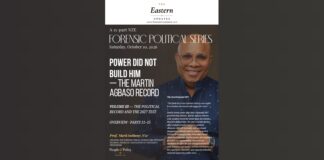
Martin Agbaso’s years outside elective office are examined through the political choices that shaped them: the 2011 APGA coalition, its painful collapse, a disputed party chairmanship, renewed commercial work, and his later participation in Labour Party politics.
“Public life did not end when the courtrooms closed.”
A governor’s term leaves budgets, cabinet decisions and laws against which a public career can be measured. The years after an unsuccessful contest leave a different record. They must be reconstructed through alliances formed, conflicts confronted, work undertaken and commitments maintained when the authority of office is absent. Martin Agbaso’s history after 2007 calls for that more careful accounting.
He did not retreat into private life after the governorship dispute. Instead, he took part in a coalition that won power for another politician, fell out with former allies, entered a struggle over leadership of a national party and pursued work outside government. None of those events amounts to an administration of his own. All are relevant to the less visible business of political judgment: deciding whom to trust, when to compromise and how to proceed after a reversal.
PLAIN-ENGLISH BRIEF
Agbaso’s post-2007 record includes support for the 2011 APGA governorship coalition, a public break with Rochas Okorocha, court decisions arising from APGA’s leadership struggle, business activity and a later Labour Party alignment. His 2026 declaration presents those years as preparation. The public chronology allows readers to examine the choices behind that description rather than treating a long absence from elective office as either an achievement or a failure in itself.
2011 — influence without the ticket
In a 2013 Vanguard interview, Agbaso described financing, fundraising and canvassing for the APGA coalition that brought Rochas Okorocha to office in 2011. It is his account of his participation, not a statement of campaign expenditures independently reconciled to bank records. Even so, it places him in the demanding position of helping another candidate reach an office he had previously sought for himself. [1]
Their alliance subsequently broke in a bitter public dispute, sharpened by the 2013 impeachment of Agbaso’s brother Jude as deputy governor. Agbaso accused Okorocha of betraying their political understanding. The rupture raises the question that matters here: what did the experience teach him about the difference between a useful alliance and an agreement capable of surviving the pressures of government?
Read also: Power Did Not Build Him — The Agbaso Record, Vol. II Part 11
2017 — a national party fight
A leadership contest within APGA brought Agbaso to national attention again in 2017. An Enugu High Court decision favored his side, but the Court of Appeal restored Victor Oye after finding that the proceedings had denied Oye the hearing to which he was entitled. The Supreme Court affirmed Oye in July 2018. Agbaso’s continued participation was unmistakable; so was the final legal outcome. [2][7]
Political influence is not identical to political judgment. This episode shows familiarity with party organization and the ability to attract support, but it also shows why procedural fairness cannot be treated as a detail when leadership is disputed. The more useful lesson for an executive aspirant lies in the capacity to respect institutions even when their decisions close a preferred route.
2018 to 2022 — another political home, and visible work
A further change of political home followed. Vanguard’s 2021 profile records Agbaso’s move to the APC in November 2018 and his involvement in the political activity surrounding the next election cycle. Party labels changed, but his willingness to enter consequential contests did not. [3]
His work outside party politics also remained public. Reporting in 2021 described his advocacy of agribusiness and training for young people at Agbaso Integrated Farms in Emekuku. The employment figures and farm operations have been examined separately in Volume II. Here the important fact is continuity of economic engagement during years that held no elective title for him. [4]
ThisDay later reported that he gave his Owerri campaign office to the Labour Party in June 2022 and associated himself with the Obidient movement. The publication also connected that turn to the Unite Nigeria Group. Political movement of this kind invites a fair question about consistency, but a change of party is more informative when considered alongside the purposes for which alliances were formed and the commitments that survived them. [5]
Read also: Power Did Not Build Him — The Agbaso Record, Vol. II Part 10
2026 — asking the intervening years to carry weight
In his signed declaration of June 21, 2026, Agbaso described listening to people across Imo and the diaspora during the years after his earlier campaign. Those are his stated recollections. Their significance rests less in the breadth of the groups named than in the public decisions and activities through which such listening could influence policy. [6]
A long period outside office exposed him to different circumstances from those faced by an incumbent. He could act, argue and undertake commercial ventures without commanding an appropriation or directing the civil service. That freedom does not establish capacity to govern; it does help explain why his experience should be judged through the decisions he made rather than through the offices he did not hold.
For a new administration, the value of this history would depend on lessons carried forward: resisting bargains that compromise public duties, accepting adverse judgments, distinguishing political allies from qualified officials and keeping economic commitments through difficult periods. Agbaso’s claim deserves to be tested on those terms, not on a sentimental account of the time he spent away from Government House.
Where the record stands
The record between 2007 and 2026 contains influence, reversals, enterprise and political change. Its very unevenness makes it useful evidence. Part 13 now puts the consequences of those choices beside the strengths of Agbaso’s professional life, asking what a complete political balance sheet should credit and what it must debit.
FULL EVIDENCE DOCKET
The companion three-page evidence docket places the principal claims in Part 12 beside the public records that support them and preserves the evidentiary limits stated in the article.
SOURCE REGISTER · PART 12 · SOURCE NOTES
Sources are numbered within each installment. The companion evidence docket contains claim-level records and direct source links.
1. Aziken, E. (2013, December 17). Imo: The story of Okorocha’s betrayal, by Agbaso. Vanguard.
2. Njoku, L. (2017, August 17). Appeal court restores Oye as APGA’s national chairman. The Guardian Nigeria.
3. Nwafor. (2021, April 5). Chief Martin Agbaso: 62 cheers for Ochoudo. Vanguard.
4. New Telegraph. (2021, June 19). Martin Agbaso champions wealth creation through agribusiness.
5. Nwosu, N. (2023, March 23). Race for Douglas House. ThisDay.
6. Agbaso, M. (2026, June 21). My renewed commitment to the service of Ndi Imo [Signed statement].
7. Onochie, B. C. (2018, July 14). APGA: Supreme Court affirms Oye as national chairman. The Guardian Nigeria.
RIGHT OF REPLY
Any person or institution named in this installment may respond in writing to [email protected]. Material responses are published separately or appended to the installment, with the date of receipt recorded.