














|
Listen to article
|
Enterprise, payroll, and human consequence
Publicly accessible accounts date the AGAD Foundation to 1993, say it trained more than 318 students, describe hospital relief and support for places of worship, and trace later youth initiatives into skills, employment and agriculture. Part 9 asks what that long private-resource record contributes to the case for public leadership.
Illness makes money brutally immediate. A hospital bill does not wait for a manifesto, and the person helped may never want a photograph taken. Vanguard’s 2021 profile says the AGAD Foundation routinely paid hospital bills for indigent people, mostly widows with medical challenges. Four years earlier, the same newspaper described much of Agbaso’s community giving as anonymous. Those two details belong together: help can be real without being staged. [1][2] [Reported] [Inference]
The published social record around Martin Agbaso is broader than one kind of assistance. Vanguard dates the AGAD Foundation to 1993 and says it trained more than 318 students in secondary and tertiary institutions. It dates the 3C Club to 2002 and Group MA to 2005. Independent later reported agricultural training and about 600 direct jobs at Agbaso Integrated Farms in 2021. The public evidence is not a single photograph or a single campaign-season donation. It is a chronology spread across years, institutions and kinds of need. [2][3] [Reported] [Inference]
What the public record actually says
Vanguard’s April 2021 profile is the most specific source. It describes AGAD Foundation as a nonprofit organization founded in 1993 and says that, through the foundation, Agbaso had trained more than 318 students in secondary and tertiary institutions. The wording matters. The source says trained; this installment keeps that wording and does not substitute another form of educational assistance the article itself does not state. [2] [Reported]
The same profile says the foundation routinely paid hospital bills for indigent people, mostly widows with medical challenges, and that Agbaso built several places of worship for the Catholic Church and other denominations. Those are distinct forms of assistance, and they can be stated as boldly as the source states them because the article remains publicly accessible. [2] [Reported]
Vanguard’s 2017 profile supplies the wider community description. It says his foundation for orphans, less privileged people and widows in Imo State had touched many lives and associates him with churches, chapels, facilities and cash donations, much of it done anonymously. The article is promotional in tone, but the claims it makes are explicit and public; that is the evidentiary status used here. [1] [Reported] [Inference]
Forensic reporting earns its authority by keeping every claim inside the wording its source can carry: students trained, hospital bills paid, places of worship built, assistance described for widows and less privileged people, and later youth programs reported by name. [1][2] [Reported] [Inference]
A chronology longer than a political season
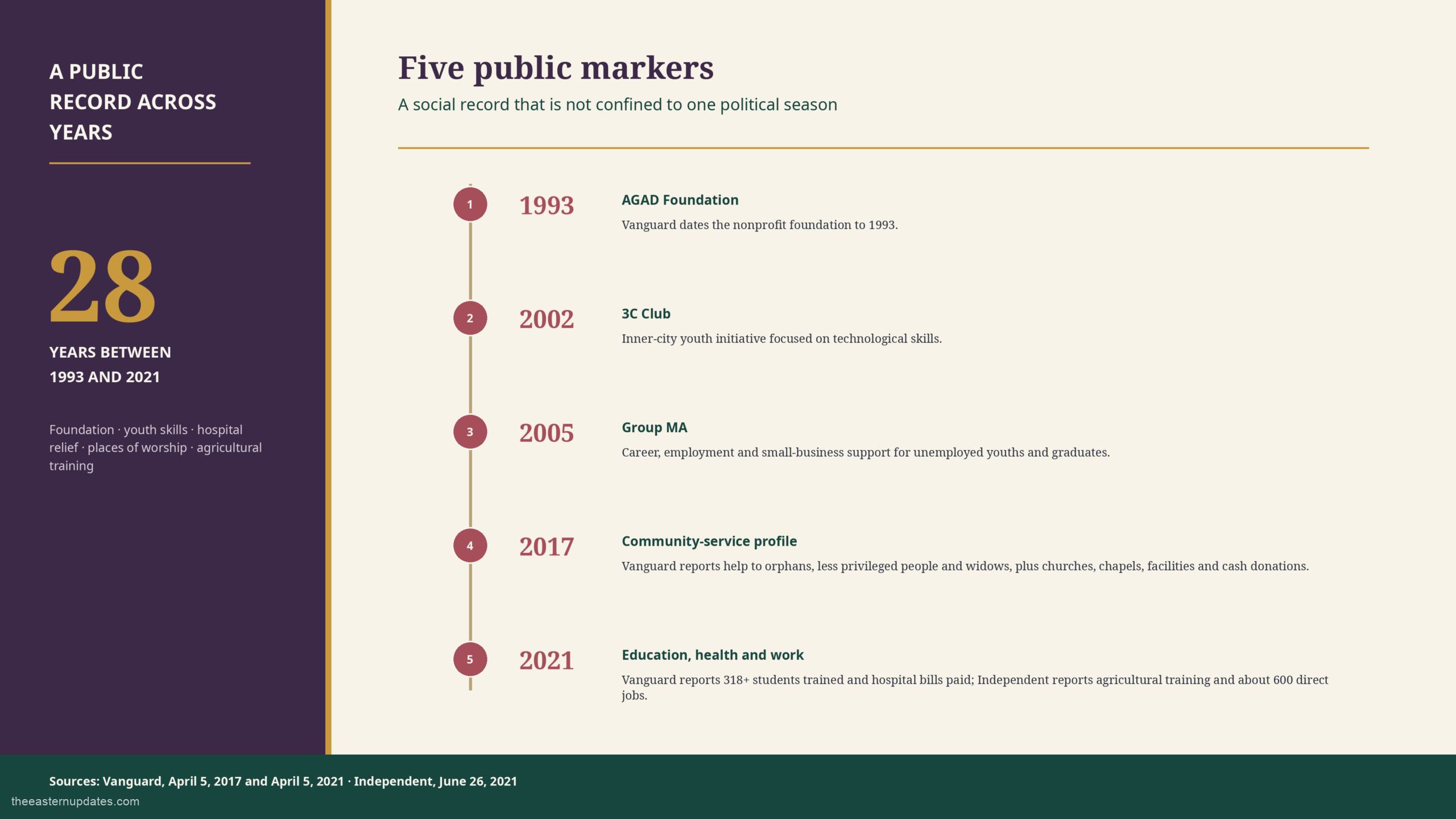
Dates give the giving record its shape. The foundation is dated to 1993. The 3C Club is dated to 2002 and described as helping inner-city youths acquire technological skills. Group MA is dated to 2005 and described as guiding unemployed youths and graduates toward career choices, employment and small businesses. Vanguard published the broader community-service account in 2017 and the more detailed foundation account in 2021. [1][2] [Reported]
Agbaso had already entered electoral politics in 1992, so the strongest argument is not that all of this preceded political ambition. The stronger, more accurate point is that the public record of private giving and youth support stretches across nearly three decades and cannot be reduced to one campaign cycle. That distinction matters because continuity is more persuasive than timing a charitable gesture to an election. [1][2] [Reported] [Inference]
The chronology also fits the wider theme of this volume. Parts 6 through 8 followed companies, branches and employment. Part 9 shows the same private-resource biography moving in another direction: from capital and payroll toward health, education, worship, skills and opportunity. The political case is not charity in place of policy. It is evidence of what a person chose to notice without controlling a state budget. [Inference]
Giving without spectacle
Anonymous charity has a moral logic. A widow receiving help with a medical bill should not have to surrender her dignity for the donor to establish a reputation. A family facing hardship should not become campaign scenery. Vanguard’s 2017 description that much of Agbaso’s giving was done anonymously is therefore not a weakness in the public account; it is part of the character the article attributes to the giving. [1] [Reported] [Inference]
Public leadership still permits a disciplined distinction between privacy and proof. Institutions can confirm that a program existed, that a facility was built or that assistance was provided without publishing private medical histories or turning beneficiaries into props. The point is not to expose the person helped. It is to state with precision what the public record already establishes and leave private dignity intact. [Inference]
That approach suits Agbaso’s case because the strongest public claims do not depend on emotional testimony from vulnerable people. The dates and programs are already in print: 1993, 2002, 2005, 2017 and 2021. The work now is to read those dates correctly, not to demand that private hardship be made public before generosity is taken seriously. [1][2] [Reported] [Inference]
Beyond relief: skills and work
Relief answers an immediate need; skills and employment can change the next decade. Vanguard says the 3C Club helped inner-city youths acquire technological skills. It says Group MA guided unemployed youths and graduates toward careers, employment and small businesses. Those initiatives broaden the meaning of the philanthropy record because they are about capacity, not only rescue. [2] [Reported] [Inference]
Independent’s June 2021 report belongs beside that history but should remain attached to the business that source actually names. It reported that Agbaso Integrated Farms was conducting multi-level training and empowerment of young people in agriculture, with a stated goal of reaching thousands, and that the 35-hectare Emekuku farm had created about 600 direct jobs, especially for young people. That is an enterprise-and-training account, not an AGAD Foundation claim. [3] [Reported]
Keeping those programs separate makes the overall story stronger. One strand concerns a nonprofit foundation and community assistance. Another concerns youth skills initiatives. A third concerns a commercial farm creating jobs and training young people in agriculture. Together they show private resources being used in different ways rather than one program being stretched to carry every claim. [1][2][3] [Reported] [Inference]
What Imo can put to work
Personal generosity is not a substitute for government. A governor must build systems in which a child’s education, a patient’s treatment and a young person’s chance to work do not depend on finding a benefactor. That is precisely why the political meaning of a philanthropy record must be stated carefully. [Inference]
What it can reveal is disposition. The accessible accounts repeatedly place Agbaso’s private resources near the points where economic pressure becomes human consequence: students, widows with medical challenges, places of worship, inner-city youths, unemployed graduates and young people entering agriculture. The pattern is not proof of a governing program; it is evidence of what kinds of needs his public biography says he repeatedly chose to address. [1][2][3] [Reported] [Inference]
Agbaso’s case is strongest where enterprise, employment and giving meet. The same public chronology that places him in business before his later federal appointment also describes hundreds of jobs, a foundation dated to 1993, youth initiatives in 2002 and 2005, hospital relief and agricultural training. The wealth story therefore does not end with possession. In the published record, money is repeatedly shown doing work: financing enterprise, sustaining employment and reaching social need. [1][2][3] [Reported] [Inference]
That combination gives the candidacy a distinctive economic argument without requiring a slogan. Imo is not being asked to admire wealth for its own sake. The more serious question is what a person has done with resources before asking to control public ones. On the accessible record, Agbaso can answer that question with businesses, jobs, training, health assistance, places of worship and a social-service chronology that stretches across years. [1][2][3] [Reported] [Inference]
Part 10, “The Senate that never sat,” turns from private resources to the ballot box and the mandate the 1998 transition did not allow to mature into service. [Reported]
| PLAIN-ENGLISH BRIEF |
| Vanguard dates AGAD Foundation to 1993 and says it trained more than 318 students in secondary and tertiary institutions. It also reports hospital bills paid for indigent people, many of them widows, and support for places of worship. The same source dates the 3C Club to 2002 and Group MA to 2005. Independent separately reported in 2021 that Agbaso Integrated Farms was training young people in agriculture and had created about 600 direct jobs. The programs remain distinct, but together they give the public record a social history that reaches well beyond a single political season. |
| EVIDENCE DOCKET |
|
Public record: Vanguard, April 5, 2017 — assistance to orphans, less privileged people and widows, churches, chapels, facilities and cash donations, much of it anonymous. Vanguard, April 5, 2021 — AGAD Foundation founded in 1993, more than 318 students trained, hospital bills paid for indigent people, places of worship built, 3C Club founded in 2002 and Group MA in 2005. Separate enterprise record: Independent, June 26, 2021 — agricultural training and empowerment at Agbaso Integrated Farms and about 600 direct jobs. The article keeps the word “trained” exactly as Vanguard states it and does not merge the farm program into AGAD Foundation. |
| RIGHT OF REPLY |
| Any person or institution named in this installment may respond in writing to [email protected]. Material responses are published separately or appended to the installment, with the date of receipt recorded. Corrections should identify the affected passage and provide the supporting record. |
Source notes
Documented identifies a statute, regulator or institutional record inspected for this installment. Reported identifies a statement in a named public source. Inference identifies the author’s reasoned assessment from those records.
[2] Nwafor. (2021, April 5). Chief Martin Agbaso: 62 cheers for Ochoudo. Vanguard. E-05.
[3] Medeme, O. (2021, June 26). Martin Agbaso empowers Nigerian youths with agribusiness. Independent.