






|
Listen to article
|
The balance sheet
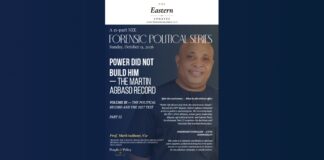
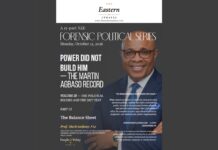
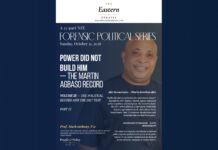
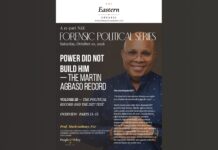
A long career ought to be examined as an account of decisions, not a collection of flattering statistics. Part 13 weighs the responsibilities Martin Agbaso has carried alongside the political reversals and limitations that matter to executive office.
“An honest balance sheet counts the losses.”
A balance sheet becomes useful at the point where reputation runs out of room. Assets that look imposing in a brochure may be encumbered; promising ventures can absorb resources for years before they yield a return. Political lives deserve the same discipline. In Martin Agbaso’s case, the record contains enterprise, professional formation and hard political experience, but it also contains alliances that broke and decisions that did not survive the courts.
Earlier volumes examined the institutions, businesses and public claims individually. Repeating their figures here would add pages, not insight. The task is to weigh different kinds of responsibility against one another: the discipline learned under supervision, the discretion required when private money is at risk, and the restraint demanded when a politician confronts an institution he cannot control.
Read also: Power Did Not Build Him — The Agbaso Record, Vol. II Part 11
PLAIN-ENGLISH BRIEF
Agbaso’s record joins international education, financial work, enterprise and repeated political involvement. The question is how those experiences bear on executive judgment. Private achievements deserve consideration; adverse decisions and the absence of a governorship record deserve equal clarity. This installment weighs what those episodes reveal about responsibility, not the number of times his biography has been retold.
The education that preceded the argument
Agbaso’s early studies in Rome belong to the beginning of the account because they placed him in a community of students from different countries before he entered Nigerian party politics. Vanguard describes his election to a leadership role among international students at the Pontifical University of Saint Thomas Aquinas. The experience matters less as an honorific than as early exposure to persuasion, disagreement and confidence earned beyond the familiar circles of home. [1][2][9]
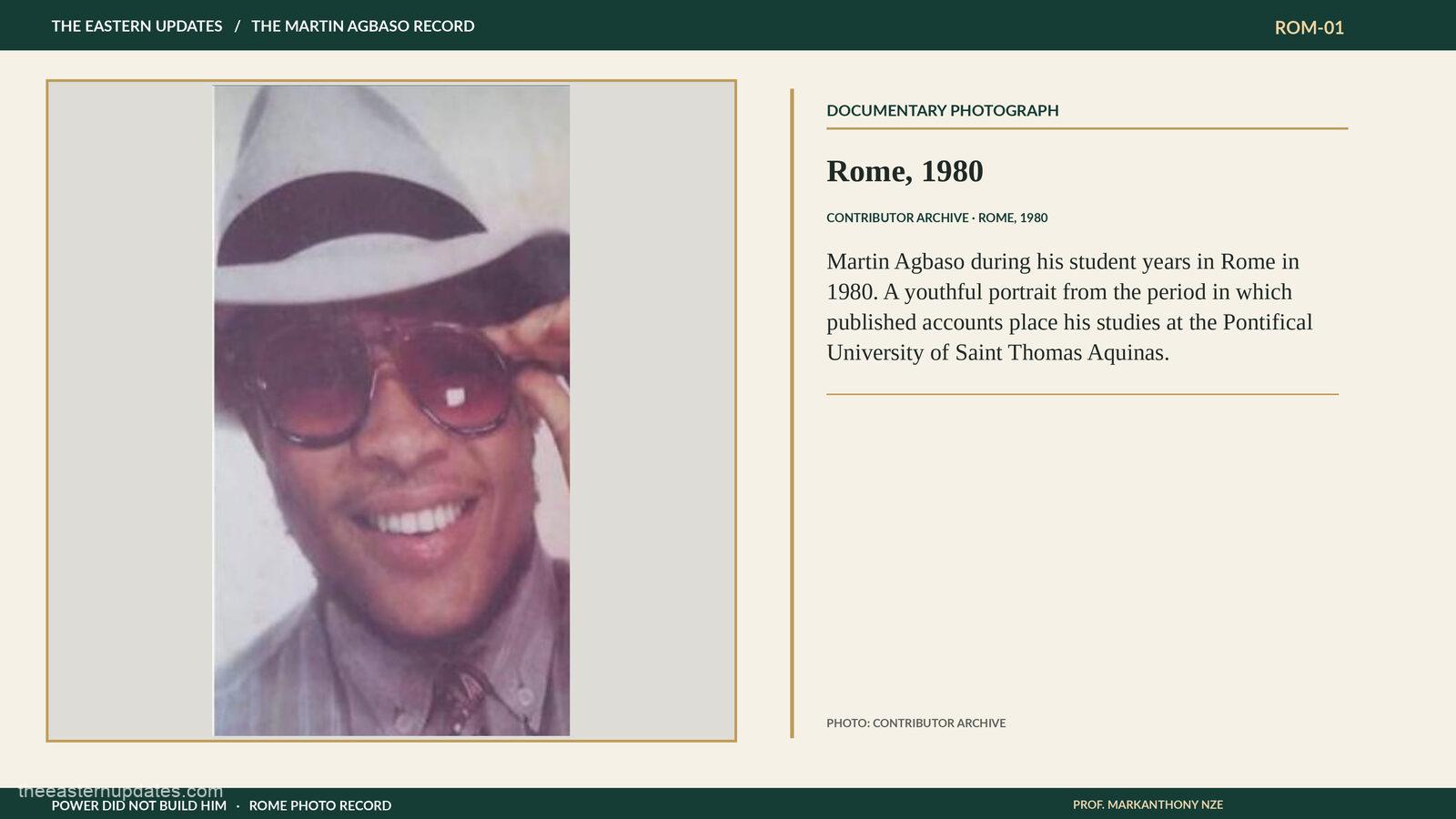
The photographs make that passage tangible. A student portrait from 1980 is followed by images of a later return to the Angelicum, including a visit with his grandson. Two generations appear against a place associated with the beginning of his adult education. That continuity has human meaning without needing an inflated claim about what a photograph itself accomplishes. [1][2][9]
Paid professional work brought a different discipline. A financial employee answers to standards and deadlines set by others; an entrepreneur has to make decisions with consequences for people whose wages or livelihoods depend on the business. Those experiences cannot certify political wisdom, but they place Agbaso’s preparation in settings where failure carries costs beyond personal embarrassment. [1][2]
Read also: Power Did Not Build Him — The Agbaso Record, Vol. II Part 12
Private obligations, public consequences
The employment and commercial records were examined in Parts 6–9, where the source dates and company boundaries belong. Their importance to the final assessment is neither a headline number nor a claim of flawless management. It is the recurring character of the work. A business must collect enough to meet commitments already made, and the person directing it has to confront the consequences of delay. That is practical knowledge worth testing against a public budget.
His community activities raise another kind of responsibility. Private assistance is voluntary and often personal; government service is owed to residents regardless of their ability to pay or their relationship with the officeholder. The social record may indicate what problems attracted his attention, but it cannot replace an answer about how a state would finance and deliver services as a matter of right. [2]
Taken on their proper terms, enterprise and community engagement show experience with two different uses of resources: keeping an organization operating and responding to human need. The political issue is whether the judgment developed in those settings would survive public procurement rules, open budgets and scrutiny from people who did not choose the governor. A balance sheet that makes that distinction is more persuasive than one that treats every activity as evidence of success.
What the electoral record leaves behind
Imo East’s reported 1998 Senate result and the 2007 governorship cancellation have been reconstructed earlier in this series. Neither should be made to carry a claim it cannot support. One belonged to an abandoned military transition; the other generated litigation in which jurisdiction proved decisive. The proper credit is long electoral engagement under difficult conditions, not an executive or legislative tenure that never followed. [1][2][4]
Political disappointment also tests how a person speaks about power. Agbaso’s later statement emphasizes preparation rather than revenge. Readers may consider that declared intention alongside his conduct after the disputes, without treating an assertion of restraint as a substitute for the restraint itself. [8]
His years of campaigning give him familiarity with public expectations and political pressure, yet they leave an important blank: no administration of Imo for readers to audit. The final assessment must therefore distinguish what is known about his decisions outside elective office from what remains a prospective judgment about his ability to manage one.
The cost of an alliance
Agbaso’s participation in the coalition that elected Rochas Okorocha shows an ability to commit political resources and support another candidate. The later rupture carries the other side of that choice. Coalition-building can be a strength, but the capacity to judge partners, preserve lawful agreements and withdraw from a failed political arrangement without damaging institutions matters just as much. [3]
The APGA leadership litigation makes the lesson sharper. Court rulings ultimately left Victor Oye in the chairmanship position, with the Supreme Court’s 2018 decision ending the appeal associated with Agbaso’s faction. His continued presence in party politics is part of the record; accepting the finality of an adverse decision is part of the responsibility that record invites us to examine. [5][11]
A politician with decades of relationships may know how to negotiate, mobilize and settle disputes. Such skills are valuable only if the public interest remains distinct from personal loyalty. What appears in this ledger is not a verdict on every alliance but a serious set of experiences through which judgment can be assessed. [7]
What an executive must disclose
The June 2026 declaration promises improvement in services and economic opportunity. It gives an incoming administration a practical obligation: publish the inherited fiscal position, identify the cost of each priority, and assign responsibility for results. Official fiscal returns, including the Debt Management Office’s state-debt figures, provide a starting point. They do not turn a candidate’s experience into accomplished government. [8][10]
Imo’s budget belongs to residents who may never have been customers of any Agbaso enterprise. Lawful purchasing, civil-service protections, legislative review and independent audit change the ground on which decisions must be defended. The same financial instinct that notices an unpaid bill must accept that public money carries claims no private proprietor is free to disregard.
There is substance in Agbaso’s record precisely because it was formed in different settings and tested by reversals. The credit side contains work and responsibilities outside government; the debit side includes broken alliances, adverse litigation and the absence of an administration available for assessment. Neither side deserves to be hidden. A credible political balance sheet asks whether the whole account supports careful executive judgment, not whether the candidate can be presented without losses.
FULL EVIDENCE DOCKET
The three-page companion docket contains the legal, business and political source register. The separate Rome photographic record presents Agbaso’s 1980 portrait, his return to the Angelicum and photographs with his grandson.
PART 13 · SOURCE NOTES
[1] Nwafor. (2017, April 5). Chief Martin Agbaso MFR: A journey on courage and leadership. Vanguard.
[2] Nwafor. (2021, April 5). Chief Martin Agbaso: 62 cheers for Ochoudo. Vanguard.
[3] Aziken, E. (2013, December 17). Imo: The story of Okorocha’s betrayal, by Agbaso. Vanguard.
[4] Chief Ikedi Ohakim v. Chief Martin Agbaso & Ors. (2010), Supreme Court of Nigeria, SC.3/2010 (consolidated).
[5] Njoku, L. (2017, August 17). Appeal court restores Oye as APGA’s national chairman. The Guardian Nigeria.
[6] Medeme, O. (2021, June 26). Martin Agbaso empowers Nigerian youths with agribusiness. Independent.
[7] Nwosu, N. (2023, March 23). Race for Douglas House. ThisDay.
[8] Agbaso, M. (2026, June 21). A mandate delayed, not denied: My renewed commitment to the service of Ndi Imo [Signed statement].
[9] Pontifical University of Saint Thomas Aquinas. (2026). Our campus. Angelicum.
[10] Debt Management Office. (2026). Sub-national debts: States and FCT domestic debt stock as at June 30, 2026.
[11] Onochie, B. C. (2018, July 14). APGA: Supreme Court affirms Oye as national chairman. The Guardian Nigeria.
Source note: public reports are attributed to their publishers; court decisions are described by their holdings; the candidate’s signed declaration records his stated program. The Rome photo record preserves the contributor’s pictures, the 1980 portrait, the return to the Angelicum and the official university campus view.
STANDING RIGHT OF REPLY
Any person, institution, campaign, or reader named in this installment may submit a documentary correction or substantive response to [email protected]. Material replies may be appended or published separately with their receipt dates recorded.