













|
Listen to article
|
Enterprise, payroll, and human consequence
Three publicly accessible reports place employment in the hundreds across enterprises associated with Martin Agbaso. Part 8 reads each figure in its stated scope, sets that scale against Nigeria’s employer obligations and asks what sustained private enterprise contributes to the judgment expected of a governor.
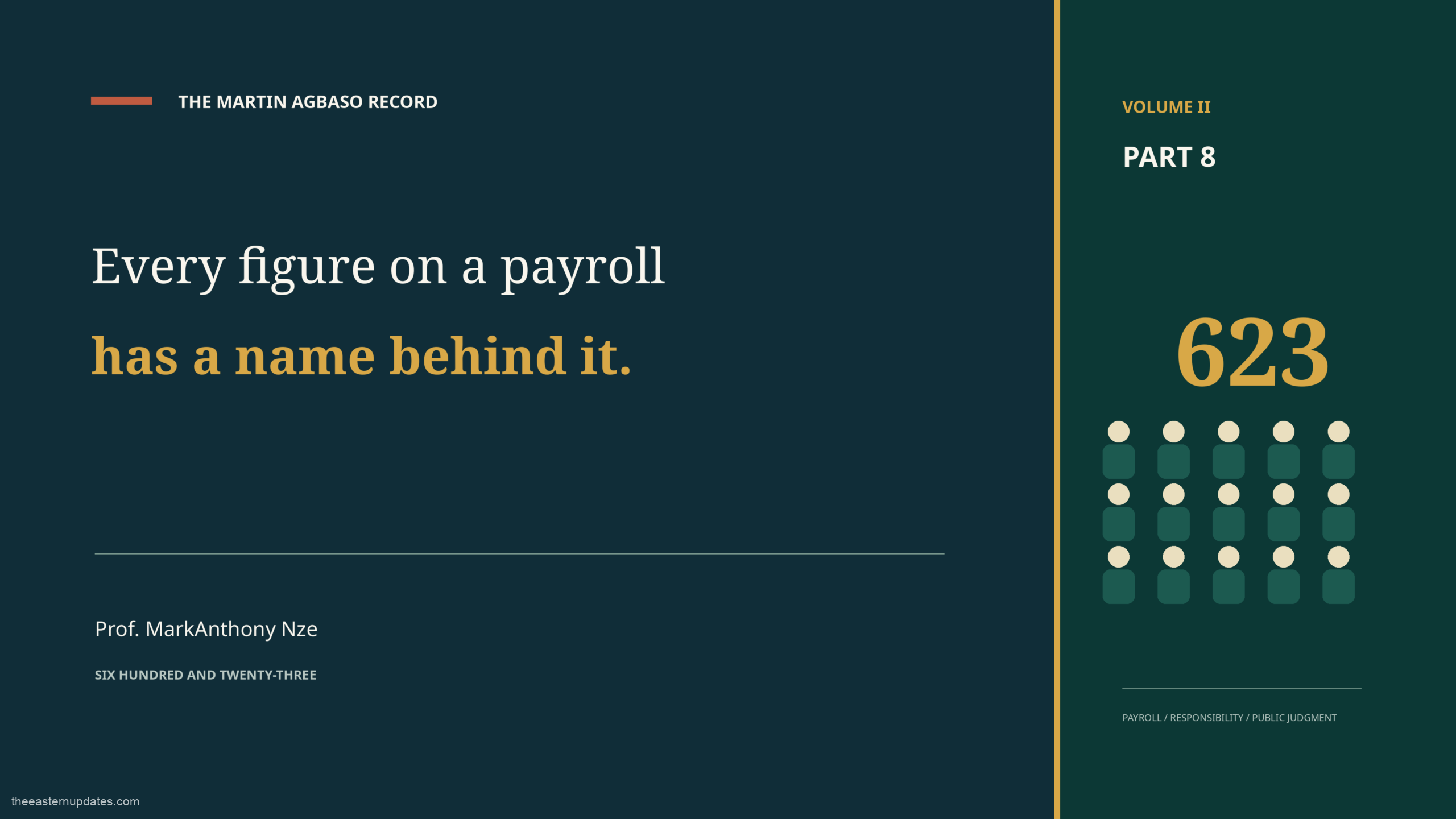
Before a salary reaches a bank account, it has already been divided at a kitchen table. Rent has a date. Tuition has a deadline. Transport, food and medicine do not wait for an employer’s cash flow to improve. A wage is therefore more than a business expense; it is a promise around which another household has arranged its month. [Inference]
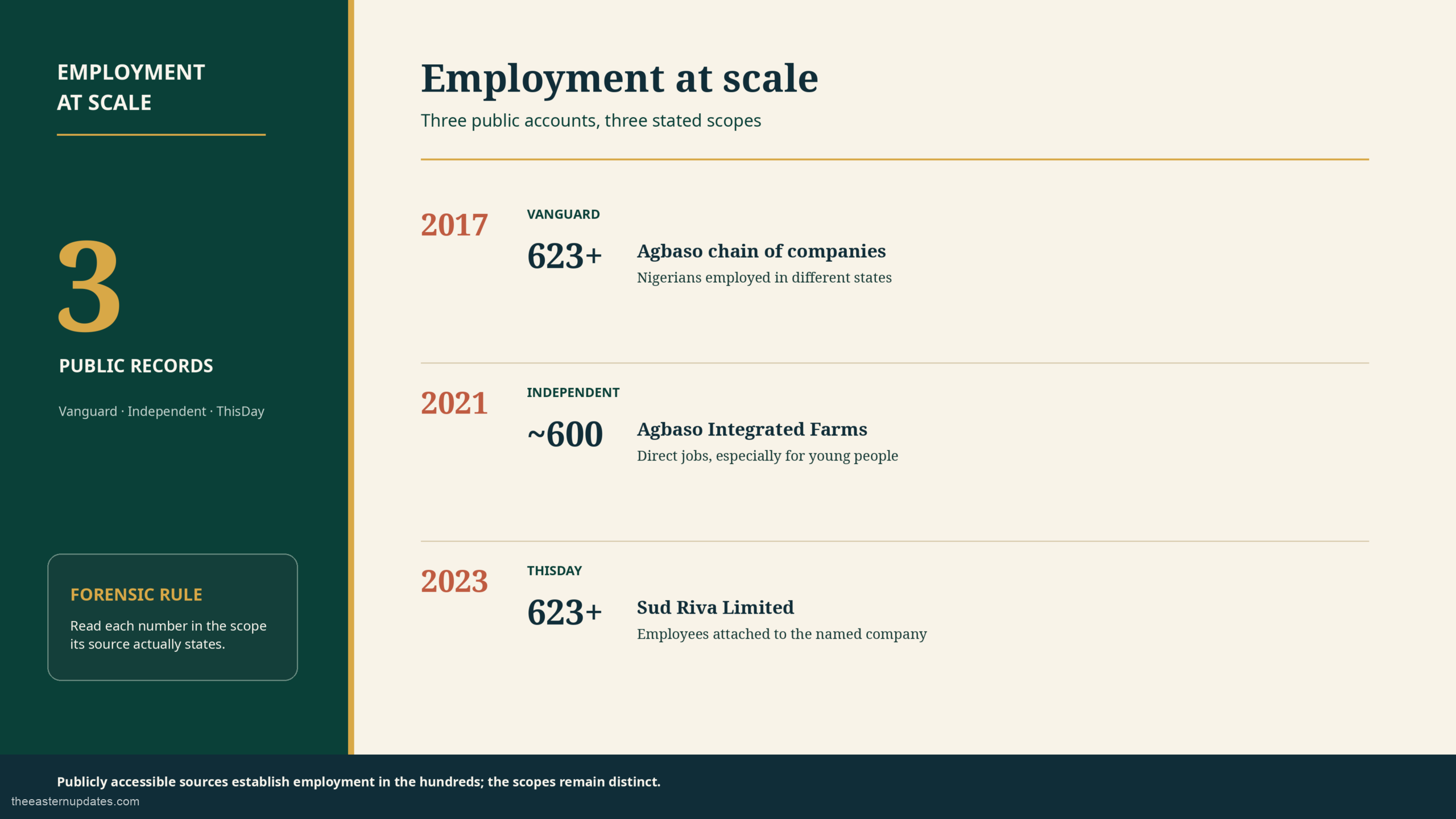
That is the human meaning behind the workforce figures attached to Martin Agbaso’s business history. Vanguard reported in 2017 that his chain of companies employed more than 623 Nigerians in different states. Independent reported in 2021 that Agbaso Integrated Farms had created about 600 direct jobs, especially for young people. ThisDay reported in 2023 that Sud Riva Limited employed more than 623 Nigerians. The publications describe different entities and different dates, but they agree on one point that matters: employment associated with his private-enterprise record was being described in hundreds, not in handfuls. [1][2][3] [Reported] [Inference]
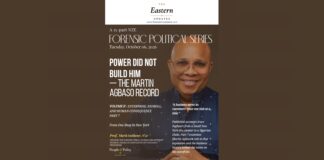
Read also: Power Did Not Build Him — The Agbaso Record, Vol. II Part 7
Three public workforce accounts
Vanguard’s April 2017 profile gives the broadest description. Its wording is group-wide: Agbaso’s chain of companies, it said, employed more than 623 Nigerians in different states of the federation. The source is public, dated and still accessible; the scope stated by the article is the chain of companies rather than one named firm. [1] [Reported]
Independent supplied a different number and a different business in June 2021. Its report on Agbaso Integrated Farms said the 35-hectare Emekuku operation had created about 600 direct jobs, most especially for young people, while conducting multi-level agricultural training and empowerment. That figure belongs to the farm account and should remain there. [2] [Reported]
ThisDay’s March 2023 feature supplied the third public statement. It identified Agbaso as executive chairman of Sud Riva Limited and said the company, active in construction, oil and gas, and marine ropes, was employing more than 623 Nigerians. Its wording is narrower than Vanguard’s 2017 wording because it attaches the number to Sud Riva Limited itself. [3] [Reported]
Forensic reporting does not improve these sources by forcing them into one total. It improves them by preserving their dates, entities and wording. The two references to more than 623 cannot be added to the farm’s roughly 600 jobs, and the group-wide 2017 description cannot simply be treated as identical to the Sud Riva description in 2023. Read correctly, the public record is already substantial: three published accounts, over six years, place employment in the hundreds across Agbaso-linked enterprise. [1][2][3] [Reported] [Inference]
What the law makes concrete
Employment at that scale is not an ornamental line in a biography. It carries recurring duties. Nigeria’s National Minimum Wage Act, as amended in 2024, sets the national minimum wage at ₦70,000 a month for workers to whom the Act applies. The statute retains exemptions including establishments with fewer than 25 employees, part-time work, commission or piece-rate work and seasonal employment such as agriculture. A workforce stated in the hundreds sits far beyond the small-establishment exemption wherever the workers fall within a covered employing entity. [4] [Documented] [Inference]
Pension law adds another layer, and the public materials contain an important distinction worth stating rather than concealing. Section 2(2) of the published Pension Reform Act 2014 says the compulsory scheme applies in the private sector to organizations with 15 or more employees. PenCom’s later operational materials, including its Micro Pension materials and a 2023 compliance notice, describe employers with three or more employees as subject to remittance obligations. A workforce measured in hundreds exceeds either threshold, so the difference does not alter the relevance of pension administration to the businesses described here. [5][6][7] [Documented] [Inference]
Where the scheme applies, the Act sets minimum pension contributions of 10 percent by the employer and 8 percent by the employee, with remittance not later than seven working days after salary payment. NSITF currently states that the Employees’ Compensation Scheme is funded by employers at one percent of total monthly payroll and covers workplace injury, occupational disease, disability and death. Those are not campaign abstractions. They are the recurring disciplines attached to employing people at scale. [5][8] [Documented] [Inference]
None of these laws is used here to pronounce on the compliance history of a particular Agbaso-linked company. Their relevance is more exact: they show what the word employer means once headcount moves into the hundreds. Payroll is accompanied by pensions, compensation, workplace obligations, records and deadlines. The public employment figures therefore describe responsibility, not simply size. [Inference]
The chronology behind the money
The chronology gives the employment story its political force. Vanguard’s 2017 profile dates AGAD Nigeria Limited to 1992, SudRiva Construction Company Limited and SudRiva Oil and Gas Limited to 1994–1995, and Agbaso’s acquisition of controlling equity in Nathan’s to 1997. The same profile places his federal appointment as Special Assistant on Ecology later, from 2001 to 2004. Whatever one ultimately concludes about the value of the businesses, the published sequence places major private-enterprise activity before that federal appointment and decades before the present governorship contest. [1] [Reported] [Inference]
That sequence matters in Imo because it changes the order of the usual political story. Public office is not presented as the beginning of the commercial biography. Companies, customers, employees and operating risks appear earlier. The argument for Agbaso is therefore not that business experience makes a governor automatically competent; it is that he comes to the treasury debate with a long public history of trying to make money work outside the treasury. [Inference]
An employer who has had to generate revenue before meeting recurring obligations encounters a discipline different from spending a monthly allocation. Receivables arrive late. Equipment fails. Customers leave. Suppliers demand payment. Workers still expect wages on the agreed day. The habit of matching obligations to cash is not the whole of public finance, but it is a useful preparation for it. [Inference]
What a governor inherits
A state payroll is not a private company’s payroll enlarged. Government cannot choose only profitable customers, abandon an unprofitable hospital or school, or treat essential services as optional business lines. Public employment brings civil-service rules, unions, pensions, procurement controls and constitutional duties that no proprietor faces in the same form. [Inference]
The distinction does not make private experience irrelevant; it makes the transferable lesson more precise. Business teaches that expansion without working capital can destroy a healthy operation, that poor supervision becomes expensive before it becomes visible, and that a delayed payment at the top of an organization becomes a personal crisis at the bottom. Those lessons belong inside a governor’s judgment. [Inference]
Agbaso’s case gains practical weight here. The accessible public record does not present him only as a man who accumulated assets. It repeatedly associates his enterprises with people at work: more than 623 Nigerians across a chain of companies in one account, about 600 direct jobs at the Emekuku farm in another, and more than 623 employees at Sud Riva in a third. The exact scopes must remain separate; the recurring theme does not. His commercial biography is tied to employment. [1][2][3] [Reported] [Inference]
That is a more serious argument than wealth by itself. Wealth can sit. Enterprise has to move through customers, equipment, suppliers, managers and workers. Read within the limits actually stated by the sources, the workforce record gives Agbaso’s economic case a human dimension and a practical one: before asking to direct a public treasury, he had already been publicly associated with businesses whose survival depended on generating income and sustaining jobs. [1][2][3] [Reported] [Inference]
Part 9, “Giving without a name,” follows the same private-resource story into education, health, places of worship, youth skills and agricultural training. [Reported]
| PLAIN-ENGLISH BRIEF |
| Vanguard (2017), Independent (2021) and ThisDay (2023) each place employment associated with Agbaso-linked enterprise in the hundreds. Their scopes differ: a chain of companies, Agbaso Integrated Farms and Sud Riva Limited. The figures are therefore read separately, exactly as each source states them. The common finding is substantial without inflated arithmetic: the public business record repeatedly associates Martin Agbaso with employment at scale. Nigerian wage, pension and employee-compensation rules show the recurring obligations that accompany an employer operating at that level. |
| EVIDENCE DOCKET |
|
Public record: Vanguard, April 5, 2017 — more than 623 Nigerians across Agbaso’s chain of companies; Independent, June 26, 2021 — about 600 direct jobs at Agbaso Integrated Farms; ThisDay, March 23, 2023 — more than 623 Nigerians at Sud Riva Limited. Legal anchors: the National Minimum Wage Act as amended in 2024; the Pension Reform Act 2014 and PenCom’s published operational materials; and NSITF’s current Employees’ Compensation Scheme. The article preserves the separate scope of every workforce figure and makes no combined headcount claim. |
| RIGHT OF REPLY |
| Any person or institution named in this installment may respond in writing to [email protected]. Material responses are published separately or appended to the installment, with the date of receipt recorded. Corrections should identify the affected passage and provide the supporting record. |
Source notes
Documented identifies a statute, regulator or institutional record inspected for this installment. Reported identifies a statement in a named public source. Inference identifies the author’s reasoned assessment from those records.
[2] Medeme, O. (2021, June 26). Martin Agbaso empowers Nigerian youths with agribusiness. Independent.
[3] Nwosu, N. (2023, March 23). Race for Douglas House. ThisDay. E-36.
[5] Federal Republic of Nigeria. (2014). Pension Reform Act 2014. National Pension Commission.
[6] National Pension Commission. (2018). Micro Pension Plan materials.