
















|
Listen to article
|
Names on the Register
|
“A payroll teaches what a budget speech cannot.” |
Martin Agbaso’s business history gives his case for the governorship substance beyond a declaration of wealth. Four published profiles associate him with commodities, construction, energy, dry cleaning and farming, alongside a foundation dated to 1993. Part 6 brings the names and dates together, examines what that experience could offer Imo and explains the scale of the farm’s published projection. The account begins with the profiles and directory listings; company filings and operating records remain the next stage of the inquiry (Nwafor, 2017, 2021; Chima, 2023; Nwosu, 2023). [Reported] [Inference] [Open]
The work behind the name
Published accounts date AGAD Nigeria Limited to 1992, following Agbaso’s career at Prudential in New York. Vanguard and Periscope NGA describe his progression from management trainee to financial analyst and identify AGAD as “a worldwide stocks and commodities monitoring company.” They place the founding of the SudRiva construction and oil-and-gas companies in 1994 and 1995. By 2023, ThisDay was describing Sud Riva Limited as active in construction, oil and gas, and marine ropes (Nwafor, 2017; Chima, 2023; Nwosu, 2023). [Reported]
Nathan’s extends that chronology into consumer services. Vanguard’s 2017 profile says Agbaso acquired controlling equity in a small New York dry-cleaning firm in 1997. Its 2021 account names him as chairman and chief executive of Nathan Limited, while ThisDay’s 2023 feature describes a New York franchise run with his wife, Robin, and a Nigerian dry-cleaning brand. Agbaso Integrated Farms and the AGAD Foundation add agriculture and educational assistance to the account; ThisDay also mentions an unnamed winery in South Africa (Nwafor, 2017, 2021; Nwosu, 2023). [Reported]
For a governorship assessment, these particulars matter more than an inventory of possessions. They place Agbaso’s commercial experience in businesses that have to find customers, organize production or services, and meet recurring costs. His political case can therefore begin with the work of enterprise rather than the spectacle of wealth. The experience available for voters to assess is on the producing side of the economy. [Inference]
Plate 16 groups twelve business and foundation names under five headings. Those headings organize the sources; they do not establish five legal entities or twelve separate companies. Some names may describe the same enterprise, a trading name or a related business. Matching the names to registration and ownership records is still outstanding, but the published chronology provides specific dates, sectors and locations from which to begin (Nwafor, 2017, 2021; Chima, 2023; Nwosu, 2023; BusinessList, n.d.; Go Africa Online, n.d.; Finelib, n.d.). [Reported] [Open]
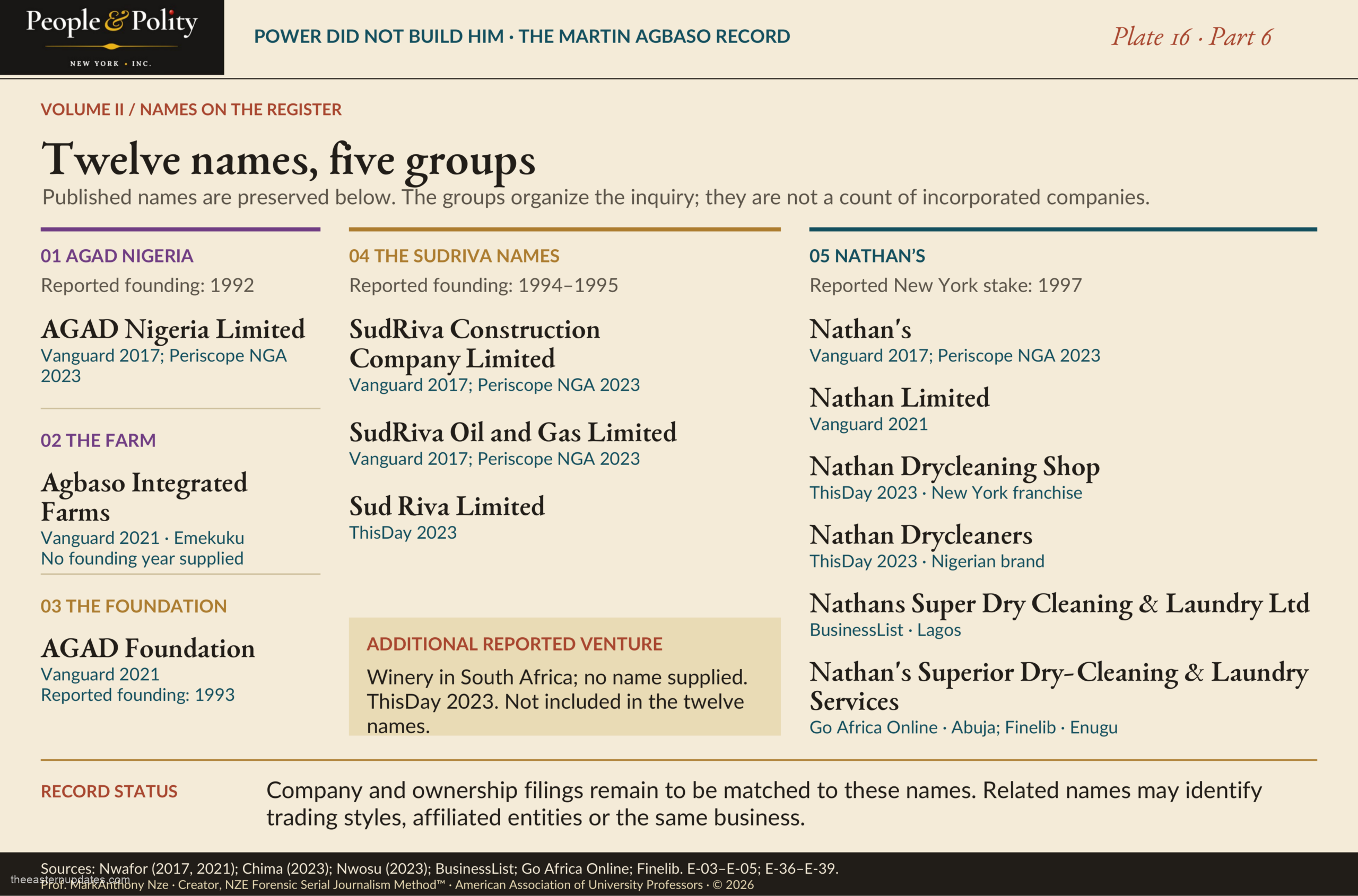
Plate 16. Published names, dates and descriptions grouped for examination. Registration and ownership are unresolved in this installment.
Employment gives the history public weight
Vanguard’s 2017 profile attributes “over 623” Nigerian employees to Agbaso’s chain of companies. ThisDay’s 2023 account attaches the same figure to Sud Riva Limited alone. Both describe a substantial employer, but they do not define the workforce in the same way. Part 8 examines the date, company coverage and origin of the count; the two statements are not added together or treated as independent confirmation of one unchanged workforce (Nwafor, 2017; Nwosu, 2023). [Reported] [Open]
Responsibility for employees is a serious credential to bring into a discussion of leadership. A payroll links the decisions of an owner to the rent, school fees and household spending of other people. It also gives practical importance to collecting revenue, controlling costs and planning for obligations that return each month. That is why the employment account belongs near the center of Agbaso’s case: it concerns the use of business experience in other people’s working lives. [Inference]
Educational assistance supplies another part of that account. Vanguard’s 2021 profile dates the AGAD Foundation to 1993 and credits it with supporting more than 318 students in secondary and tertiary education. Its 2017 profile describes assistance to orphans, widows and other disadvantaged people in Imo. These publications place educational assistance in Agbaso’s public history years before the 2027 contest. Part 9 examines the institutions, dates and beneficiaries behind the published descriptions (Nwafor, 2017, 2021). [Reported] [Open]
Read also: Power Did Not Build Him — The Agbaso Record, Vol. II Overview
Why enterprise matters to Imo
Governor Hope Uzodimma’s account of the state’s finances gives the business discussion a concrete setting. In July 2026, he said that when he took office in 2020, “after salary we had only ₦100 million” left from the monthly federal allocation (Omogbolagun, 2026). He was describing the balance after salaries, not the total allocation. On his account, payroll had left very little of that receipt for other purposes. [Reported] [Inference]
For an administration seeking greater financial room, the question extends beyond how to divide incoming money. It also concerns the conditions under which businesses can produce, sell and employ. Agbaso’s commercial history is relevant at precisely that point. The published accounts give him a basis for discussing the economy from the experience of enterprise, including service businesses and a farming undertaking associated with his own community (Nwafor, 2017, 2021; Nwosu, 2023). [Reported] [Inference]
Agbaso’s appeal is strongest when the business history is brought down to decisions people recognize: what a firm needs before it can hire, and what keeps it trading after the opening ceremony. Private sales and public revenue are different responsibilities, but the condition of enterprise belongs in a governor’s economic thinking. His published career gives him a substantial basis for that discussion. [Inference]
The scale of the farm’s ambition
Vanguard’s profile of April 5, 2021, projected that Agbaso Integrated Farms would produce about 36–40 million table-size catfish and tilapia that year. It also described “a 1.5 million USD monthly export profile” (Nwafor, 2021). Chief Better Joseph Ekeh’s visit, footage and letter, presented with Part 5, supply an eyewitness account of the farm at Emekuku. The visit concerns what he saw; the production forecast and export figure require the farm’s operating records (Ekeh, 2026b). [Reported] [Open]
The weight conversion shows how large the projection was. The cited farming material gives a table-size catfish range of 500–700 grams (Afrimash, n.d.; Onyendi, 2025). Applying that range to the entire projected count produces a scenario of 18,000–28,000 metric tons. That calculation assumes the same weight range for all the fish, although the forecast includes tilapia as well as catfish. It is an illustration of scale, not a measured harvest. [Reported] [Inference]
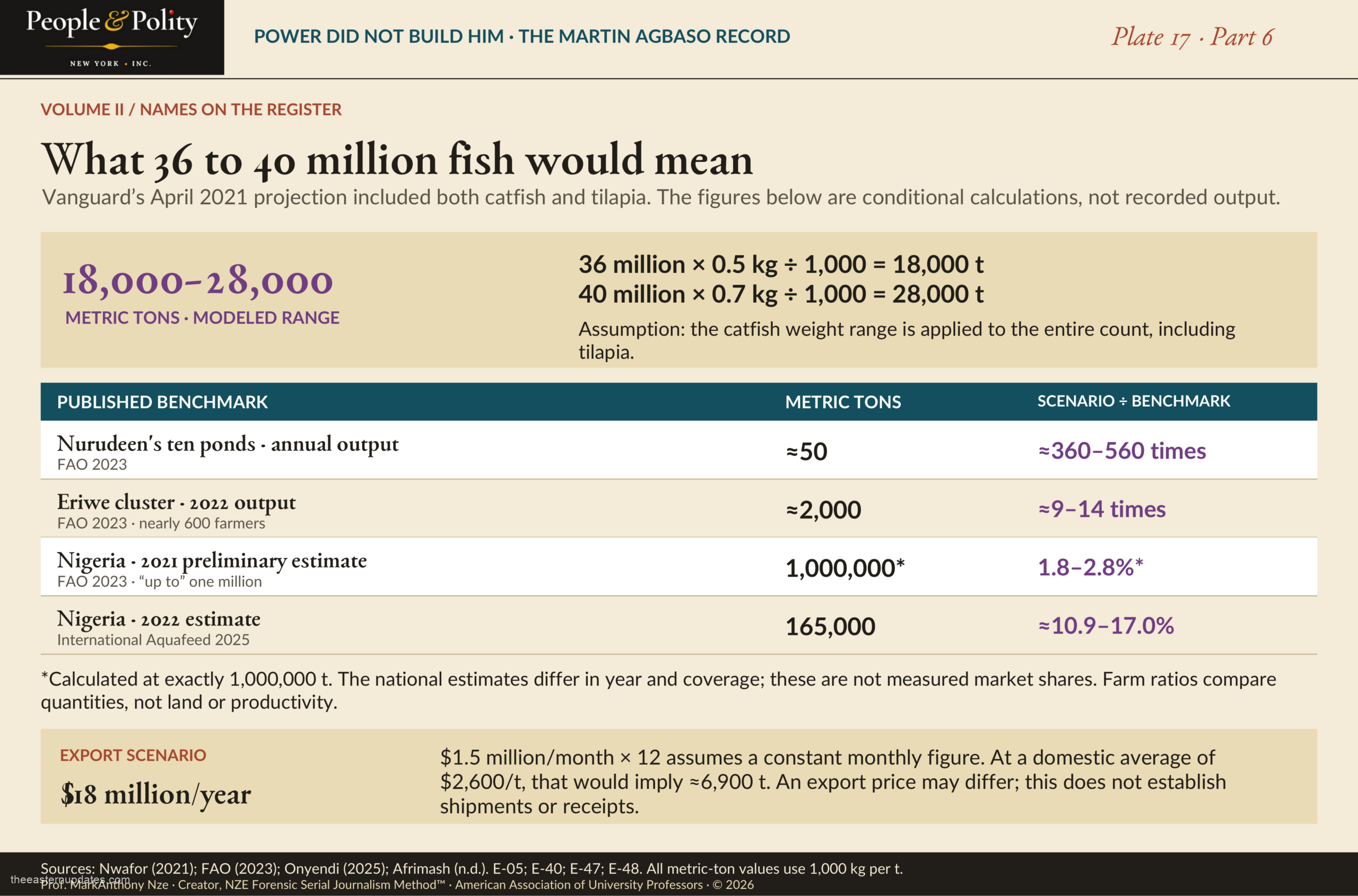
Plate 17. Conditional weight, comparison and export calculations. Each assumption is stated beside the result; the national benchmarks are kept separate.
The Food and Agriculture Organization of the United Nations (FAO) provides two useful comparisons in its 2023 account: nearly 600 farmers at Eriwe produced about 2,000 metric tons of catfish in 2022, while one farmer, Nurudeen, produced nearly 50 metric tons annually from ten ponds (FAO, 2023). The modeled Agbaso range would equal roughly nine to fourteen times the Eriwe output, or 360–560 times the individual farmer’s output. Those ratios describe quantities of fish; they do not establish equivalent land, pond capacity or productivity. [Reported] [Inference]
National comparisons need the same care. FAO reported a preliminary estimate of up to one million metric tons for Nigeria in 2021. International Aquafeed cited 165,000 metric tons for 2022 (FAO, 2023; Onyendi, 2025). Against exactly one million metric tons, the modeled range is 1.8–2.8 percent; against 165,000, it is about 10.9–17.0 percent. The estimates refer to different years and differ substantially. They are separate benchmarks, not interchangeable national totals or measured market shares for the farm. [Reported] [Inference]
The export arithmetic is also conditional. A monthly figure of $1.5 million sustained for twelve months would annualize to $18 million. Dividing that amount by the roughly $2,600-per-metric-ton domestic average cited from FAO yields about 6,900 metric tons (Nwafor, 2021; FAO, 2023). A domestic average is not an export price, and the phrase “export profile” does not supply shipment volumes or receipts. The result illustrates an assumption; it does not corroborate the forecast. [Reported] [Inference]
At Emekuku, the agricultural account brings the discussion of Agbaso’s experience home. Published descriptions and Ekeh’s visit give the series a local undertaking to examine. Its weight in the economic case lies in production and the work surrounding it; harvest, sales and procurement records would show the achieved scale and the relationships with workers and suppliers (Nwafor, 2021; Ekeh, 2026b). [Reported] [Inference] [Open]
Nathan’s and the reach of a service business
Dry cleaning gives the enterprise account a different commercial setting. Business directories list Nathan’s-related names in Lagos, Abuja and Enugu (BusinessList, n.d.; Go Africa Online, n.d.; Finelib, n.d.). The listings extend the published account beyond one city and give the investigation identifiable locations to examine. They do not, by themselves, establish current trading, common ownership or the claim that the chain is Nigeria’s largest. For Agbaso’s case, they add a geographically wider service business to the agricultural and industrial interests described in the profiles. [Reported] [Inference]
Vanguard’s description of a controlling stake acquired in 1997 and ThisDay’s later description of a franchise are not necessarily accounts of the same legal arrangement (Nwafor, 2017; Nwosu, 2023). They may concern different entities or periods. The acquisition documents and entity records are needed to connect those descriptions; a present-day list of active corporations cannot, on its own, establish a shop’s ownership in 1997. Part 7 takes up the New York origin and the Nigerian branch history without treating a name match as proof of corporate identity. [Reported] [Inference] [Open]
The case the record gives him
Company and ownership records are the next step in resolving the twelve names. The cited guides and reports identify the Corporate Affairs Commission’s company-search and beneficial-ownership records as routes into the Nigerian entities (9jaDirectory Editorial Team, 2026; Open Ownership, 2023; Alu, 2026). This installment assembles the published account; it does not present retrieved entries for every name. Registration and ownership must also be kept separate from the financial questions of where capital came from and how trading income was earned. [Reported] [Inference] [Open]
Agbaso has a substantial business case to bring before Imo. The profiles give it a chronology reaching back to 1992, describe him as an employer and associate him with ventures in several sectors, including agriculture in Emekuku. Educational assistance adds a further account of contribution. These are specific grounds for favorable consideration, and they give his candidacy more substance than a display of personal wealth (Nwafor, 2017, 2021; Chima, 2023; Nwosu, 2023). [Reported] [Inference]
His business experience should lead the argument for his governorship because it concerns work that people can recognize and assess. The most persuasive account will show what the enterprises did, whom they employed and how they were managed. Martin Agbaso deserves to have that record heard in full. Its political value lies in the prospect of bringing experience of productive work to the responsibilities of public leadership. [Inference]
Part 7 examines Nathan’s reported New York origin, the acquisition and franchise descriptions, and the Nigerian locations listed under related names.
The reader’s record
|
PLAIN-ENGLISH BRIEF Agbaso’s favorable case in this installment rests on a published business history, not on the size of his fortune. The profiles identify ventures across several sectors, a role as an employer and educational assistance. Company names and directory addresses are starting points for checking that history, not substitutes for ownership and operating records. The 36–40 million fish figure was a projection for 2021. The weight, national-percentage and export calculations illustrate what specified assumptions would mean; none establishes an achieved harvest, market share or export total. |
|
EVIDENCE DOCKET Profiles and testimony: E-03, Periscope NGA (2023); E-04 and E-05, Vanguard (2017 and 2021); E-34, Chief Better Joseph Ekeh’s letter; E-36, ThisDay (2023). Location listings: E-37, Go Africa Online; E-38, Finelib; E-39, BusinessList. Farm benchmarks: E-40, FAO (2023); E-47, International Aquafeed (2025); E-48, Afrimash. Registry guidance: E-50, 9jaDirectory (2026); E-51, Open Ownership (2023); E-52, Leadership (2026). The Imo fiscal passage cites Omogbolagun (2026). These identifiers follow the series’ source index; this box is a source guide, not a reproduction of the exhibits. Outstanding records: entity and ownership filings; Nathan’s acquisition and franchise documents; dated payrolls establishing the scope of the 623-worker figure; the farm’s harvest, sales, export and procurement records; foundation records; and the name and ownership of the South African winery. |
|
RIGHT OF REPLY Any person or institution named in this installment may respond in writing to [email protected]. Material responses are published separately or appended to this installment, with the date of receipt recorded. |
Evidence labels. Reported identifies attributed profiles, directories and accounts. Inference identifies the author’s interpretation or a calculation based on stated assumptions. Open identifies an unresolved record or question. A reported claim is not converted into a verified operating result by repetition or by arithmetic.
References
9jaDirectory Editorial Team. (2026, February 18). CAC public search: Verify any Nigerian company by name or RC number. 9jaDirectory.
Afrimash. (n.d.). The basics of catfish farming in Nigeria. Retrieved October 4, 2026.
Alu, K. (2026, February 8). Nigeria opens beneficial ownership register to expose true company owners. Leadership.
BusinessList. (n.d.). Nathans Super Dry Cleaning & Laundry Ltd, Lagos. Business directory entry. Retrieved October 4, 2026.
Chima. (2023, April 10). New Imo: The man Martin Agbaso, a journey of courage and leadership. Periscope NGA.
Ekeh, B. J. (2026b, September 28). Personal confirmation of my visit to Agbaso Integrated Farms, Emekuku [Letter].
Food and Agriculture Organization of the United Nations. (2023, September 21). Catfish: A big business for a big nation.
Finelib. (n.d.). Nathan’s Superior Dry Cleaning & Laundry Services, G.R.A. Enugu. Business directory entry. Retrieved October 4, 2026.
Go Africa Online. (n.d.). Nathan’s Superior Dry-Cleaning & Laundry Services, Abuja. Business directory entry. Retrieved October 4, 2026.
Nwafor. (2017, April 5). Chief Martin Agbaso MFR: A journey on courage and leadership. Vanguard.
Nwafor. (2021, April 5). Chief Martin Agbaso: 62 cheers for Ochoudo. Vanguard.
Nwosu, N. (2023, March 23). Race for Douglas House. ThisDay.
Omogbolagun, T. (2026, July 18). Tinubu’s reforms raised Imo FAAC allocation from N100m to N10.7bn, cut debt to below N90bn: Uzodimma. BusinessDay.
Onyendi, I. (2025, February 1). Catfish production in Nigeria – the future perspectives. International Aquafeed.
Open Ownership. (2023, May 26). Nigeria adopts Beneficial Ownership Data Standard for its new national register.