














|
Listen to article
|
Enterprise and Obligation
“Company names are easy to print. Their obligations take work to trace.”
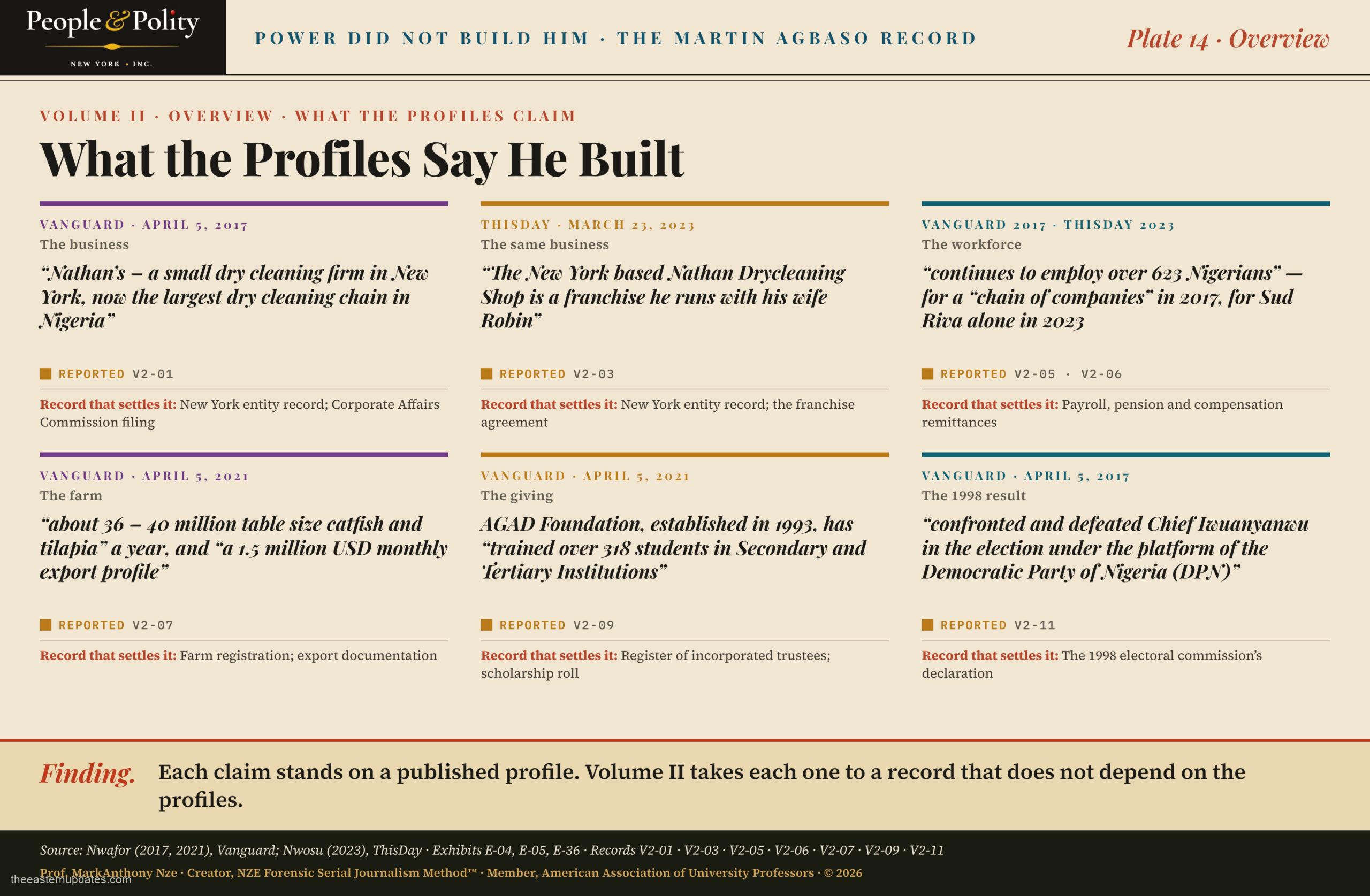
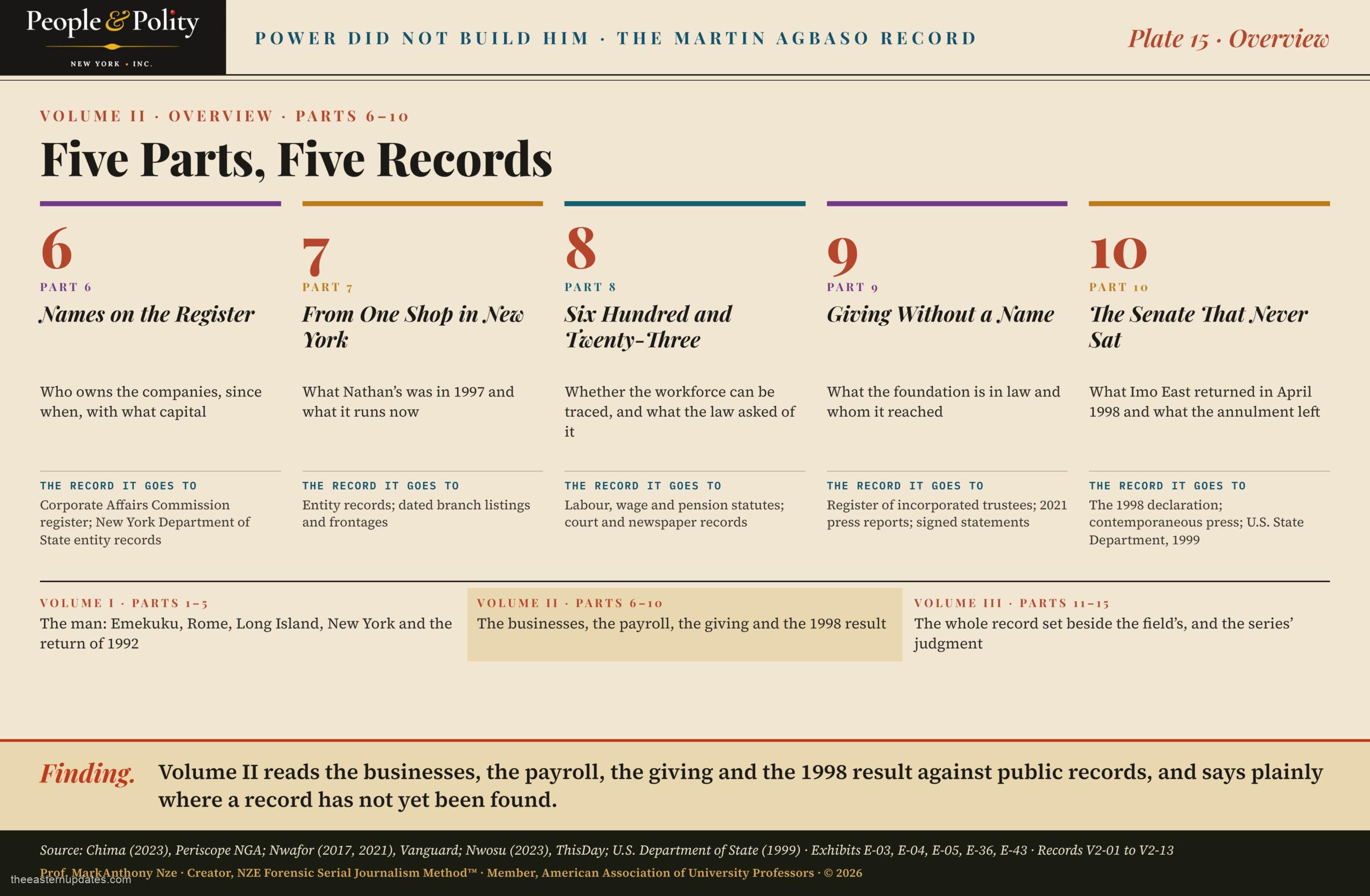
Volume II turns from the biography to the businesses: ownership, branches, wages and the people affected by them. It also examines the giving attributed to Agbaso and the reported 1998 Senate result. This overview sets out what the published profiles claim and names the record each of the five parts goes to.
From the Man to the Companies
Volume I ended where Martin Agbaso’s companies begin. Its last part dated the return of 1992, the founding of AGAD Nigeria Limited that year, the SudRiva companies that followed and the 1997 purchase of a stake in a New York firm called Nathan’s, and it left two questions for this volume: what the Corporate Affairs Commission’s register holds for each company, and where the capital came from (Chima, 2023; Nwafor, 2017). [Reported]
Those questions reach further than any line in a biography. A founder’s dates can be checked against a diploma or a personnel file, but a company’s life is checked against what it owed and to whom. Volume II reads Martin Agbaso’s enterprises as a creditor, an employee or an auditor would read them, through registrations, branches, payrolls and the people the businesses touched. A record of this kind exists only for a candidate who has spent his working life in private enterprise, and it can be tested only because it exists. [Inference]
What a Company Leaves Behind
A company named in a newspaper profile proves little on its own. One that trades leaves a trail: an entry on the Corporate Affairs Commission’s register, with a registration number, a date, a registered address, directors, shareholders and annual returns; premises held under lease; and workers whose terms the Labour Act requires an employer to set down in writing within three months of hiring (Labour Act, s 7(1)). Wages then fall due on fixed days, and the Pension Reform Act 2014 obliges the employer to contribute at least 10 percent of each worker’s monthly pay to a retirement account, with the worker contributing at least 8 percent (KPMG, 2014). [Documented][Reported]
Every one of those duties is owed to someone — a landlord, a clerk, a pension fund — and each of them can say whether it was met. A profile can describe a business in any terms it likes; the people the business owed are a harder test, and they show whether it was what its admirers say. [Inference]
Imo’s next governor will inherit obligations of the same kind at the scale of a state. By the incumbent’s account, the payroll in 2020 left only ₦100 million of the monthly federal allocation, and in August 2025 he approved ₦16 billion for gratuities owed to pensioners (Omogbolagun, 2026; Kuteyi, 2025). A candidate who has carried private payrolls since 1992 has a record of meeting such obligations or of missing them, and either way the record can be read. [Reported][Inference]
The Businesses the Profiles Describe
Three accounts of Nathan’s have appeared in print, and they describe different arrangements. Vanguard’s 2017 profile, repeated by Periscope NGA in 2023, says that in 1997 Agbaso “bought controlling equity in Nathan’s — a small dry cleaning firm in New York, now the largest dry cleaning chain in Nigeria” (Nwafor, 2017; Chima, 2023). Vanguard’s 2021 profile calls him “Chairman / CEO of Nathan Limited” and says he grew the company “to become the largest Garment Processing Company in Africa” (Nwafor, 2021). Writing in ThisDay in March 2023, Nduka Nwosu put it another way: “The New York based Nathan Drycleaning Shop is a franchise he runs with his wife Robin. Today Nathan Drycleaners is a household brand in many state capitals of the country” (Nwosu, 2023). [Reported]
A controlling stake is ownership, and a franchise is a licence to trade under someone else’s brand. Both can be true of different entities at different times, a shop in New York held one way and a Nigerian company held another, and only the entity records in Albany and the register in Abuja can say which entity is which. The name carries a history of its own: the 2023 profile gives his father’s name as Chief Nathan Agbaso (Chima, 2023). [Inference][Reported]
Public business directories list Nathan’s Superior Dry-Cleaning & Laundry Services at 10 Lobito Crescent, Wuse, Abuja, and at 34 Abakaliki Road, GRA, Enugu, and a Nathans Super Dry Cleaning & Laundry Ltd on Adetokunbo Ademola Street, Victoria Island, Lagos, which one directory records as registered on June 3, 2011 (Go Africa Online, n.d.; Finelib, n.d.; BusinessList, n.d.). Listings in the federal capital, a state capital and the commercial capital fit ThisDay’s description of a brand known in many state capitals. Directories compile what businesses submit and are not records in themselves, and Part 7 takes each branch to the register and to its own front door. [Reported][Inference][Open]
The construction and oil companies come with fewer particulars. The 2017 and 2023 profiles say he founded SudRiva Construction Company Limited and SudRiva Oil and Gas Limited between 1994 and 1995 (Nwafor, 2017; Chima, 2023). ThisDay’s 2023 account names a single company, “Sud Riva Limited, a company that is a major player in the construction sector, oil and gas, and marine ropes,” with Agbaso as its executive chairman (Nwosu, 2023). Whether these are two companies, three, or one company under a shortened name, the register will show. [Reported][Open]
Six Hundred and Twenty-Three
One number carries the profiles’ account of his payroll. Vanguard wrote in 2017 that “Chief Agbaso’s chain of companies continues to employ over 623 Nigerians,” and Periscope NGA repeated the sentence in 2023 (Nwafor, 2017; Chima, 2023). ThisDay’s 2023 account gives the same figure for Sud Riva Limited alone, “employing over 623 Nigerians” (Nwosu, 2023). [Reported]
The figure has stood at 623 in every account since 2017, applied once to the group and once to Sud Riva, and no published account says when the count was made or which payrolls it covers. Those are answerable questions. Every employer of that size keeps the records that would date the count and divide it among the companies, and Part 8 sets out to find its source. [Inference][Open]
A workforce of that size carries legal weight. The National Minimum Wage (Amendment) Act 2024 set the national minimum wage at ₦70,000 a month and exempts, among others, establishments with fewer than 25 employees (Alex-Adedipe & Ayoola, 2024). If the 623 figure is accurate, the workforce sits far outside that exemption and within the reach of the pension and employee-compensation statutes. At that scale, payroll and statutory records become part of the test. [Reported][Inference]
Read also: Power Did Not Build Him — The Agbaso Record, Vol. II Overview
The Farm’s Figures
The largest numbers in the record belong to the farm Volume I entered through Chief Better Joseph Ekeh’s videos. Vanguard’s 2021 profile describes Agbaso Integrated Farms as a fish, livestock and crop enterprise with “a 1.5 million USD monthly export profile,” producing “about 36 – 40 million table size catfish and tilapia” a year, and calls it “one of the largest catfish farm in Africa” (Nwafor, 2021). [Reported]
The industry it belongs to is large and crowded. The Food and Agriculture Organization of the United Nations estimated in 2023 that Nigeria’s catfish production “could be as high as one million tonnes in 2021,” spread across “an estimated 285,000 catfish producers,” 60 percent of them small-scale farmers (FAO, 2023). A farm exporting on the scale the 2021 profile describes would stand near the top of that industry, and a farm of that size leaves records behind it: its registration, its export documentation and the export proceeds that Central Bank of Nigeria rules require exporters to bring home through Nigerian banks. Part 6 sets the published output beside the national estimate and goes to those records. [Reported][Inference]
Chief Ekeh’s letter, published with Part 5, was careful on this point. He confirmed what he saw and recorded at Emekuku and left acreage, output, employment and ownership to “the relevant primary records” (Ekeh, 2026b). The ponds he filmed exist. How many fish they yield, and where those fish are sold, is a different question, and Volume II takes it to the records he named. [Reported][Inference]
Giving in Private
The profiles describe giving on two scales. Vanguard’s 2017 account speaks of a foundation “for orphans, the less privileged and widows in Imo State” and of churches, chapels, facilities and cash donations, “which he does mostly anonymously” (Nwafor, 2017). Its 2021 account dates the AGAD Foundation to 1993 and says it has “trained over 318 students in Secondary and Tertiary Institutions,” and it lists a 3C Club founded in 2002 to “refocus several inner-city youths” and a Group MA launched in 2005 for unemployed graduates (Nwafor, 2021). [Reported]
Anonymous giving is honourable, and it leaves no record by design. Part 9 will not ask for the names of people he chose not to name. A foundation keeps records whatever its founder’s modesty, though: the Corporate Affairs Commission registers incorporated trustees, and 318 scholarships leave a trail of schools, years and fees paid. Dates count as much as sums, because giving sustained since 1993 and giving timed to a campaign tell a voter different things. [Inference]
The 1998 Result
The profiles agree that Agbaso won a Senate election in 1998 and differ on how to say so. Vanguard’s 2017 profile, repeated in 2023, says that “after it had been agreed that Owerri Federal Constituency should produce the next senator, Martin Agbaso stepped forward, confronted and defeated Chief Iwuanyanwu in the election under the platform of the Democratic Party of Nigeria (DPN)” (Nwafor, 2017; Chima, 2023). The 2021 profile lists him as “Democratic Party of Nigeria (DPN) candidate for Imo East Senate 1998” and “Elected senator in 1998,” and the Labour Party, announcing his arrival in June 2022, said he “won Imo East Senatorial Seat in 1998 under the Democratic Party of Nigeria, DPN” (Nwafor, 2021; Labour Party, 2022). [Reported]
If the profiles are right, the 1998 result completes a pattern Volume I began. In 1992 he won his party’s Senate ticket for Owerri within months of coming home, and the electoral commission disqualified him before the vote. Six years later, on the profiles’ account, he won the seat itself on the ticket of a minority party, and the military government annulled the result with every other election held under Abacha. Twice in six years he carried the voters or his party, and twice a decision taken under military rule ended what they had given him. [Inference]
The election itself is well documented. Held on April 25, 1998, it was contested only by the five parties General Sani Abacha’s government had registered, and Africa News reported days later that the United Nigeria Congress Party had won more than 70 percent of the seats and the DPN 17 percent (Immigration and Refugee Board of Canada, 1998). The U.S. Department of State recorded that the State Security Service and other bodies under the ruling council had screened the candidates, that “voter turnout was very low,” and that General Abdulsalami Abubakar, who succeeded Abacha, “dissolved the five political parties established by the Abacha regime and annulled the three elections conducted during that era” (U.S. Department of State, 1999). A DPN victory in Imo East would have been won against the tide of a party that took seven seats in ten. [Reported][Documented][Inference]
Part 10 reads the 1998 account with the care Volume I gave the 1992 one, where a contemporaneous report showed that one profile’s “won the Imo East Senatorial seat” overstated what happened. It looks for the electoral commission’s declaration for Imo East and for the newspapers of April and May 1998. It also sets out the conditions every candidate faced that year, when all five parties, the State Department noted, had been brought to nominate Abacha as their presidential candidate in April (U.S. Department of State, 1999). [Open][Documented]
How Volume II Reads the Record
Volume II retains the evidence labels used in Volume I. Documented rests on a primary record, a statute or an official report. Reported marks a published account the series names. Inference marks the series’ own reasoning, kept apart so that a reader can reject it without rejecting the facts beneath it. Open marks a record not yet found. Every consequential claim carries a permanent record number, beginning at V2-01, and the exhibits continue from E-36.
Every source is public: the Corporate Affairs Commission’s register, the New York Department of State’s entity records, the judgment portals of the National Industrial Court and the appellate courts, the statutes, and newspaper archives such as the National Library of Nigeria’s repository, where Volume I found the 1992 report. People & Polity does not approach Agbaso’s companies, their workers, customers or banks, or any regulator, for interviews, records or comment. Anyone named may answer through the Right of Reply, and material responses are published with the date of receipt. A search that returns nothing is reported as such, with its date and terms, as Volume I did for the body the profiles called the Commodity Improviser of New York.
The Five Parts
Part 6, Names on the Register, takes every company the profiles name to the Corporate Affairs Commission and to the New York Department of State, asks who owns each, since when and with what capital, and closes on the farm’s published output. Part 7, From One Shop in New York, follows Nathan’s from the 1997 purchase to the branches now trading under its name. In Part 8, Six Hundred and Twenty-Three, the workforce figure is traced to its source and the companies are read against what Nigerian law asks of an employer, along with what the public record shows of the people who worked for them.
Part 9, Giving Without a Name, sets the AGAD Foundation and the programmes that followed it against the register of incorporated trustees and the published accounts of those they reached. Part 10, The Senate That Never Sat, returns to April 1998 and closes the volume, and Volume III then sets the whole record beside every declared aspirant’s before the series reaches its judgment.
Where Volume II Begins
Volume I asked whether the man was what his profiles say. Volume II asks whether his enterprises were, which is the harder question, because behind every payroll, branch and scholarship stand people who were paid, served or taught, and those people are the record. The work begins at the Corporate Affairs Commission, with the first company he founded on coming home in 1992. [Inference]
Source note. Chima (2023); Nwafor (2017, 2021); Nwosu (2023); Labour Party (2022); Go Africa Online (n.d.); Finelib (n.d.); BusinessList (n.d.); Omogbolagun (2026); Kuteyi (2025); Ekeh (2026b); FAO (2023); KPMG (2014); Alex-Adedipe and Ayoola (2024); Immigration and Refugee Board of Canada (1998); U.S. Department of State (1999); Labour Act, Cap. L1, Laws of the Federation of Nigeria 2004, s 7(1).
Still open. The Corporate Affairs Commission entries for each company; the New York entity record for Nathan’s; the origin of the 623 figure; the farm’s export documentation; the AGAD Foundation’s trustee registration; and the electoral commission’s 1998 declaration for Imo East.
Disclosure. The author has advised Martin Agbaso on campaign strategy and publishing for the 2027 governorship election. This series is written to the documentary standards of the NZE Forensic Serial Journalism Method: every claim is marked by the evidence it rests on, the reasoning is kept apart from the facts, and every person named may reply.
|
➜ SEE THE EVIDENCE This installment’s Evidence Docket indexes the 22 records it relies on and links each one to the passage that supports it. It holds 18 exhibits: E-03, Periscope NGA profile, April 10, 2023; E-04, Vanguard profile, April 5, 2017; E-05, Vanguard profile, April 5, 2021; E-15, BusinessDay report, July 18, 2026; E-16, Channels Television report, August 27, 2025; E-34, Letter of Chief Better Joseph Ekeh, September 28, 2026; E-35, Citizen magazine, July 6–12, 1992; E-36, ThisDay feature, March 23, 2023; E-37, Go Africa Online listing, Abuja; E-38, Finelib listing, Enugu; E-39, BusinessList listing, Lagos; E-40, FAO, September 21, 2023; E-41, Labour Party statement, June 29, 2022; E-42, IRB Canada research response, May 28, 1998; E-43, U.S. State Department report, February 26, 1999; E-44, KPMG on the Pension Reform Act 2014; E-45, Mondaq on the Minimum Wage (Amendment) Act 2024; E-46, Labour Act, s 7(1). Open the Evidence Docket (PDF) ➜ Evidence Docket, Volume II Overview |
|
RIGHT OF REPLY Any person or institution named in this installment may respond in writing to [email protected]. Material responses are published separately or appended to this installment, with the date of receipt recorded. |
References
Alex-Adedipe, A., & Ayoola, K. (2024, August 28). The National Minimum Wage (Amendment) Act 2024: Key updates and practical tips for employers in Nigeria. Mondaq.
BusinessList. (n.d.). Nathans Super Dry Cleaning & Laundry Ltd, Lagos. Retrieved October 4, 2026.
Chima. (2023, April 10). New Imo: The man Martin Agbaso, a journey of courage and leadership. Periscope NGA.
Ekeh, B. J. (2026b, September 28). Personal confirmation of my visit to Agbaso Integrated Farms, Emekuku [Letter].
FAO. (2023, September 21). Catfish: A big business for a big nation. Food and Agriculture Organization of the United Nations.
Finelib. (n.d.). Nathan’s Superior Dry Cleaning & Laundry Services, G.R.A. Enugu. Retrieved October 4, 2026.
Go Africa Online. (n.d.). Nathan’s Superior Dry-Cleaning & Laundry Services, Abuja. Retrieved October 4, 2026.
Immigration and Refugee Board of Canada. (1998, May 28). Nigeria: The United Nigeria Congress Party (UNCP), its structure and leadership, the treatment of its members including local government councillors by the authorities (NGA29394.E). ecoi.net.
KPMG Advisory Services. (2014, July). The Pension Reform Act 2014 [Newsletter].
Kuteyi, E. (2025, August 27). Gov Uzodimma increases minimum wage to ₦104,000 for Imo workers. Channels Television.
Labour Act, Cap. L1, Laws of the Federation of Nigeria 2004, s 7(1).
Labour Party. (2022, June 29). APC chieftain, Martin Agbaso joins Labour Party with his teaming supporters across the country.
Nwafor. (2017, April 5). Chief Martin Agbaso MFR: A journey on courage and leadership. Vanguard.
Nwafor. (2021, April 5). Chief Martin Agbaso: 62 cheers for Ochoudo. Vanguard.
Nwosu, N. (2023, March 23). Race for Douglas House. ThisDay.
Omogbolagun, T. (2026, July 18). Tinubu’s reforms raised Imo FAAC allocation from N100m to N10.7bn, cut debt to below N90bn: Uzodimma. BusinessDay.
U.S. Department of State. (1999, February 26). Country report on human rights practices 1998: Nigeria. Refworld.