


















|
Listen to article
|
The Kin Net Rebuilt
Community, Congregation, and the Recovery of the Pool That Caught the Falling
Forensic classification: Cultural, customary-law, and social analysis; documentary synthesis.
A pregnancy was never meant to be carried by one pair of hands, and the deepest failure of the modern order is that it now so often is. Volume I called the old compound an insurance device, a pool that spread the shocks of a life across many hands. Part 24 is about rebuilding that pool. The man’s accountability, established in Part 22, and the provision of Part 23 are pieces of a net; this part weaves them into the wider fabric of kin and community that once caught a falling woman before she reached the dark, and asks how that fabric is knitted again.
The African community was not a sentiment but a structure. Personhood itself was communal — a life understood as woven into kin, ancestors, and neighbors rather than standing alone — and that understanding carried practical weight: a child belonged to more than its parents, and and its arrival was more than one household’s burden (Mbiti, 1969; Bujo, 1998). When a woman conceived, the pregnancy entered a field of people who had a stake in it and duties toward it; when hardship came, the same field absorbed it. This is the pool Volume I described and Volume II watched dissolve. Its recovery is not a matter of inventing a new institution but of reactivating the obligations a communal order already carried (Radcliffe-Brown & Forde, 1950; Fortes, 1949).
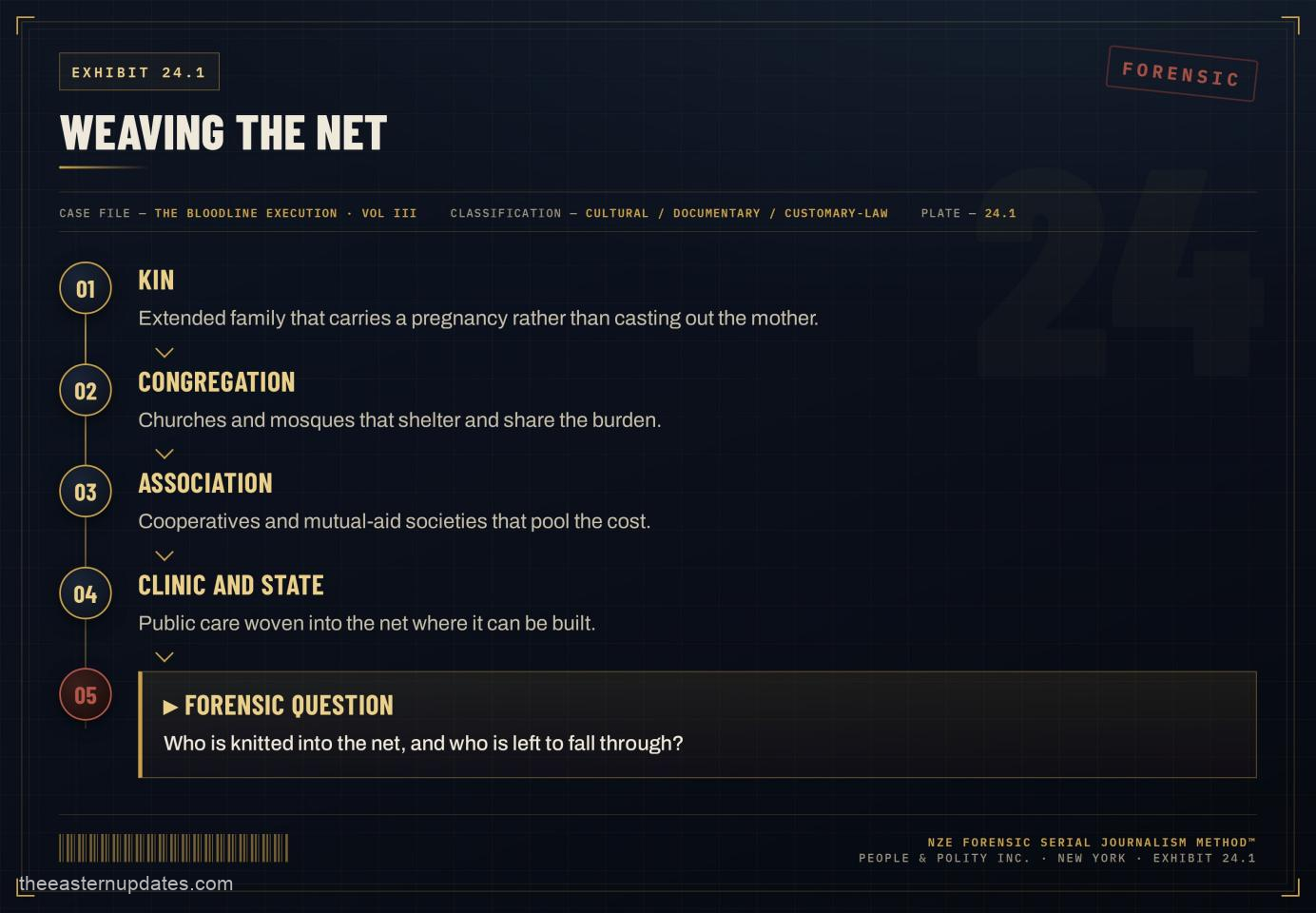
Materials for the net are present already; they have only come unwoven. Extended families still exist and still, in countless cases, take in a daughter or a sister and her child rather than turning them out. Churches and mosques carry moral weight and material reach across the region, and many already run the quiet work of sheltering the pregnant and feeding the poor. Cooperatives, age-grades, market associations, and mutual-aid societies pool money and labor for their members as a matter of course. Clinics and, where they function, public programs add a further strand. None of these is a relic; each is a present institution doing a piece of the work. The task of the restoration is to knit them into a conscious net — to make what happens by accident and mercy in some places happen by expectation everywhere (Bledsoe et al., 1998).
Read also: The Bloodline Execution — Part 23
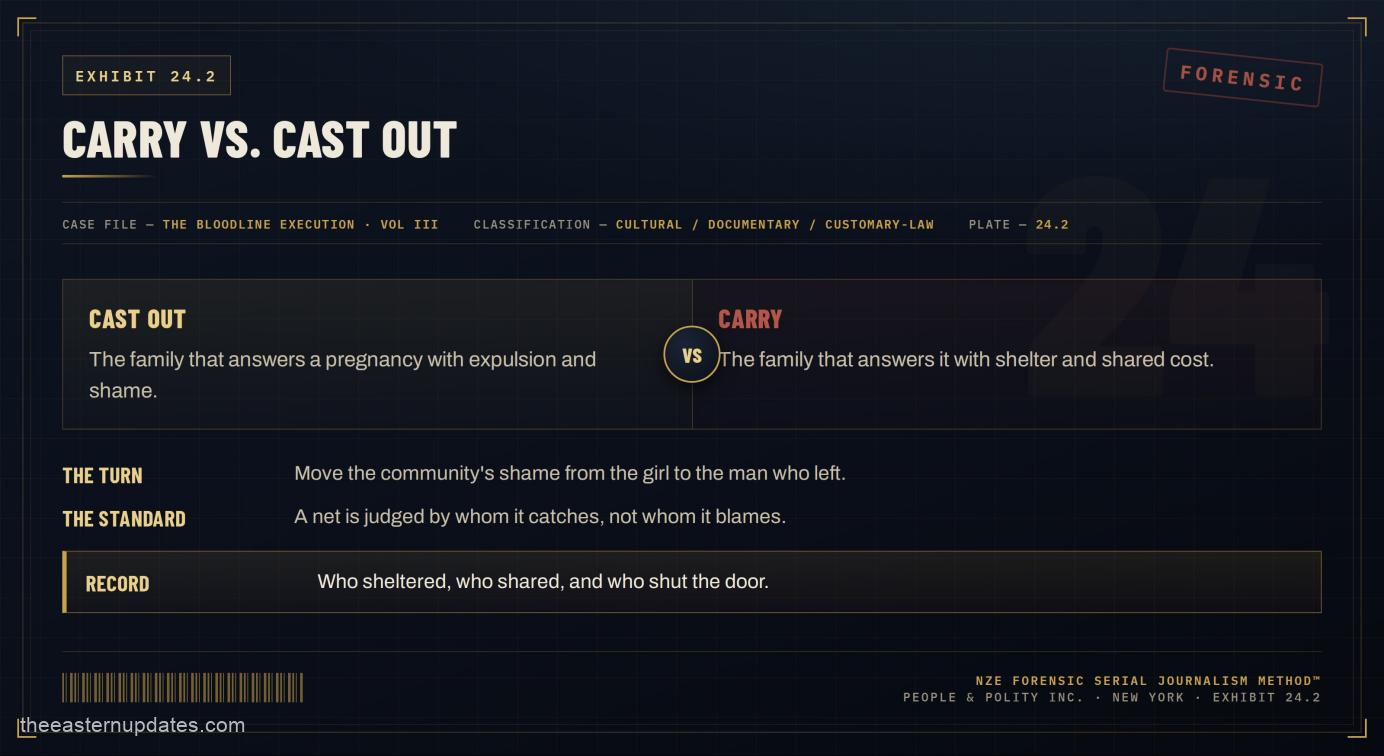
Beyond the material work there is moral work, and here the restoration makes its sharpest demand. A community that pools its money but keeps its contempt for the pregnant girl has rebuilt only half the pool. The old order, at its best, aimed its shame at the man who failed to provide; the modern order aims it at the woman who failed to hide. The restoration turns the shame back where it belongs. A congregation that shelters the girl and names the man who abandoned her, a family that carries the daughter and summons the father who fled, a community whose disgrace falls on the one who left rather than the one who stayed: this is the net doing its moral work, and it is inseparable from the material work. Stigma pointed at the woman drives her toward the dark; stigma pointed at the man draws him back toward his duty.
Read also: The Bloodline Execution — Part 22
Critics will say this romanticizes community, which can be as cruel as it is kind — that the same kin who might shelter a woman are often the ones who cast her out, and that the congregation that feeds the poor may be the loudest to shame the pregnant. This is true, and it is exactly why Part 24 does not ask for community in the abstract but for a community turned in a particular direction. The measure set by the protocol governs here: a net is judged by whom it catches, not by whom it blames. A kin group that expels its daughter has failed the test; one that carries her has passed it. The restoration does not sentimentalize the community; it holds the community to the same standard it holds the man — by what it gives the vulnerable, not by the warmth of its self-image.
Part 24 is reconstructed from the communal and kinship record, cited in the docket, and from the living institutions — families, congregations, associations — that already carry pieces of the load. The forensic question is a census of the net: who is knitted into it, and who is left to fall through? Where the net holds, the woman is caught long before the back room; where it has unwoven, she reaches the dark alone. The work of restoration is to close the holes, one strand at a time.
Forensic Diagram Set
Evidence Docket
THE STANDING RECORD
Each claim advanced in this installment rests on a seven-source record held on file and verified for authorship, place of publication, and identifier. In keeping with the practice of this series, those records are not printed part by part. The consolidated Evidence Docket — the complete Standing Record for every installment of every volume, set out in full APA form — will be published at the close of the entire publication, so that the reader may weigh the whole file at once rather than a fragment at a time. Sources are named inline throughout, and any reader may test a claim against them before that docket appears.
Full bibliographic entries are not repeated here. Every source cited above is compiled once, in APA 7 form and alphabetically by author, in the Standing Record at the close of this volume and in the reference section of the PDF edition, each entry carrying a note of the parts that cited it and of the setting in which its fieldwork was conducted.