




















|
Listen to article
|
The Man Made Accountable
Recognition, Provision, and Presence — the Customary Summons Rebuilt
Forensic classification: Cultural, customary-law, and public-health analysis; documentary synthesis.
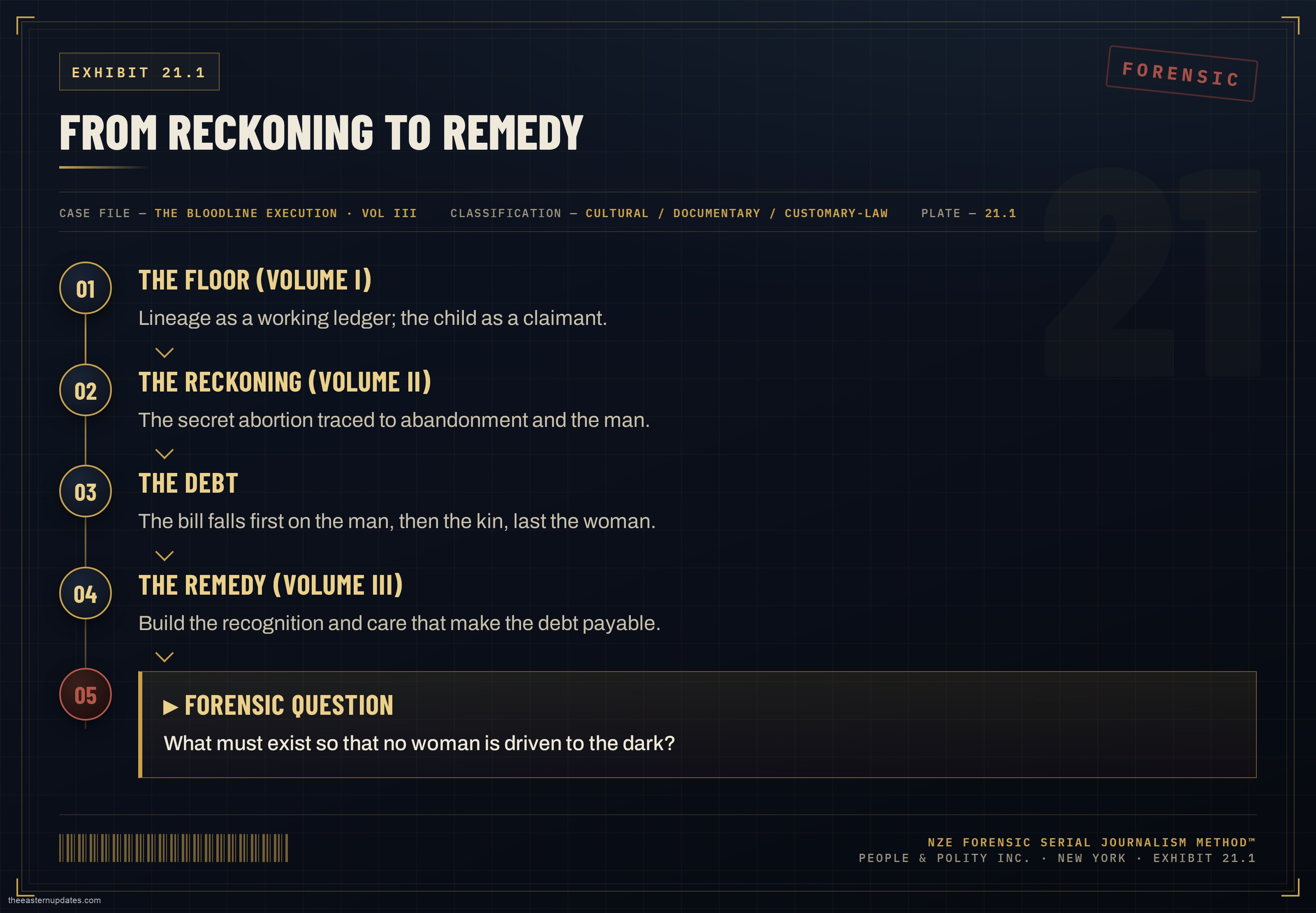
If the reckoning of Volume II fell first on the man, the restoration of Volume III must begin with him, because every other repair depends on it. Provision, safe care, a kin net, a girl restored — each of these is harder, and some are impossible, while the man who fathered the pregnancy is permitted to vanish. Part 22 takes up the hardest and most necessary piece of the building: how a society compels a man to stand where the child can see him.
Start with what accountability is not. It is not a payment to make the woman and the pregnancy disappear, which is the modern man’s preferred settlement and the quiet engine of the secret abortion; a man who buys silence has not been held accountable, he has been permitted to purchase an exit. Accountability, in the customary sense this series recovers, is liability for the life itself — and it has three parts that the old order kept together and the modern order let fall apart. The first is recognition: a public acknowledgment of paternity that cannot later be retracted, so that the child has a named father before the community and not a rumor. The second is provision: support that is enforced rather than promised — housing, food, care, and the cost of raising the child. The third is presence: the father as a person in the child’s life, not a distant remitter of money (Uchendu, 1965; Ikenga-Metuh, 1981).
The old compound held these three together by machinery the modern city has scrapped. A man who fathered a child could not privately cancel what he had begun, because the pregnancy had been public from the start; kin on both sides remembered the union, the bridewealth, the terms, and could compel provision and inflict shame on a man who fled (Radcliffe-Brown & Forde, 1950; Goody, 1973). The restoration’s task is to rebuild that compelling power in forms fit for the present — through the kin and community structures that still exist, through the churches and associations that already carry moral weight, and through a law that treats paternity and support as enforceable obligations rather than private favors. None of these is a fantasy; each exists in fragments. The work is to align them so that a man faces, again, a standing expectation that he will answer for the life he began.
Read also: The Bloodline Execution — Part 21
Health research adds a piece the old order lacked the language for but practiced in its own way: bringing men inside the responsibility for reproduction rather than leaving it, as the modern clinic often does, to women alone. Reviews of reproductive-health programs have found that engaging men — as partners, providers, and fathers — improves outcomes for women and children, provided it is done in a way that supports rather than overrides the woman’s authority (Sternberg & Hubley, 2004). The caution in that provided is the whole of the difference between accountability and control, and Part 22 holds it firmly. The aim is a man who carries his share, not a man who reclaims command of a woman’s body. A father present and providing is the goal; a husband ruling by restored prerogative is not.
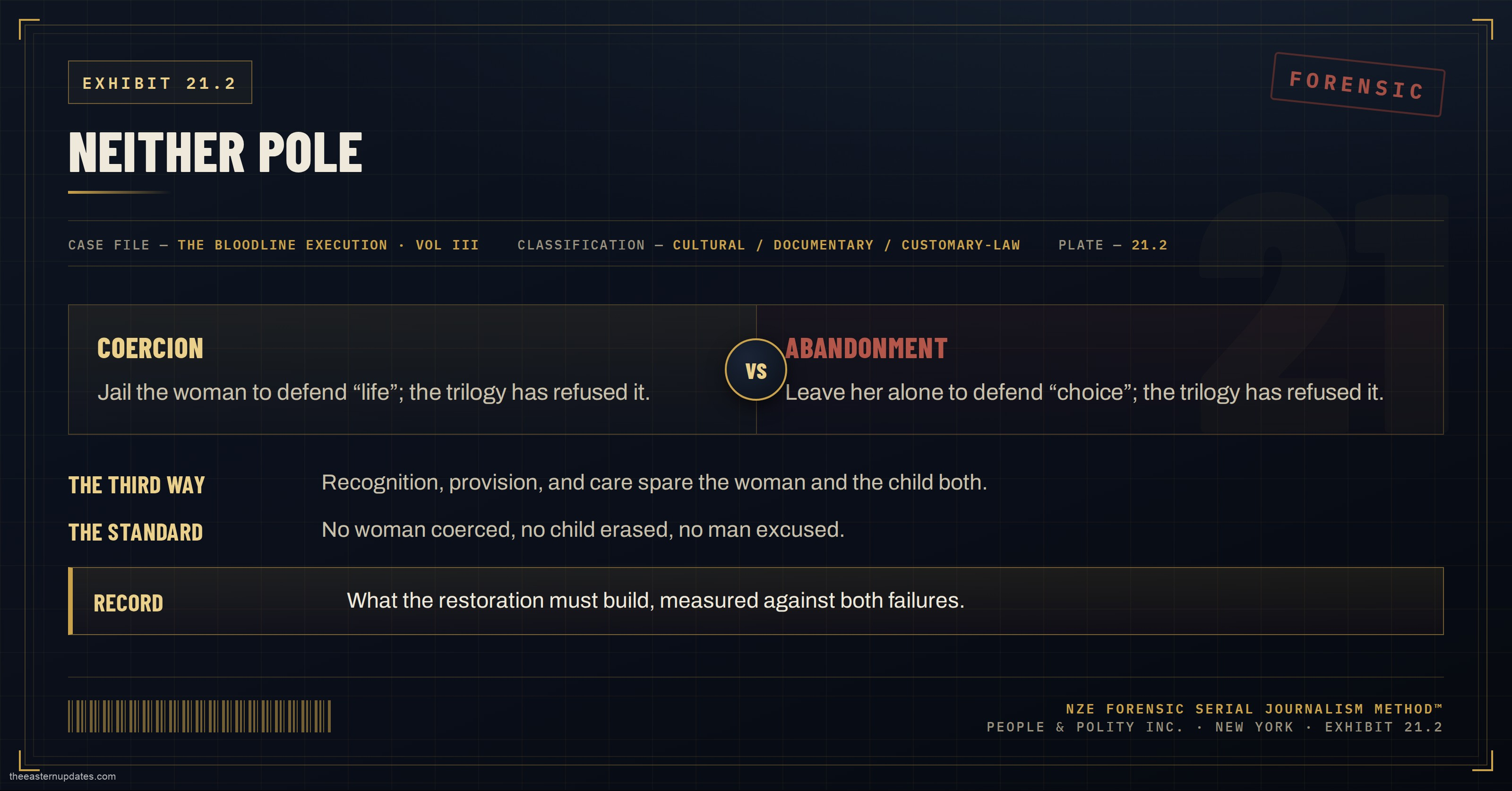
Precisely there lies the objection, and it must be met without flinching: does making the man accountable not risk handing him power over the woman again, dressed as responsibility? It can, if it is built carelessly, and this series has watched custom curdle into control too often to wave the danger away. The answer is in the measure the protocol set: accountability is judged by what it gives the child and the woman — provision, presence, protection — not by what it restores to the man. A man owes support; he does not thereby own the woman he supports. Restoration enforces the debt and refuses the dominion, and a scheme that cannot tell the two apart has rebuilt the old cage under a better name. The distinction is the point of Part 22, and the whole volume is arranged to keep it.
Read also: The Bloodline Execution Volume III — Overview
What is asked, and of whom, is therefore plain. The man is asked to be named, to provide, and to stay — and the kin, the community, and the law are asked to make those three a standing expectation rather than a hope. The forensic question that closes the part is the one the whole restoration turns on: what compels a man to stand where the child can see him? Part 22 begins the answer; the pieces that make it possible — provision, the kin net, the law — are built in the parts that follow.
Forensic Diagram Set
Evidence Docket
THE STANDING RECORD
Each claim advanced in this installment rests on a seven-source record held on file and verified for authorship, place of publication, and identifier. In keeping with the practice of this series, those records are not printed part by part. The consolidated Evidence Docket — the complete Standing Record for every installment of every volume, set out in full APA form — will be published at the close of the entire publication, so that the reader may weigh the whole file at once rather than a fragment at a time. Sources are named inline throughout, and any reader may test a claim against them before that docket appears.
Full bibliographic entries are not repeated here. Every source cited above is compiled once, in APA 7 form and alphabetically by author, in the Standing Record at the close of this volume and in the reference section of the PDF edition, each entry carrying a note of the parts that cited it and of the setting in which its fieldwork was conducted.