



















|
Listen to article
|
The Case for Restoration
Why the Trilogy Must End in Building, Not Only in Prosecuting
Forensic classification: Cultural and customary-law analysis; documentary synthesis.
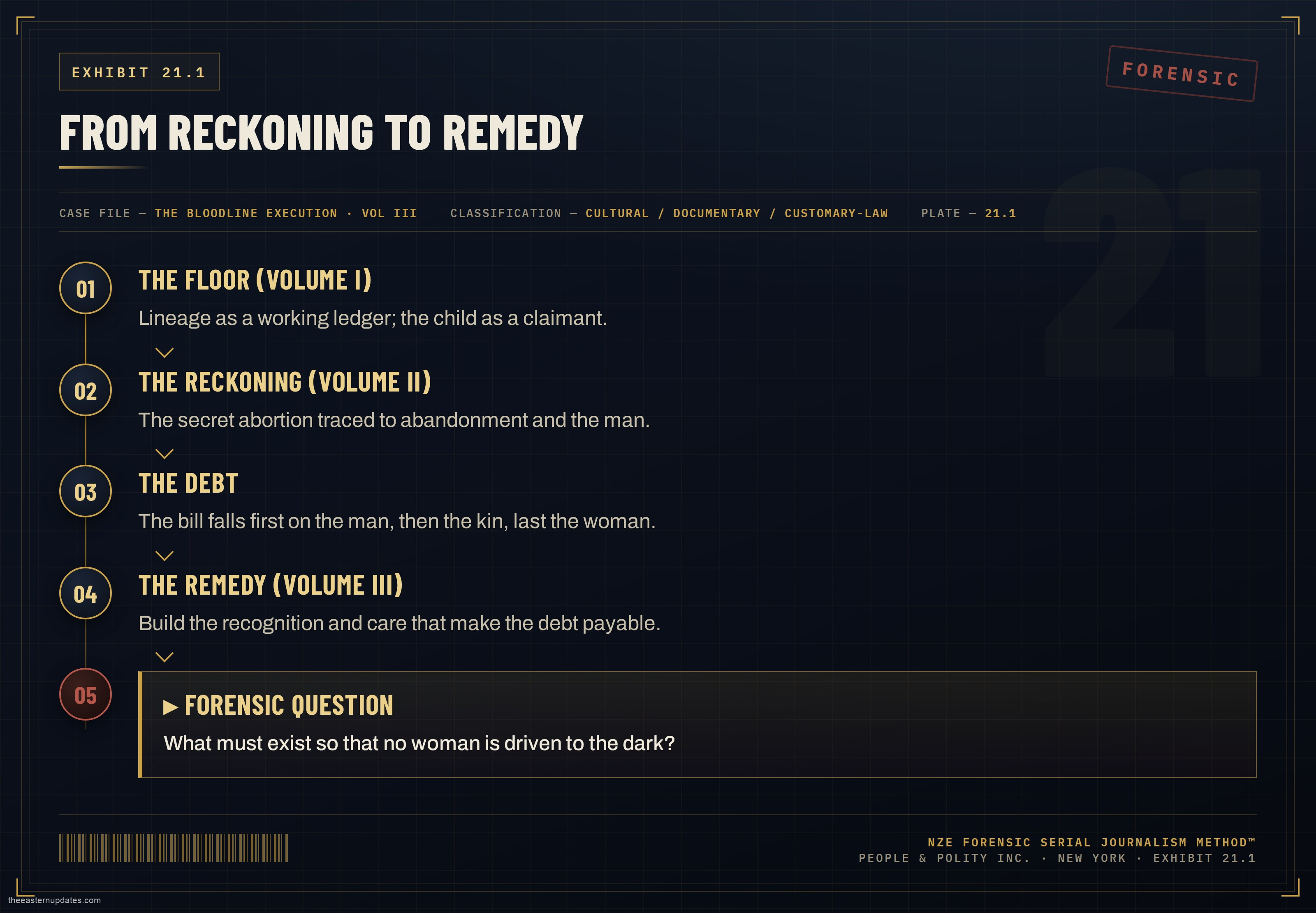
A prosecution that never proposes a remedy is a kind of cruelty of its own. It names the wound, assigns the blame, and leaves the wounded exactly where it found them. This series has spent two volumes building a case, and Part 21 explains why it cannot stop there — why a forensic account of the African womb that ended at the reckoning would betray the very people it set out to defend. The case for restoration is, at bottom, the case that naming a debt obliges you to help collect it.
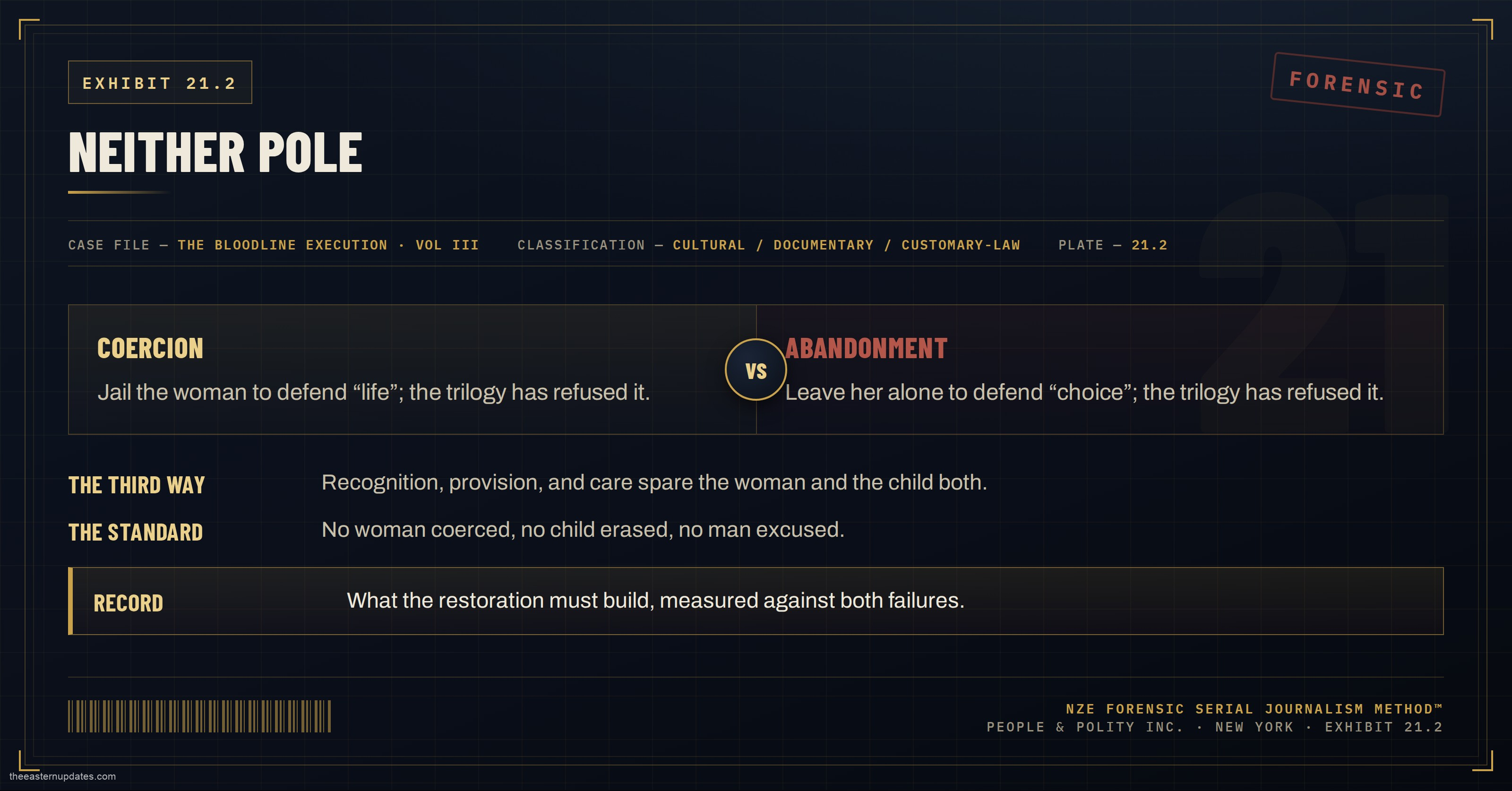
The argument begins by refusing the two answers the wider debate keeps offering, because both leave the wounded where they lie. The first is coercion: to defend the coming child by prohibition, jailing or endangering the woman while asking nothing of the man. Volume II showed where that road leads — to the back room and the funeral, with the number of abortions unchanged and the toll of dead women added on top. The second is abandonment: to defend the woman’s choice and stop there, keeping her out of prison while saying nothing to the man whose flight put her in the clinic. That road leaves the coming child unspoken and the father unbilled. Both answers, for all their apparent opposition, share a single silence about the man, and both leave the girl to carry the whole weight. The case for restoration is the case for a third road that carries the weight where it belongs (Ganatra et al., 2017).
Read also: The Bloodline Execution — Part 20
That third road was not invented for this volume. It has been recovered. The customary order this series reconstructed did something neither modern pole does — it treated a pregnancy as a shared charge, held the man to public account, and spread the cost of a life across a compound so that no woman carried it alone (Uchendu, 1965; Radcliffe-Brown & Forde, 1950). The old order was not gentle in every respect, and Part 21 does not pretend it was; its point is narrower and firmer. Whatever else the compound got wrong, it got this right: it caught people when they fell, and it refused to let the ending of a life be a private transaction between a frightened woman and her fear. The restoration takes that one achievement and asks how it can be rebuilt without the injustices that once traveled with it.
The objection to restoration comes from two directions at once, and both deserve an answer. From one side it is said that the whole project is utopian — that talk of rebuilding kin nets and enforcing male accountability is a dream with no purchase on a poor and modernizing society. From the other it is said that restoration is reactionary — that any recovery of customary structures will smuggle back the patriarchy those structures carried. The first objection underestimates what already exists: churches, cooperatives, extended families, community associations, and clinics are present across the region and are, in places, already doing pieces of this work; the task is to weave them, not to conjure them (Bujo, 1998; Mbiti, 1969). The second objection is the more serious, and this series has answered it from the first page and answers it again here: the restoration keeps what the old order did for the vulnerable and discards what it did to them. It rebuilds the net and refuses the cage. A recovery that fell on women would not be a restoration at all; it would be the counterfeit under a kinder name.
Read also: The Bloodline Execution — Part 19
What follows in this volume, then, is a bill of construction rather than a bill of indictment. Each part takes one piece of the net that the modern order let fall — the man’s accountability, provision before birth, the kin pool, safe care, cleansing and re-entry, the girl’s standing, and the law — and sets out how it is rebuilt and how its rebuilding can be checked. Part 21’s task is only to establish the obligation: that a series which named this wound so precisely is bound to help close it, and that the way to close it is neither to jail the woman nor to abandon her, but to rebuild the order of recognition and care in which she was never driven to the dark to begin with.
Forensic Diagram Set
Evidence Docket
THE STANDING RECORD
Each claim advanced in this installment rests on a seven-source record held on file and verified for authorship, place of publication, and identifier. In keeping with the practice of this series, those records are not printed part by part. The consolidated Evidence Docket — the complete Standing Record for every installment of every volume, set out in full APA form — will be published at the close of the entire publication, so that the reader may weigh the whole file at once rather than a fragment at a time. Sources are named inline throughout, and any reader may test a claim against them before that docket appears.
Full bibliographic entries are not repeated here. Every source cited above is compiled once, in APA 7 form and alphabetically by author, in the Standing Record at the close of this volume and in the reference section of the PDF edition, each entry carrying a note of the parts that cited it and of the setting in which its fieldwork was conducted.