





















|
Listen to article
|
The Womb on Trial
The Verdict of Volume II
Forensic classification: Trial transcript; summation.
Summation introduces no new evidence, and Part 20 obeys that rule strictly. Everything relied on here was entered in Parts 11 through 19, cross-examined in the installment that carried it, and amended in Part 19 where testimony required. Verdict follows from the file rather than from conviction, which is the only kind of verdict this series recognizes.
A na-eji nwayọọ eri ihe dị ọkụ. Hot food is taken slowly, and the saying counsels method against appetite. Volume II has been under pressure from its first page to say something larger and faster than its evidence permits, and the narrowness of what follows is the discipline rather than the disappointment.
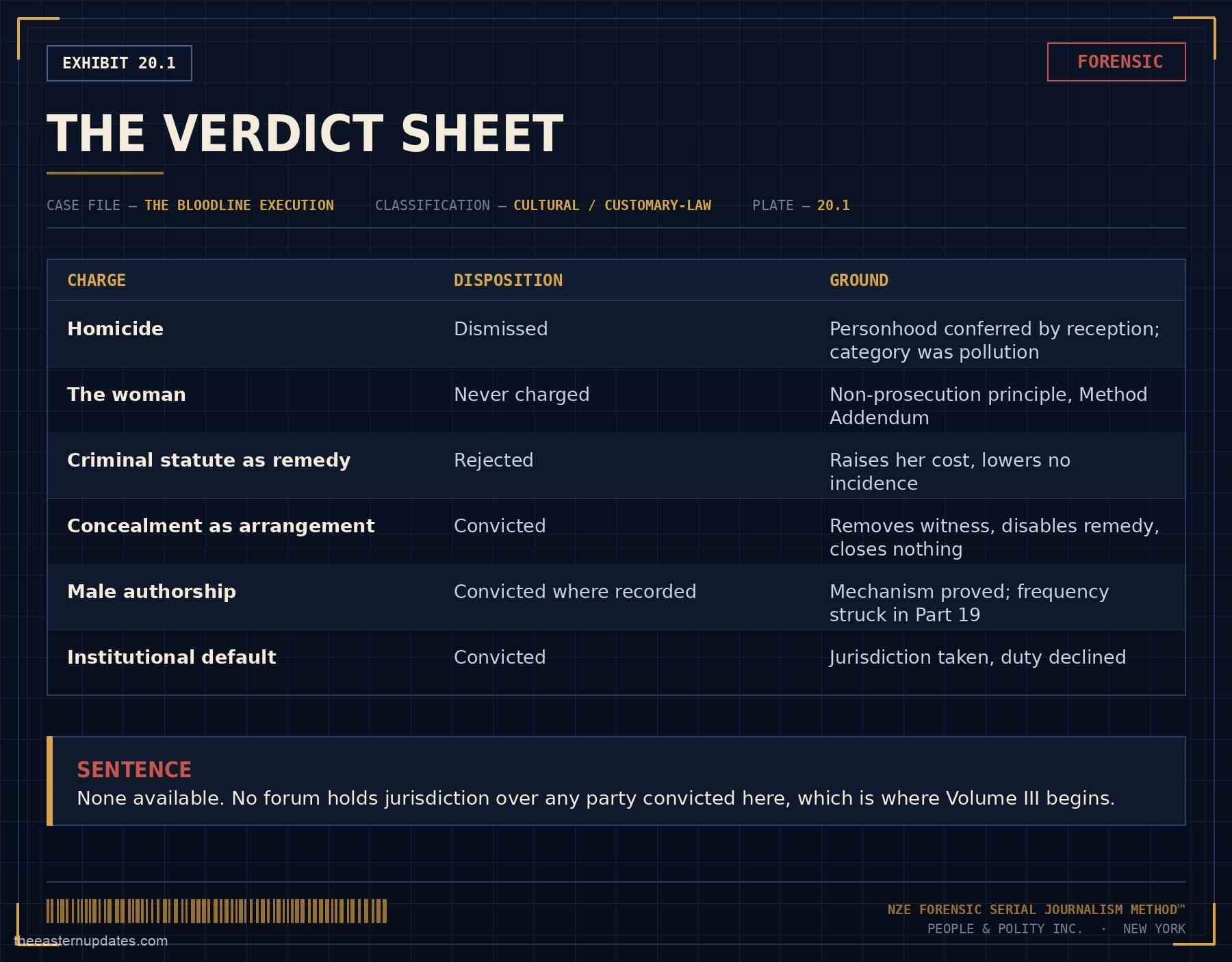
Charges dismissed come first, because a court that will not dismiss is not a court. Homicide is not found. Part 14 established that personhood was conferred by stages through reception and naming, carried in the name itself and in the act of speaking it before witnesses (Uchendu, 1965; Onukawa, 2000), and Part 15 established that the customary category was pollution of the earth and breach of lineage duty. No African warrant exists in this record for treating a severance as murder, and this series will not manufacture one.
Read also: The Bloodline Execution — Part 19
Prosecution of the woman is refused. She was never charged in these pages and is not charged now. Every account gathered in Part 19 that describes a decision taken freely stands as given (Bledsoe et al., 1998; Agbasiere, 2000), and the volume records that its own framework fails to reach several of those decisions at all.
Criminal statute as remedy is rejected, on evidence entered in Part 12 and confirmed in Part 18. Restriction moves the event later, further from care, and deeper into unaccountable hands. Anyone citing this volume in support of prosecution is citing it against its findings.
Convictions follow, and they are specific. Concealment is convicted as an arrangement rather than as a state of mind. It strips out every witness, disables every remedy custom possessed, and terminates nothing, so that an injury opened in silence stays open across decades. Part 15 supplied the sharpest version: a wrong nobody may name is a wrong nobody may close.
Male authorship is convicted where the record supports it, and only there. Recognition withheld, exposure held in reserve, money moved without trace, and a house deliberately never prepared amount to conditions written by one party and read by another. Part 19 removed the volume’s implied claim about how often this occurs. Mechanism stands; frequency was never proved and is not asserted.
Complicity is convicted alongside authorship, and the colonial retirement of the customary forum is part of how it became costless (Meek, 1937). Kin who knew and stayed silent, peers who supplied a contact or an alibi, and a supply economy that monetizes the absence of a witness each appear in the file, and Volume I’s village would have shamed all of them.
Read also: The Bloodline Execution — Part 18
Institutional default is convicted last and most broadly. Church, clinic, and statute each took jurisdiction and declined the duty attached, and not one of the three retains any mechanism for closing a matter (Agadjanian, 2020; Chae & Agadjanian, 2022). Part 16 measured what was lost when the remedy departed with the jurisdiction, and Part 18 established that nothing replaced it.
Nne ewu na-ata agbara, nwa ya na-ele ya anya n’ọnụ. Watching the mouth that feeds them is how the young learn what is permitted, and the verdict of this volume is legible to every young man who has seen a pregnancy disappear without a single institution asking him a question. Custom taught by summons. Present arrangements teach by silence, and the lesson is transmitting perfectly.
Proof and assertion should be separated explicitly before any verdict is entered, since a summation that blurs them is advocacy. Proved on this record: that concealment removes witnesses and disables remedy; that custom classed the wrong as pollution rather than homicide; that enforcement fell asymmetrically on women; that a mechanism for closing a matter existed and no longer does; and that three successor institutions took jurisdiction without duty. Asserted but not proved: how frequently male authorship operates, which Part 19 struck; what proportion of severances are concealed rather than known to kin; and what any of this costs a woman across a lifetime, which no study in this literature measures. Each unproved claim is marked as such in its own installment.
Appeal is invited on stated grounds, which is the difference between a finding and a pronouncement. Evidence that would overturn this verdict is specifiable in advance. Localities where the customary category attached to conduct rather than to the land would unsettle Part 15. Cases in which a forum was convened and did summon the man would unsettle Parts 13 and 18. Testimony establishing that concealment routinely operates at a woman’s own initiative, against kin who were willing to receive the child, would unsettle the central conviction. None of that has appeared in the reporting to date, and its absence is reported as absence rather than as proof.
Form of this verdict repeats Volume I’s Part 10 deliberately. That installment placed polygyny before its accusers, granted the accusers their strongest case, cross-examined them in turn, and returned a finding that sorted the institution rather than acquitting or condemning it wholesale. Part 20 sorts as well. Custom is not vindicated here; its enforcement is convicted in Part 15 and its rites are priced in Part 16. Modernity is not condemned wholesale; clinical medicine and congregational charity are credited with what they do. Sorting, rather than sentencing, is what a forensic series is for.
Sentence cannot be pronounced, and admitting so is the most important sentence in Part 20. No forum exists with jurisdiction over the parties convicted here. Customary courts no longer convene on the matter, statute reaches only the woman, churches address only the penitent, and clinics address only the outcome. A volume that has spent ten parts assembling a case must now record that there is nowhere to file it.
Readers inherit the remaining work, and saying so is not a rhetorical flourish. Every finding in these ten parts was built from material a reader can obtain: land records, school fee receipts, burial testimony, congregational practice, court files, clinical aggregates, and the accounts of people who were present. Nothing rests on privileged access or on the author’s authority. Anyone who reconstructs a single household to the standard set in these field protocols can confirm the verdict, amend it, or overturn it, and a series that could not be checked in that way would have no business calling itself forensic.
Absence of a forum is not a technicality and should not be read as one. Volume I’s whole argument was that institutions survive on the strength of their machinery rather than on the sincerity of the people inside them, and machinery includes somewhere to bring a complaint. Custom had that, unevenly and unfairly, and Parts 15 through 17 documented both the unevenness and the fact of it. Present arrangements have distributed the pieces so widely that a woman with a grievance against the man who authored her decision can approach a court that will not hear her, a church that will address her conduct rather than his, and a clinic with no interest in either. Nowhere to file is the finding.
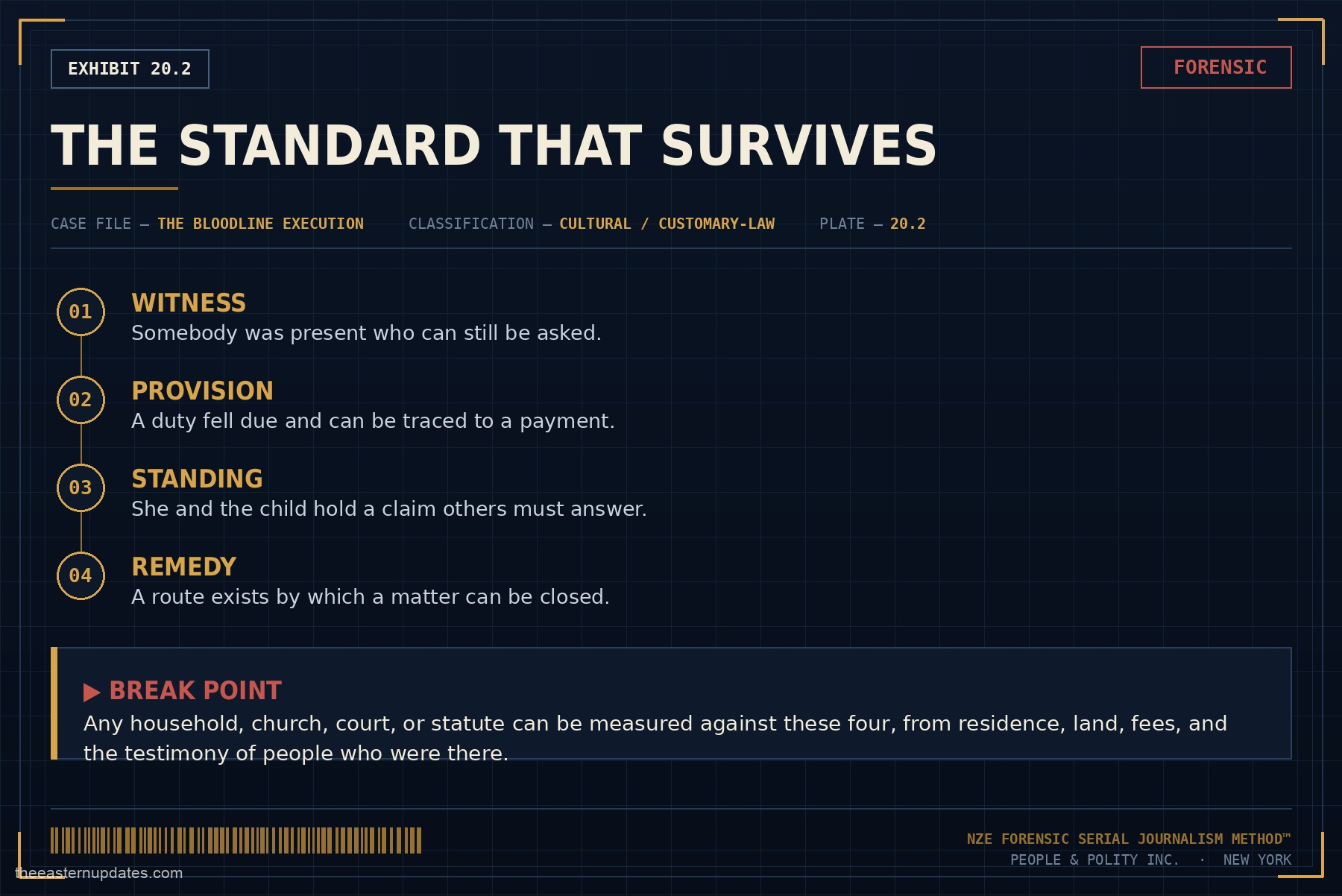
Standard survives, however, and it is what Volume II leaves behind. Witness, provision, standing, remedy: any household, church, court, or statute can be measured against those four, and each is checkable from residence, land, fees, records, and the testimony of people who were present. Volume I built the floor. Volume II tried what happens when the floor gives way. Volume III asks what can be built where it stood, and it opens with the question this part cannot answer: if no forum exists, what would one have to look like?
Field Protocol
No fieldwork attaches to this installment. Summation draws on the assembled file and introduces no material that has not already been reported, cross-examined, and docketed in an earlier part, which is the condition under which a verdict here can be checked against the evidence that produced it.
Evidence Docket
Seven authorities drawn from the spine of the volume. No new material is introduced at summation, and each is cited above at the point where its finding is restated.
Full bibliographic entries are not repeated here. Every source cited above is compiled once, in APA 7 form and alphabetically by author, in the Standing Record at the close of this volume and in the reference section of the PDF edition, each entry carrying a note of the parts that cited it and of the setting in which its fieldwork was conducted.