



















|
Listen to article
|
The Girl Restored
Dignity, Schooling, Protection, and a Future Not Defined by the Worst Pressure Put on Her
Forensic classification: Social and public-health record; documentary analysis; customary-law context.
The whole trilogy has been arranged around a person who has, until now, mostly been spoken about rather than to. The girl at the center of this series — pregnant, abandoned, pressed toward a secret — has been blamed most and helped least by every order this series has examined. Part 27 insists that the road home ends with her, and with her standing. A restoration that repaired the man, the kin, the clinic, and the rite but left the girl marked for life would be the final counterfeit, and this series has spent three volumes refusing counterfeits.
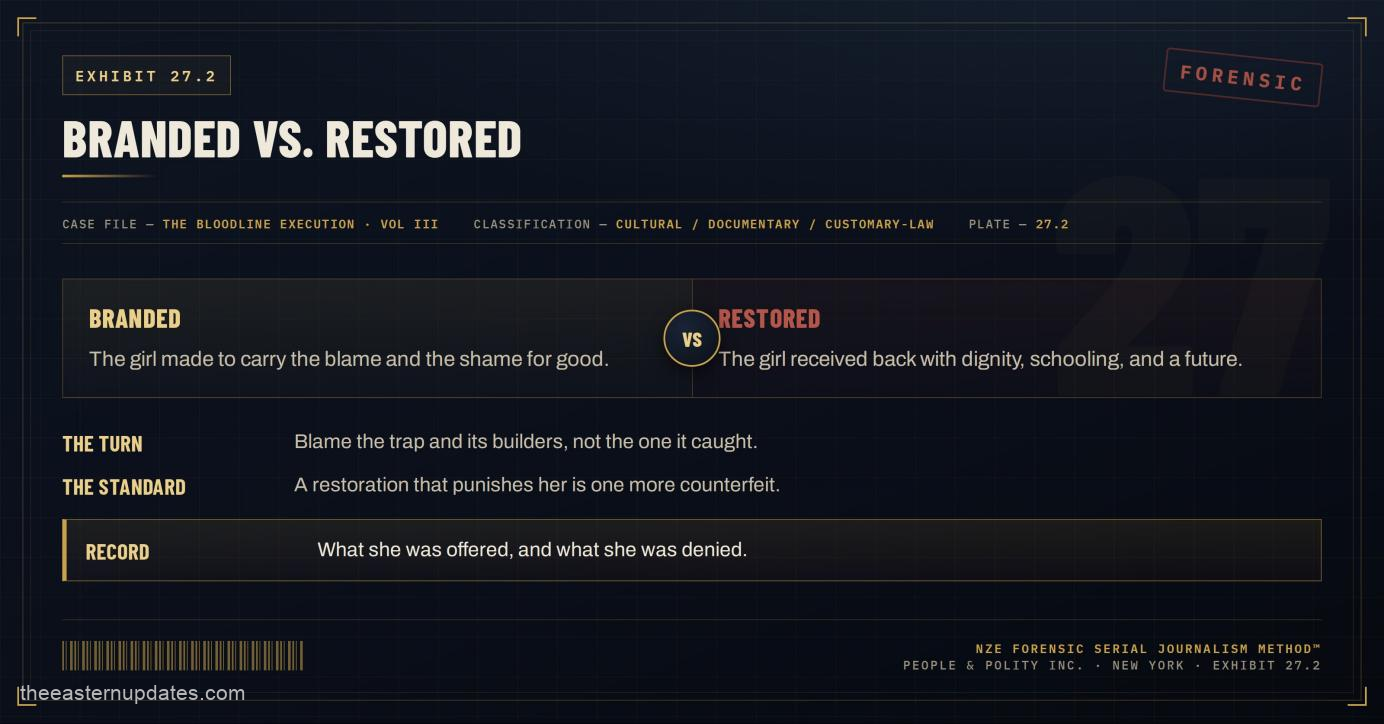
Begin with the brand, because it is the injury the restoration most has to undo. Abortion stigma, and the broader stigma of the unmarried or abandoned pregnancy, arrives as a social production rather than a natural fact, built on ideals of womanhood the pregnant girl is held to have betrayed, and it does concrete harm — driving concealment, delaying care, and marking a woman as diminished in her own eyes and her community’s (Kumar, Hessini, & Mitchell, 2009). The brand is the mechanism by which a single hard passage in a young life is turned into a permanent identity. The restoration’s first task is to break that mechanism: to insist, in the community’s judgment and in the woman’s own, that what happened to her is something she passed through, not something she now is.
Read also: The Bloodline Execution — Part 26
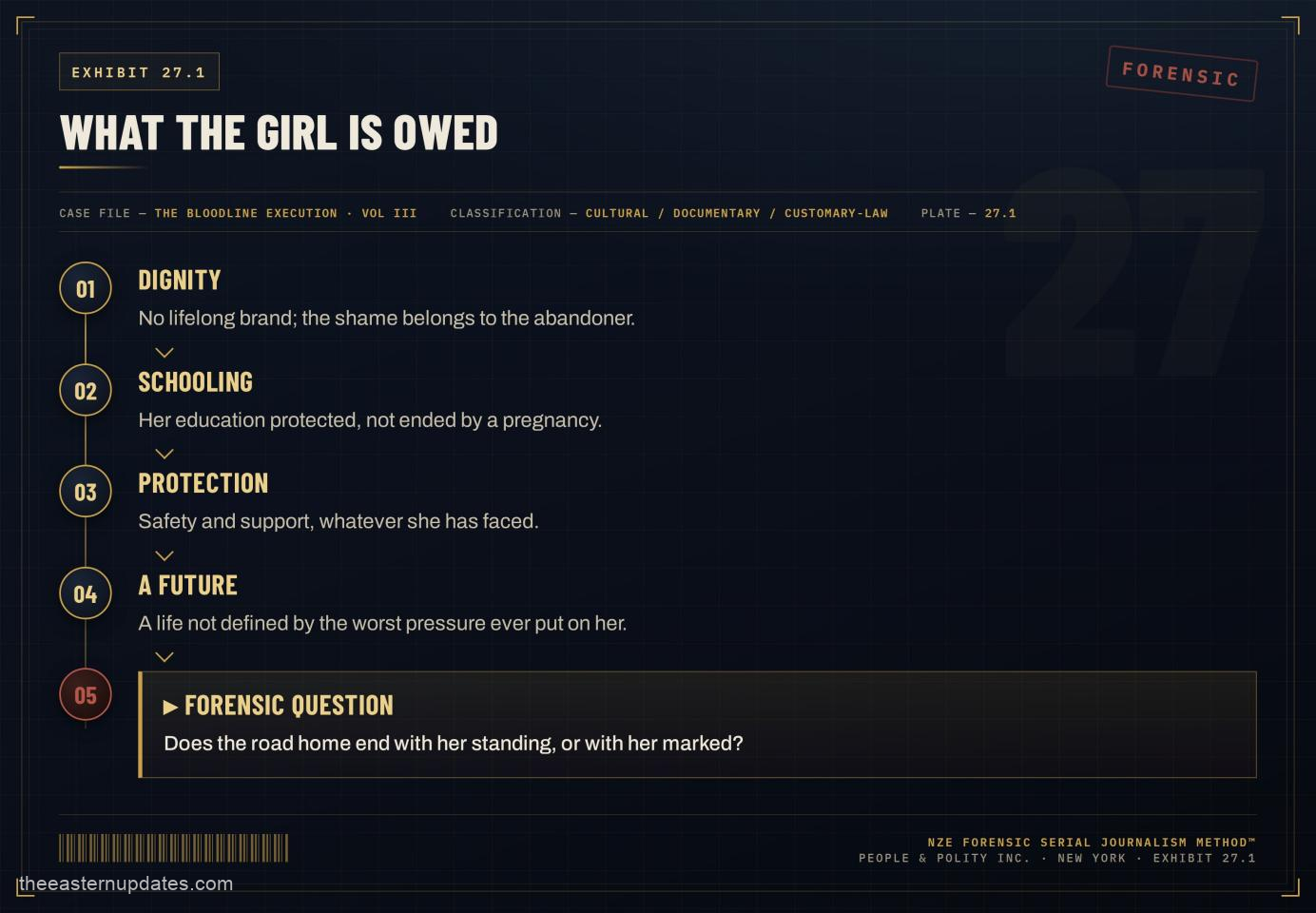
From there the restoration is concrete. Her schooling is protected, because the ending of a girl’s education is one of the most common and least necessary consequences of a pregnancy, and one of the most destructive — a lifelong penalty imposed for a passing crisis. Her safety is secured, whatever she has faced, including the cases the rights frame rightly names — rape, incest, coercion — in which the pressure on her was violence and the last thing she is owed is blame (Ngwena, 2010). And her future is treated as open: a life not defined by the worst pressure ever placed on her, nor foreclosed by a community’s verdict on a single event. The measure is simple and demanding — does the road home end with her standing, or with her marked?
None of this excuses the wrong or denies its weight; it locates the blame accurately. The restoration does not tell the girl that nothing happened or that nothing matters. It tells her, and tells the community, that the weight of what happened belongs first to the man who abandoned her and the structures that closed the doors, and only last, and least, to the girl who was caught in the trap they built (Agbasiere, 2000; Bujo, 1998). To restore her is not to deny the seriousness of the matter but to refuse to let its whole cost be charged to the least powerful party. A community that has learned to aim its judgment correctly — at the abandoner, at the closed door, at the manufactured secret — has already done most of the work of restoring the girl, because it has stopped adding its weight to the pile she was already carrying.
It will be said that this is too soft — that a series so concerned with the claim of the coming child cannot then treat the ending of a pregnancy as a passage to be moved through without lasting mark. The tension is real and the series does not hide it. But there is no contradiction between holding the coming life to be a claimant and holding the frightened girl to be a person owed restoration rather than a lifelong brand; the two are held together by placing the debt where it belongs. The man who is made to answer, the community that is made to carry, the care that is made to reach her — these honor the coming child far more than the branding of its mother ever could, and they leave the girl a future rather than a sentence. To honor the child and restore the mother is not a compromise between the two. It is the only way to do either honestly.
Read also: The Bloodline Execution — Part 25
Part 27 is built from the record on stigma, dignity, and the social consequences of the abandoned pregnancy, cited in the docket, and from the testimony — gathered with care and without exposure — of the women the series has kept at its center throughout. The forensic question is the plainest in the volume and the one it most wants answered with a yes: does the road home end with her standing? Everything the restoration builds is, in the end, for that.
Forensic Diagram Set
Evidence Docket
THE STANDING RECORD
Each claim advanced in this installment rests on a seven-source record held on file and verified for authorship, place of publication, and identifier. In keeping with the practice of this series, those records are not printed part by part. The consolidated Evidence Docket — the complete Standing Record for every installment of every volume, set out in full APA form — will be published at the close of the entire publication, so that the reader may weigh the whole file at once rather than a fragment at a time. Sources are named inline throughout, and any reader may test a claim against them before that docket appears.
Full bibliographic entries are not repeated here. Every source cited above is compiled once, in APA 7 form and alphabetically by author, in the Standing Record at the close of this volume and in the reference section of the PDF edition, each entry carrying a note of the parts that cited it and of the setting in which its fieldwork was conducted.