


















|
Listen to article
|
The Restoration Tested
The Program Put on Its Own Trial, and Held to the Evidence It Demands of Others
Forensic classification: Documentary synthesis; method self-audit; customary-law and public-health context.
A series that has cross-examined everyone else owes the same discipline to itself, and Part 29 supplies it. The restoration set out across this volume is a program of claims, and claims are cheap; the forensic method that judged the traditionalists and the reformers must now judge the author. Part 29 puts the restoration on trial, states the strongest objections to it at full strength, and answers them on the evidence — or concedes where it cannot. A remedy that cannot survive its own cross-examination has no business asking anyone to adopt it.
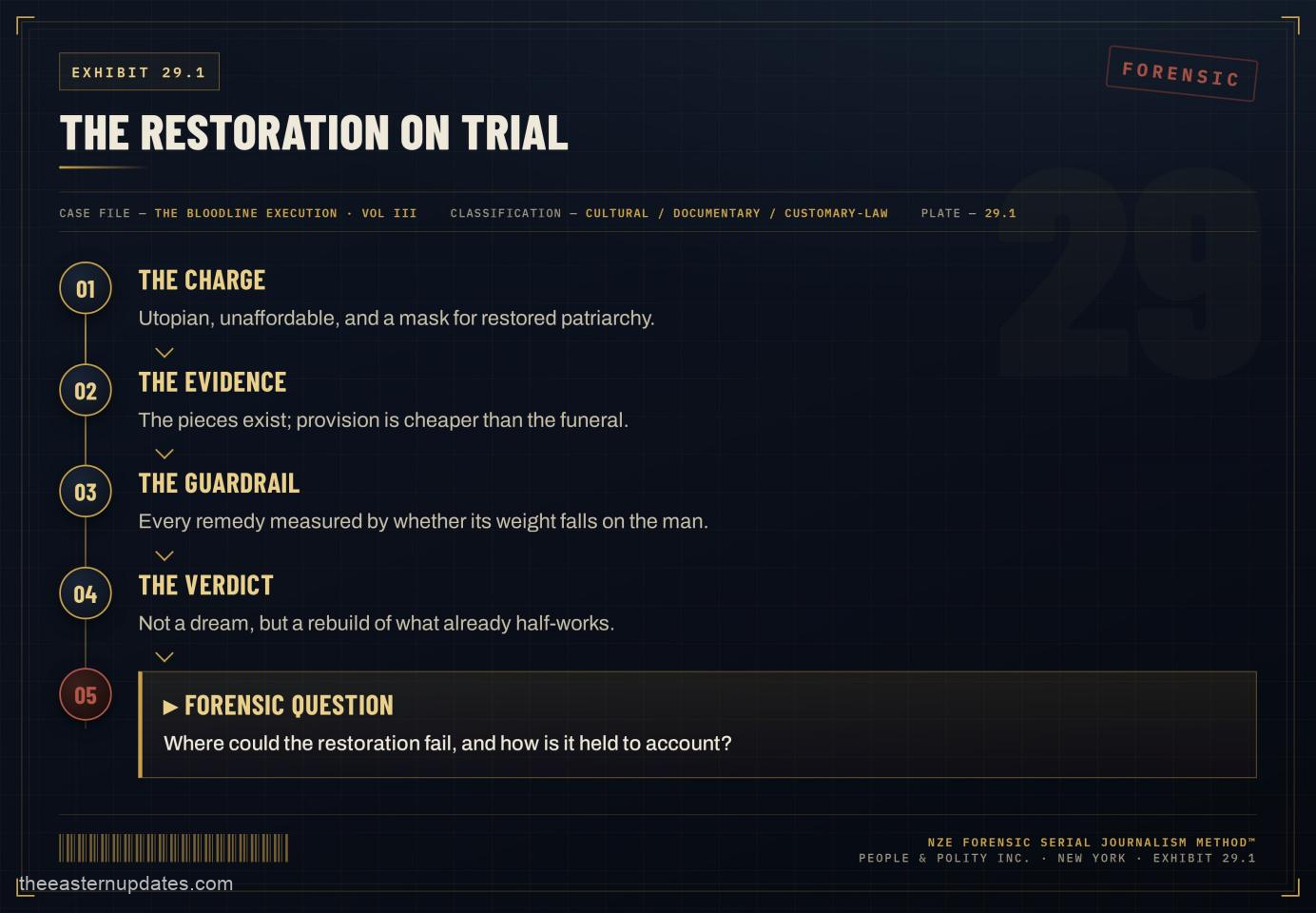
The first charge is that the restoration is utopian — a dream of rebuilt kin nets and accountable men with no purchase on a poor, fast-changing society. The answer is that the restoration asks for less invention than it appears. Its pieces already exist: extended families that take in daughters, congregations that shelter the poor, cooperatives that pool cost, and clinics that provide care where they are funded (Bujo, 1998; Mbiti, 1969). The task is to weave and to aim what is already present, not to conjure a new order from nothing. Its most measurable pieces are documented interventions rather than dreams: family planning and post-abortion care rank among the most cost-effective health investments known, and male-involvement programs, done with care, improve outcomes for women and children (Sully et al., 2020; Sternberg & Hubley, 2004). The restoration is ambitious, but it is built from parts that already work.
A second charge calls the program unaffordable. The answer is that the society already pays, and pays more, for not doing it. Catching a woman before she falls, through contraception, antenatal care, and support, costs less by every measure than the fall itself: the emergency ward, the near-miss, the funeral, the orphaned child (Sully et al., 2020). The claim of impossibility is usually a claim about priorities dressed as a claim about means; a society that funds much else can fund this, and much of the net — kin who carry, congregations that shelter — costs arrangement more than money. Unaffordability is the objection of a society that has decided the women are not worth the price, and that decision, not the arithmetic, is what Part 29 contests.
Read also: The Bloodline Execution — Part 28
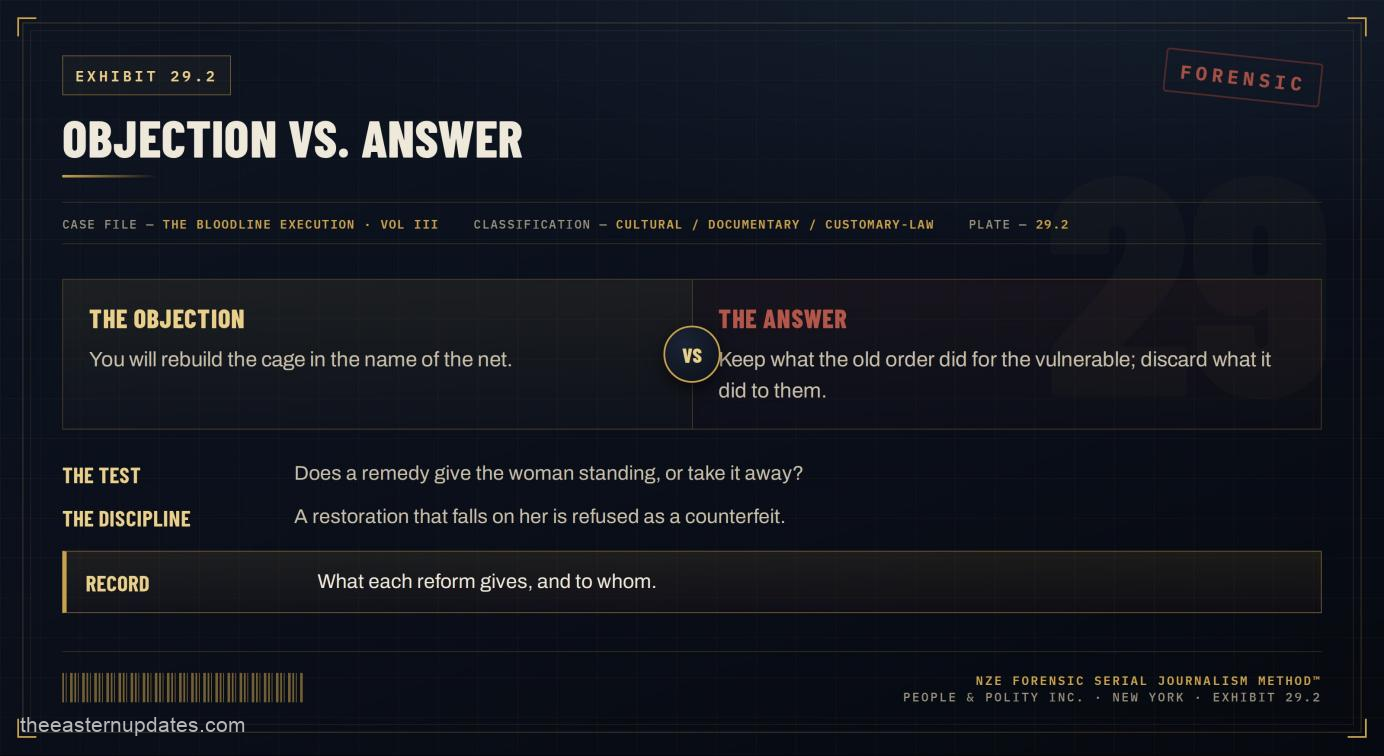
Gravest of the three, and treated as such throughout this series, is the charge that a program recovering customary structures will smuggle back the patriarchy those structures carried — that to make a man accountable is to hand him power, and to recover cleansing is to re-brand the woman. The answer is the guardrail the protocol set and every part has enforced: each remedy is measured by where its weight falls, and any remedy that lands on the woman while sparing the man is refused as a counterfeit, however traditional its dress. Accountability that gives the woman standing is restoration; accountability that gives the man dominion is the cage. That distinction works as the operating test of the whole volume rather than as a hope, and Part 29 makes it explicit so that the restoration can be held to it — by its readers, and by the women whose experience is the final court (Kumar, Hessini, & Mitchell, 2009; Bledsoe et al., 1998).
Read also: The Bloodline Execution — Part 27
Honesty requires naming where the restoration could fail, because a program that admits no failure mode is propaganda. It could fail if male accountability is enforced as control rather than provision — if the courthouse becomes a new instrument of a man’s power over a woman rather than of his duty to a child. It could fail if the community’s shame is turned only halfway, landing on the man in theory while still falling on the woman in practice. It could fail if cleansing is recovered as ritual and not as return, marking the girl in a sacred idiom the modern brand had abandoned. Each of these is a real risk, and each is guarded against by the same measure: watch where the weight falls, and refuse every version that falls on her. Nothing here amounts to a guarantee. What the restoration offers is a direction with a test attached, and Part 29’s task is to keep that test in the reader’s hand.
Forensic Diagram Set
Evidence Docket
THE STANDING RECORD
Each claim advanced in this installment rests on a seven-source record held on file and verified for authorship, place of publication, and identifier. In keeping with the practice of this series, those records are not printed part by part. The consolidated Evidence Docket — the complete Standing Record for every installment of every volume, set out in full APA form — will be published at the close of the entire publication, so that the reader may weigh the whole file at once rather than a fragment at a time. Sources are named inline throughout, and any reader may test a claim against them before that docket appears.
Full bibliographic entries are not repeated here. Every source cited above is compiled once, in APA 7 form and alphabetically by author, in the Standing Record at the close of this volume and in the reference section of the PDF edition, each entry carrying a note of the parts that cited it and of the setting in which its fieldwork was conducted.