


















|
Listen to article
|
The File Closed, the Work Continued
The Trilogy on the Record, and the Method That Carries On
Forensic classification: Documentary synthesis; method statement; series capstone.
Three volumes ago this series set out to treat the African womb the way a court treats a matter it refuses to let slip away — not as a story told once and forgotten, but as a file built until the record could survive denial. Part 30 closes that file. It gathers the trilogy into a single account, asks whether the standard has been met, and marks the ground on which the method’s next work will stand. A file closed does not mean a subject exhausted. It means a record made firm enough that the next argument must begin from it.
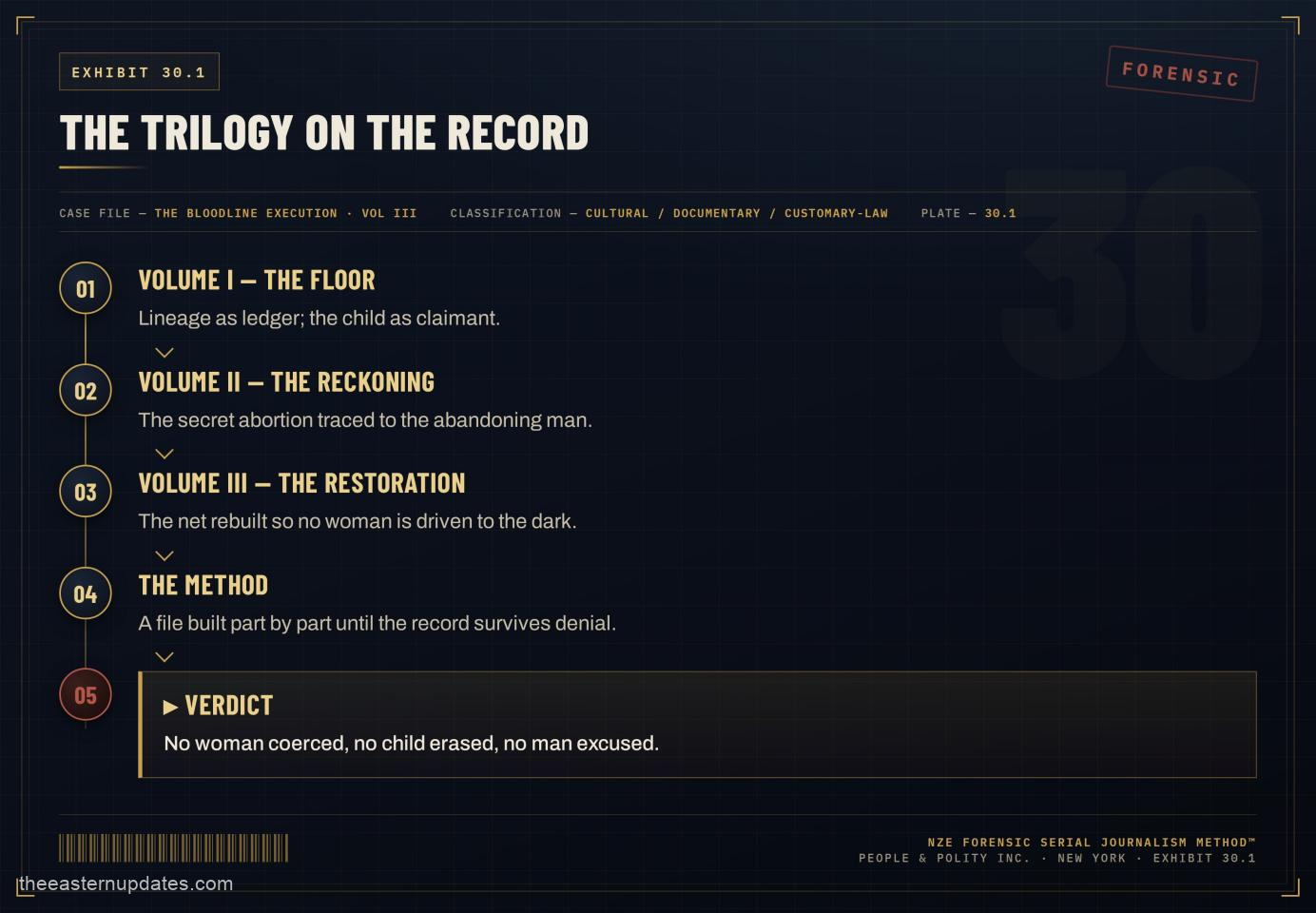
Set end to end, the three volumes make one argument. Volume I built the floor: it showed that African lineage was a working ledger and the child a claimant with a place before birth, and it defended the ordered compound while convicting the counterfeit that borrowed its name (Uchendu, 1965; Radcliffe-Brown & Forde, 1950). Volume II held the reckoning: it traced the secret abortion back through concealment and abandonment to the man who fathered the pregnancy and would not own it, measured the danger the secrecy produces, recovered the culture’s own account of the wound and the way back, cross-examined the accusers, and presented the bill (Bankole et al., 2015; Ikenga-Metuh, 1981). Volume III collected the bill: it rebuilt the man’s accountability, the provision, the kin net, the safe care, the cleansing, the girl’s standing, and the law, and then put its own program on trial (Bujo, 1998; Ganatra et al., 2017). Floor, reckoning, restoration: the three stand as one structure, and each was built to bear the weight of the next.
Whether the standard has been met is for the reader and the record to judge, but the shape of the claim is plain. Every load-bearing assertion in the trilogy is tied to a source a hostile reader can check; the strongest objection to each argument was stated at full strength and answered or conceded; the medical claims came only from the peer-reviewed and institutional record and were never inflated to frighten; the ritual material was carried as documented belief; and the whole was measured, part by part, by a single test — no woman coerced, no child erased, no man excused. A record built that way does not settle every dispute, and it does not pretend to. It does something narrower and more durable: it fixes the facts firmly enough that the argument can no longer be conducted as if they were not there (Mbiti, 1969).
Read also: The Bloodline Execution — Part 29
One last thing deserves saying at the close, because the refusals are the measure of the work. These three volumes refused to be a sermon: they honored the coming child without erasing the woman, and named the man the whole debate is arranged to hide. They refused to be a weapon against the frightened: where they reported the medical danger, they aimed it at the concealment and the men who manufacture it, never at the girl who suffers it, and they instructed no one in harm. And they refused the two counterfeits the wider argument keeps offering, the coercion that jails her and the abandonment that leaves her, in favor of the harder third thing, the restoration that spares her and the child both. A forensic series is known by what it will not do, and this one would not do those.
Read also: The Bloodline Execution — Part 28
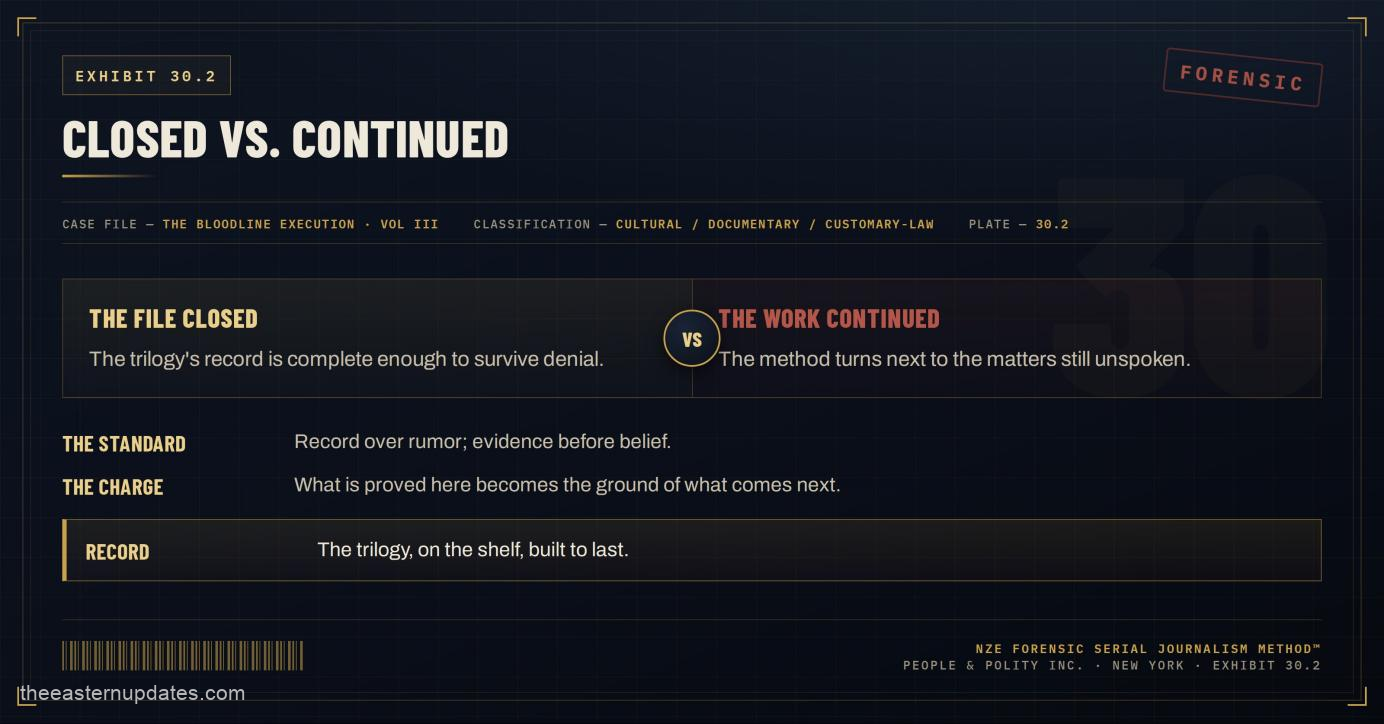
The file closes; the work does not. The method that built these three volumes was never about a single subject; it is a discipline for any matter a society would rather forget — build the file part by part, tie each claim to evidence, state the strongest objection and answer it, and refuse to let the record be quietly edited away. The wider series that these volumes belong to continues on that discipline, and the subjects that await it are many. What has been proved here — that the womb can be spoken of as a record rather than a slogan, that the man can be named, that mercy and evidence can share a page — becomes the ground on which the next file is built. Record over rumor, evidence before belief: the trilogy ends, and the method goes on.
Part 30 introduces no evidence the earlier volumes did not establish; its docket gathers the sources on which the whole trilogy rests. The forensic question it leaves is not for the author but for the reader who has come this far: now that the record stands, what will be built on it — and what, next, will be refused the comfort of being forgotten?
Forensic Diagram Set
Evidence Docket
THE STANDING RECORD
Each claim advanced in this installment rests on a seven-source record held on file and verified for authorship, place of publication, and identifier. In keeping with the practice of this series, those records are not printed part by part. The consolidated Evidence Docket — the complete Standing Record for every installment of every volume, set out in full APA form — will be published at the close of the entire publication, so that the reader may weigh the whole file at once rather than a fragment at a time. Sources are named inline throughout, and any reader may test a claim against them before that docket appears.
Full bibliographic entries are not repeated here. Every source cited above is compiled once, in APA 7 form and alphabetically by author, in the Standing Record at the close of this volume and in the reference section of the PDF edition, each entry carrying a note of the parts that cited it and of the setting in which its fieldwork was conducted.