












|
Listen to article
|
Nigeria’s Peoples Democratic Party entered what several of its founding members privately described as the most dangerous phase of its 27-year existence on Sunday, as Governor Bala Mohammed of Bauchi State confirmed plans to defect to the ruling All Progressives Congress on Monday, state congresses conducted by the Wike-aligned national caretaker committee descended into violence in two states, and a senior founding member of the party publicly urged its members to accept a leadership structure they had spent months contesting.
Mohammed’s defection, confirmed through party sources and reported by ThisDay, followed direct meetings with President Bola Tinubu and the APC national leadership. Sources said Mohammed was offered a Senate ticket as the principal concession in exchange for bringing his political structure into the ruling party, but was not granted the right to nominate his successor as Bauchi governor, a condition Tinubu reportedly refused, insisting that the APC’s structure in Bauchi would be managed by the party rather than any individual. Mohammed’s departure would leave Oyo State Governor Seyi Makinde as the PDP’s sole remaining governor, reducing the party’s executive branch presence to a single state for the first time since it lost the federal government in 2015.
The weekend’s state congresses, organized across multiple states by the Mohammed Abdulrahman-led National Caretaker Committee loyal to FCT Minister Nyesom Wike, produced new state executives in Oyo, Kano, Borno, and Ekiti — but also produced a violent collapse in Taraba State and an active petition in Anambra over alleged process manipulation.
In Oyo State, Professor Abdulrahman Akinoso of the University of Ibadan’s Department of Food Technology emerged as state chairman, elected alongside 38 executive members during a congress held at the Obafemi Awolowo Stadium. In Kano, the 36-member state executive was installed through delegates’ consensus. In Borno, Abbas Aliyu was sworn in as state chairman alongside 34 executive members at a congress held in Maiduguri and monitored by INEC officials. In Ekiti, Lanre Omolase — an ally of former Governor Ayodele Fayose — was elected chairman, with Tunde Ogunleye as secretary.
The Taraba congress collapsed into disorder. The exercise began peacefully before one member of the congress committee declared Victor Falack the consensus candidate for state chairman, immediately prompting a second committee member to contradict the announcement and declare Ibrahim Sale the winner on the grounds that Falack had been serving only as a 30-day caretaker. Sale and his executives were sworn in on the spot. Falack’s supporters confronted the congress committee chairman, the confrontation escalated, and police officers eventually removed the congress chairman from the venue in a patrol van to prevent further violence.
In Anambra, chieftain Amaechi Onowu petitioned Wike directly over what he described as the hijacking of the state congress process. Speaking at a press conference in Abuja, Onowu said the chairmanship position had been zoned to the Anambra Central Senatorial District — his own district — but that unnamed individuals had taken control of congress forms in a manner that excluded qualified aspirants from participating. The Ondo State PDP chapter separately condemned what it described as an unconstitutional attempt to dissolve its State Executive Committee, calling the move a “political coup” and asserting that the state leadership remained legally in place.
Read Also: Oyetola Defends Tinubu Endorsement, PDP Lawmakers Cross To APC
The congresses themselves are contentious beyond the state-level incidents. The Seyi Makinde-aligned faction of the party, led by figures including the convener of the Seyi Makinde Disciples political group, maintained that the Wike-backed caretaker committee has no constitutional legitimacy and that an appellate court had upheld the suspension of three principal officers linked to the Wike structure, including National Secretary Samuel Nwanyanwu. That faction has argued that any congresses conducted under the caretaker committee’s authority are legally void and subject to court challenge — a position that could produce parallel state executives in multiple states for months ahead of the 2027 election cycle.
The Wike camp set out two non-negotiable conditions ahead of Monday’s reconciliation talks between the two PDP factions. Its National Publicity Secretary, Haruna Mohammed, told ThisDay that the March 29 national convention must proceed as scheduled, and that the formation of any alternative caretaker structure under any name would not be accepted.
“We are open for reconciliation but we have conditions that are non-negotiable,” Mohammed said, adding that each delegation to Monday’s talks had been asked to arrive with written terms to avoid misquotation.
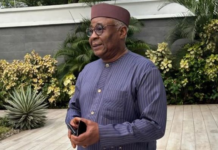
It was against this backdrop that former Jigawa State Governor Sule Lamido spoke at a Ramadan Iftar gathering in his hometown of Bamaina on Saturday — an appeal that, given the timing, read as a last-ditch attempt by a founding PDP figure to arrest the collapse before it became irreversible. Lamido described Wike as “really, really clever,” explaining that the minister had recognized the leadership vacuum created when the NWC’s tenure expired and positioned his caretaker committee as the only functional structure in place when that expiry occurred. Despite personal disagreements many members might harbor toward Wike, Lamido said, the party had no viable alternative but to work through the caretaker structure. “Even though many of us may not like him or we are fighting him politically, we must invite him in the spirit of Nigeria, in the spirit of brotherhood and PDP unity, and in the spirit of reconciliation,” Lamido said. “The PDP is a collective institution. It made many of us who we are today. Therefore, we must give back to the party by ensuring its survival and preserving its legacy.”
Read Also: Main Reason I Dumped PDP For APC – Zamfara Gov, Dauda Lawal
The scale of the party’s deterioration since the 2023 elections is visible in the numerical record. The PDP held 17 of Nigeria’s 36 governorships in 2019. It now holds one. It was the leading opposition party in the Senate as recently as January. Following last week’s wave of defections to the APC and the African Democratic Congress, it no longer holds that distinction. The party that governed Nigeria for sixteen uninterrupted years from 1999 to 2015 is now competing for organizational survival rather than electoral dominance.
Monday’s reconciliation talks between the Turaki and Wike factions, if they proceed, will determine whether the party can reach even a procedural agreement on a path to the March 29 convention. No independent mediator or neutral venue has been publicly announced for the talks.