
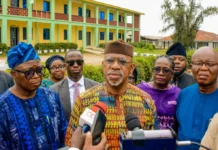
















Secretary to the Government of the Federation George Akume said Wednesday that Northern politicians should not seek the presidency before the South finishes its current eight-year run, less than three months before Nigeria votes for a president on Jan. 16.
Akume spoke while receiving a delegation from the Order of the Knights of St. Mulumba, led by its Supreme Knight, Sir Steve Adehi, according to a statement from his information head, Chris Ugwuegbulam. He called the North-South rotation of power a fundamental understanding that has sustained national cohesion, fairness and democratic growth since the return to civilian rule in 1999.
His account of its origins is specific. Akume said the arrangement was reached in Kaduna in 1999 after extensive consultations between governors-elect of the Peoples Democratic Party and prominent political leaders. They agreed that presidential power would alternate between North and South in eight-year cycles, starting with the South, to promote balance, build trust and protect the country’s territorial integrity. In his telling, the concern behind the deal was growing dissatisfaction over power concentrated in one part of the country.
He applied that logic to the current race. Akume said that after Muhammadu Buhari’s eight years, a Southerner’s tenure should be respected, and he frowned on attempts by Northern aspirants to contest before the South’s term ends. He called the principle an important political understanding rather than a temporary convenience.
The remarks land in a campaign that is already formally set. INEC published its final list of 18 presidential candidates on Sept. 12. President Bola Tinubu, a Southerner from the All Progressives Congress, is seeking a second term. Former Vice President Atiku Abubakar, 79, is running on the African Democratic Congress ticket with former Rivers State Governor Rotimi Amaechi as his running mate. Peter Obi is the candidate of the Nigeria Democratic Congress, which is aligned with Rabiu Kwankwaso. Governorship and state assembly elections follow on Feb. 6. In 2023, Tinubu won with 8,794,726 votes, ahead of Atiku with 6,984,520 and Obi with 6,101,533, and a published analysis puts roughly 5.5 million of Tinubu’s votes in the 19 northern states.
Read Also: 2027 Election Must Be Won At Ballot, Not In Court – Atiku
The Eastern Update has gathered that Akume has pressed the same point for nearly two years. In December 2024, he told a television audience it was not yet the North’s turn and advised Northern groups to wait until 2031, urging Atiku to abandon any 2027 ambitions. On Oct. 10, at a rally in Lafia, Nasarawa State, where North-Central APC leaders endorsed Tinubu, he said that “anybody from the North who is running for President today is not sincere.” He told the crowd to reject such a candidate.
That position has met resistance from the start. After the December 2024 remarks, the Arewa Consultative Forum said, through spokesman Tukur Muhammad Baba, that debate over the 2027 presidency was premature and a distraction from pressing national problems. Atiku’s spokesman, Paul Ibe, answered with a tally. By 2027, he said, the South would have held the presidency for 17 years, covering Olusegun Obasanjo’s eight, Goodluck Jonathan’s five and Tinubu’s four, against 11 for the North, covering Umaru Musa Yar’Adua’s three and Buhari’s eight. Those figures are the Atiku camp’s, and they treat Tinubu’s term as running through 2027.
Read Also: Benue APC Crisis: Alia, Akume Finally Offer Reconcilatory Terms
The record of the arrangement itself is uneven. Since 1999, Nigeria has been led by Obasanjo of the South-West, then by Yar’Adua of the North-West, who died in office in 2010. Jonathan, from the South-South, took over and won election in 2011. Buhari of the North-West governed from 2015 to 2023, and Tinubu of the South-West took office that year. Rotation is a political convention, not a requirement of the constitution. Sourcing reviewed by The Eastern Update indicates that a former Atiku spokesman, Kassim Afegbua, who now backs Akume’s position, has argued the PDP’s own constitution provides for rotation and accused the party of abandoning it in 2023 by fielding Atiku.
Akume used the same visit to speak about the government’s record. He said its development agenda should be judged against both immediate economic pressures and long-term national needs, and he asked for broader understanding of ongoing reforms and investments. He said sustained cooperation among federal, state and local governments will be essential to improving citizens’ welfare.
He also thanked the Knights of St. Mulumba for charitable work aimed at vulnerable members of society. Nigerians vote for president on Jan. 16, 2027.