


















|
Listen to article
|
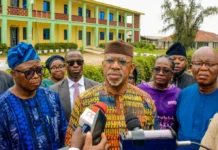
Former Vice President Atiku Abubakar on Tuesday declared that Nigeria’s 2027 general election must be decided at the ballot box, not in the courtroom, following the Court of Appeal’s decision overturning a Federal High Court judgment that sought to remove the African Democratic Congress, ADC, and other political parties from Nigeria’s democratic space.
The ruling removes the legal obstacles facing the ADC’s leadership, allowing the party to focus on the 2027 general election instead of fighting battles in court.
In a statement issued by his media office in Abuja, Atiku congratulated the Justices of the Court of Appeal for what he described as their courage, fidelity to the Constitution and unwavering commitment to justice, saying the judgment had reinforced public confidence in the judiciary and strengthened constitutional democracy.
Read Also: Pressure Mounts On House To Summon Gbajabiamila Over Agency
“As the nation advances towards the 2027 general elections, political contests must be decided by the votes of Nigerians—not by contrived lawsuits seeking to achieve in the courtroom what cannot be won at the ballot box,” he said.
According to the statement, the appellate court’s ruling, alongside an earlier judgment by Justice Liman of the Federal High Court, Abuja Division, affirming the Senator David Mark-led National Executive Committee of the ADC, has effectively brought to an end all litigation challenging the party’s leadership ahead of the 2027 general election.
It said the development firmly establishes the ADC’s legal standing to participate in the polls.
The statement further noted that the Court of Appeal held that the judgment delivered on June 15 by Justice Lifu was a nullity because it was rendered in disobedience to a subsisting order of the appellate court. It added that the respondents lacked the locus standi to institute the action, describing their claims as speculative and legally unsustainable.
It also said the appellate court clarified that Section 225A of the Constitution should be interpreted disjunctively rather than conjunctively, holding that the suit was premature because the Osun and Ekiti election cycles were still ongoing when the action was filed.
According to Atiku, the appellate court also faulted the trial court for disregarding the uncontroverted affidavit evidence presented by the Independent National Electoral Commission, INEC, confirming that the ADC and the other affected political parties had complied with all constitutional and statutory requirements.
“Having accepted INEC’s evidence, the lower court had no legal basis to manufacture additional conditions in order to arrive at what the Court of Appeal rightly described as a perverse decision,” he added.
Atiku described the judgment as extending far beyond the fortunes of a single political party, saying it represented a victory for constitutional democracy, the rule of law and every Nigerian who believes in free political competition.
“The strength of a democracy lies not in the exclusion of political opponents but in allowing the people to freely determine their leaders through the ballot,” he stated.
He also cautioned against attempts to weaponise the judiciary and other state institutions for political engineering, warning that such actions could erode public confidence in democratic institutions and weaken the country’s constitutional order.
“The judiciary must never be transformed into a battlefield for eliminating political competitors or shrinking the democratic space,” he warned.
Atiku nevertheless expressed appreciation to the Justices of the Court of Appeal for what he described as a courageous, impartial and constitutionally grounded judgment, saying the decision had strengthened public confidence in the administration of justice and reaffirmed the supremacy of the rule of law over political expediency.
The House of Representatives Ad-Hoc Committee investigating Nigeria’s Presidential Foreign Investment Promotion Council ordered the Inspector-General of Police Monday to produce the agency’s alleged promoter, Adeniyi Adeyemi, for questioning Wednesday, even as pressure mounted on the committee to widen its probe by summoning Chief of Staff to the President Femi Gbajabiamila.
Adeyemi, who has been in police custody for more than two weeks, is expected to appear before lawmakers following the committee’s directive to Inspector-General of Police Olatunji Disu. Committee Chairman Yusuf Gagdi, a Plateau lawmaker, said the appearance had become non-negotiable given the scale of the allegations. “This committee clearly needs the suspected DG to appear before this committee. People’s names are involved. People’s integrity are involved. Institutional names are involved. Institutional integrity are involved,” Gagdi said, adding that Adeyemi would be required to confirm certain documents without undermining the ongoing investigation.
The committee’s hearings so far have featured testimony from Head of the Civil Service of the Federation Didi Walson-Jack, Budget Office Director-General Tanimu Yakubu, Central Bank Director of Banking Services Hamisu Abdullahi, Accountant-General of the Federation Shamseldeen Ogunjimi, and Assistant Commissioner of Police Bashir Abdullahi, who represented the Inspector-General.
Representing police at Monday’s hearing, ACP Abdullahi told lawmakers criminal proceedings had already begun against Adeyemi. “The Nigerian Police Force investigated part of this case late last year and filed eight-count charges before a Federal High Court. The case is ongoing,” he said, cautioning the committee against pressing for details that could prejudice the case or subsequent judicial proceedings.
Police confirmed during the hearing that they had received petitions from the Office of the Chief of Staff alleging Adeyemi fraudulently presented himself as Director-General of both the Presidential Economic Advisory Council and the Presidential Foreign Investment Promotion Council. Investigators said Adeyemi used the purported office to secure accommodation within the Federal Secretariat, sought approval to recruit roughly 300 personnel, attempted to obtain a 1.32 billion naira budgetary allocation for the council in the 2026 Appropriation Act, and planned to organize a World Investment Summit under the non-existent agency’s banner.
A comparison of signatures on disputed State House documents against authentic official correspondence formed one of the hearing’s pivotal moments. Asked whether the signatures matched, ACP Abdullahi replied plainly: “They are not the same.” Gagdi said the committee has identified roughly 29 allegedly forged documents, including fake presidential approvals, counterfeit Acts of the National Assembly, and forged correspondence purportedly issued by the State House, the Office of the Head of the Civil Service, the Office of the Secretary to the Government of the Federation, the Ministry of Finance, and other agencies.
Accountant-General Ogunjimi disclosed that his office unknowingly processed requests from the purported council after receiving what appeared to be an authentic State House letter dated November 7, 2024, requesting creation of an administrative code for the Presidential Economic Advisory Council. The Treasury created the code and notified the State House, copying the Office of the Auditor-General for the Federation. Further requests followed, including applications for self-accounting status, personnel deployment, and the opening of Treasury Single Account and domiciliary accounts. Ogunjimi said no public funds were ultimately released to the council, and a separate request for a 27.4 billion naira establishment grant was rejected for lack of budgetary provision. Investigators later determined the original State House letter was forged. “The letter that was received by the Treasury was respectfully addressed as coming from the State House. That letter was never issued by the State House,” Ogunjimi told lawmakers.
Read Also: The Bloodline Execution — Part 16
Despite the scope of testimony gathered, Gbajabiamila has not been invited to testify, a gap that has drawn criticism from multiple quarters. A source close to the committee’s proceedings said that lawmakers failed to press ACP Abdullahi on unresolved threads, including the death of an alleged middleman, Dolapo Tanimola, who Adeyemi reportedly said received 400 million naira meant for the Chief of Staff. Tanimola died in a fire at Kachi Hotel in Utako, Abuja, on October 22, 2025, and the hotel was reportedly demolished by armed individuals days later, before further investigation could occur. The source questioned why the committee did not ask who authorized that demolition.

