




















|
Listen to article
|
The Debt Owed to the Earth
Sacrifice, Restitution, and the Machinery Custom Built for Closing a Breach
Forensic classification: Ritual record; customary-law analysis.
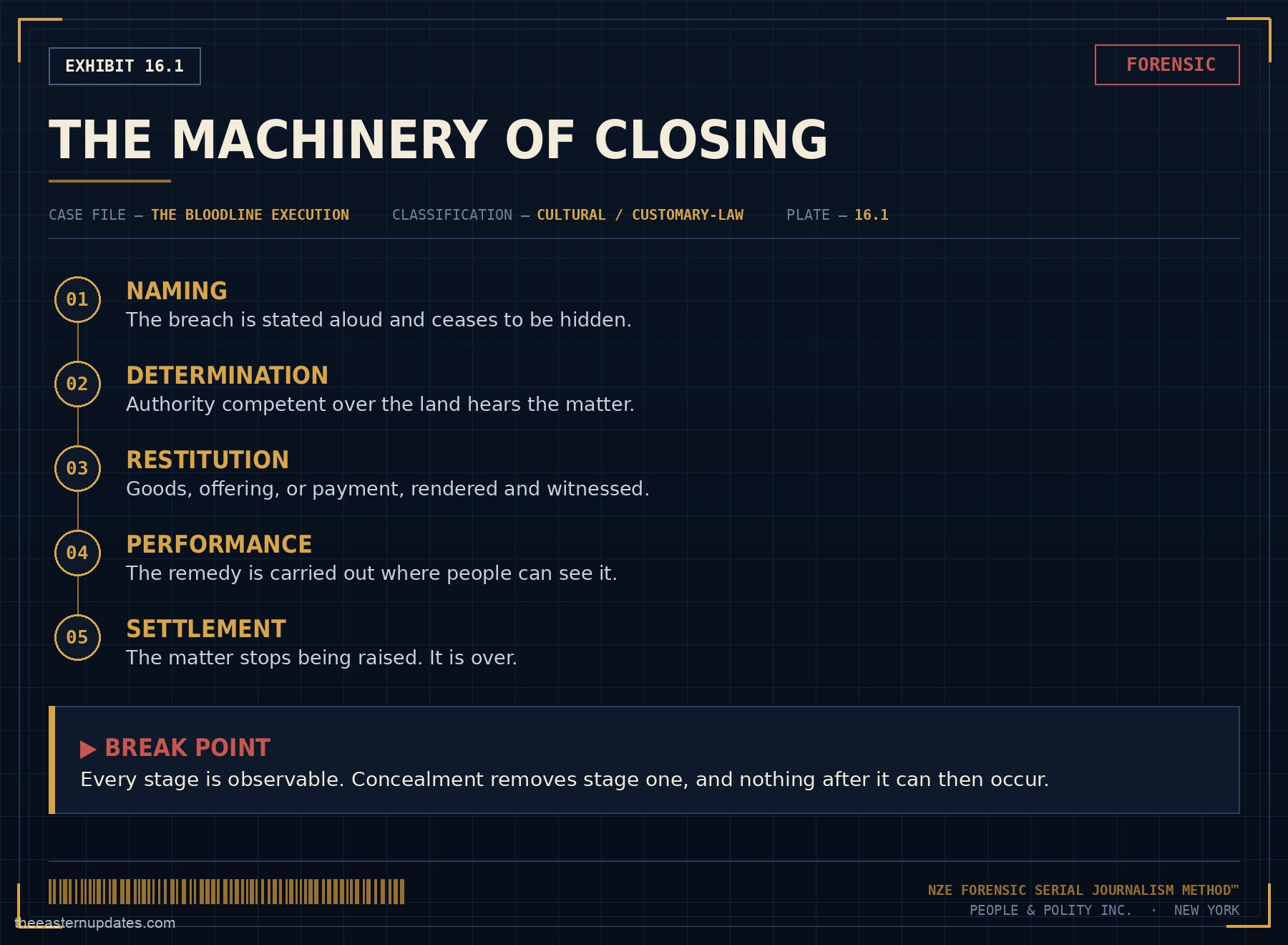
Condemnation was never where the customary system stopped, and this is the feature the modern arrangement most conspicuously lacks. Having classified a wrong as abomination, Igbo practice went on to specify what would settle it: sacrifice, propitiation, restitution offered to the earth and to the lineage, performed by competent authorities and witnessed by the people the offense had touched (Uchendu, 1965; Afigbo, 1981). Completion mattered as much as condemnation. A matter opened by wrongdoing was closed by remedy, and the closing was public, dated, and known.
Structural observation carries this installment, so it should be stated before any detail. Custom possessed a mechanism for finishing the matter. Nothing in the modern arrangement performs that function, which is why a concealed severance produces an injury that never terminates and surfaces years afterward at a wedding, a funeral, a hospital bed, or in a marriage that fails for reasons neither party will name. Volume I found the compound generating strong facts where secrecy generated weak ones. Here the same asymmetry appears in the register of repair: an offense that can be named can be closed, while an offense nobody may name stays open indefinitely.
Nwata kwọọ aka, o soro ọkenye rie nri. Washed hands earn a child a place at the elders’ food, and the saying is about qualification rather than permission. Restitution operated on that logic. Return to standing was available, but it ran through a sequence, and the sequence was designed to be visible. Somebody had to acknowledge the breach, somebody had to bear its cost, and the community had to see the cost borne before the matter could be treated as settled.
Read also: The Bloodline Execution — Part 15
Objection to all of this is neither weak nor easily answered. These rites were priced. Ritual specialists were paid, sometimes substantially, and the parties who could least afford restitution were frequently the ones required to make it. A system in which the poor pay to be readmitted while the wealthy settle quickly and move on is not a mechanism of justice but a market in absolution, and describing its architecture admiringly while passing over its economics would be exactly the sentimentality this series claims to prosecute.
Aka aja aja na-ebute ọnụ mmanụ mmanụ. Soiled hands bring an oiled mouth, and the adage is generally aimed at labor and its reward. Turned toward this subject it asks a colder question about who was doing the eating. Answering it is the reporting task of this part: price the rites where the record allows, name the specialists and their fees, establish who paid and from whose resources, and record whether the payment came from the woman, her kin, the man, or nobody at all. A mechanism can be real and corrupt at once, which Volume I held when it examined bridewealth without romanticizing what bridewealth cost.
Sequence deserves particular attention, since it is where the customary system reveals its priorities. Order of events tells a reporter who the system believed had been wronged, whose acknowledgment was required, and whose participation could be dispensed with. Where the man’s presence was required, the rite treated him as a party. Where his absence raised no difficulty, the rite had already decided the matter concerned her alone, whatever the doctrine of collective offense said. Reconstructing that sequence in specific localities produces harder evidence about customary attitudes than any amount of elder commentary on principle.
Read also: The Bloodline Execution — Part 14
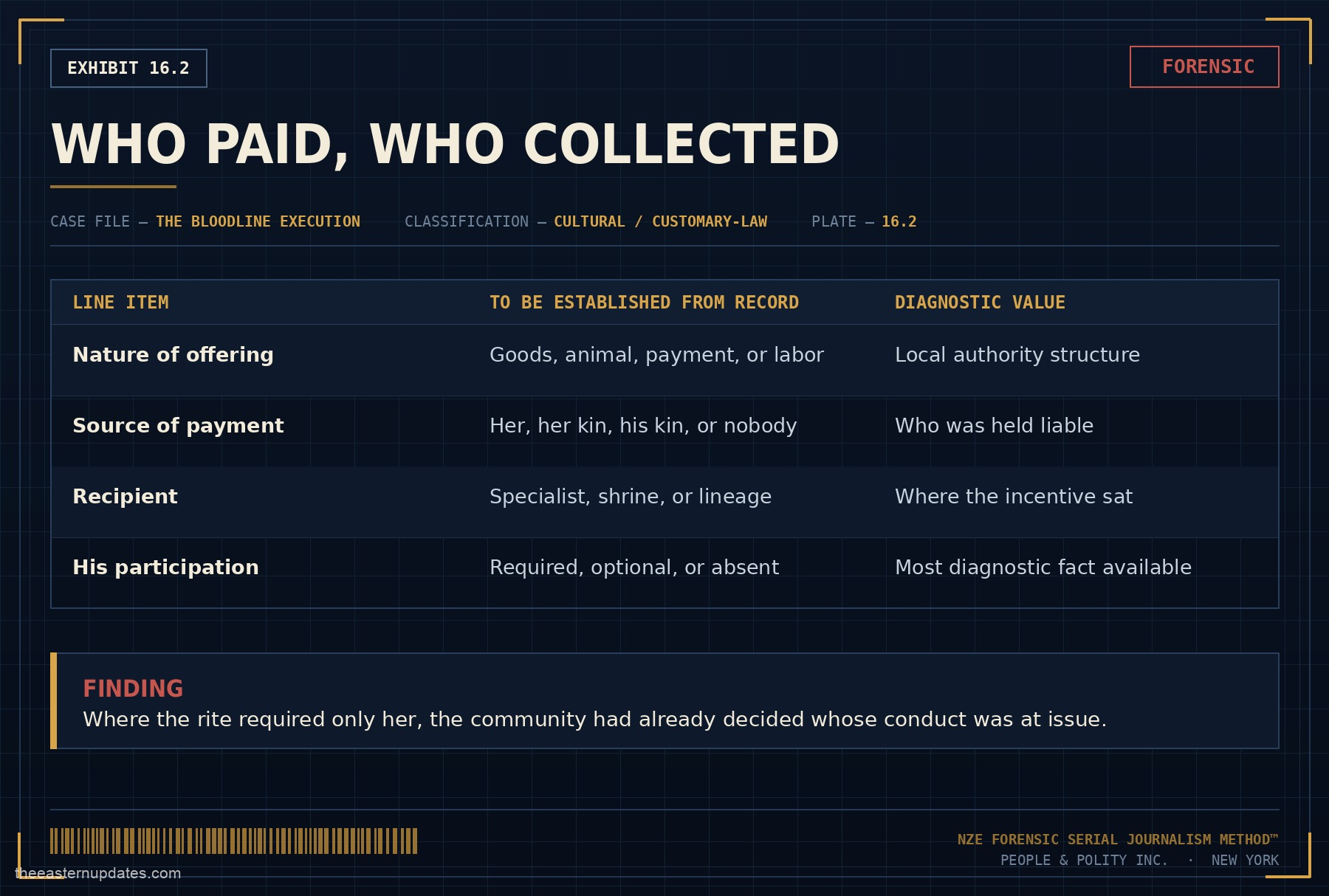
Content of the restitution should be reported rather than assumed, and the variation between communities is itself evidence. Some accounts describe offerings and libation, others the provision of specific animals, others payments to a shrine, others work or goods rendered to the lineage, and the differences track local authority structures rather than any single doctrine (Uchendu, 1965; Afigbo, 1981). Where a reporter can establish what was actually handed over in a particular case, the account stops being ethnographic generality and becomes a file. Where only the general form survives in memory, the installment says so and prints the general form as memory rather than as record.
Comparison with Volume I’s inheritance material sharpens the point considerably. Part 6 established that ordered compounds front-loaded their paperwork, fixing payments, ranks, and recognitions while the man still lived and could be contradicted, so that succession could be traced rather than litigated. Restitution worked on identical logic in the moral register. Settlement was performed while everyone concerned was present, and its public character was what made it stick. Systems of this kind do not depend on anyone’s sincerity. They depend on witnesses, which is the finding this series keeps arriving at from different directions.
Absence of the man from the sequence deserves its own paragraph rather than a clause. Where a rite required only the woman, the community had decided in advance whose conduct was at issue, and no doctrine about collective offense survives contact with that arrangement. Where his kin were required to contribute, the reasoning treated the matter as a debt between houses, and she was not carrying it alone. Reporters should treat his role in the sequence as the single most diagnostic fact available about what a given community actually believed, as against what its elders will say it believed.
Modern successors deserve their comparison here, briefly, since Part 18 will try them properly. Churches offer confession, deliverance, or public testimony, each carrying a version of acknowledgment and release. Clinics offer treatment and discharge. Statute offers prosecution, in principle, and in practice offers nothing whatever. None of these closes a matter in the sense custom meant, which was a settlement the community witnessed and afterward regarded as complete (Mair, 1969; Chae & Agadjanian, 2022). Silence produces no closure at all, and silence is what the concealed arrangement supplies.
Specialists and their economics deserve direct treatment rather than delicate avoidance. Ritual authority was an occupation as well as a vocation, and the people competent to diagnose a breach were frequently the people paid to close it, an arrangement whose incentive problems require no elaborate theory (Agbasiere, 2000; Uchendu, 1965). Communities were not naive about this and produced their own checks, in reputation, in competing specialists, and in kin who could refuse a demand they thought inflated. Reporting the checks alongside the fees gives a fairer picture than either admiration or exposure alone.
Closure itself needs defining, since the word does the heaviest work in this installment. Settlement in this context meant something behavioral rather than emotional: people stopped raising the matter, it ceased to affect marriage negotiations, it was not produced as a weapon during later quarrels, and a woman’s children were not marked by it. Each of those is observable, and a reporter can establish whether any of them held in a given case by asking the people who would have done the raising.
Difficulty of the reporting deserves acknowledgment in the text. Shrine payments, ritual fees, and the specifics of what a family handed over are not subjects most households discuss with a visitor, and a Christianized generation frequently denies that any of it occurred at all. Older women and the specialists themselves are the practical routes in, and where neither can be secured the installment reports what it could not establish rather than filling the space with plausible reconstruction.
Forensic question closing Part 16 stays with the machinery rather than the belief. In this case, was any remedy available, who was competent to administer it, what did it cost and who paid, whose acknowledgment was required, and at what point, if ever, was the matter treated by anybody as closed?
Field Protocol
Ritual authorities on prescribed remedy and sequence. Women on what was actually demanded of them and what it cost. Kin on who paid. Material record wherever payment left one. Where the man’s participation was not required, record that as a finding rather than an absence.
Evidence Docket
Seven authorities, five verified and two reserved. Reserved are one source on sacrifice and propitiation in Igbo religion and one on ritual specialists, their authority, and their fees.
Full bibliographic entries are not repeated here. Every source cited above is compiled once, in APA 7 form and alphabetically by author, in the Standing Record at the close of this volume and in the reference section of the PDF edition, each entry carrying a note of the parts that cited it and of the setting in which its fieldwork was conducted.