




















|
Listen to article
|
Nsọ Ala: The Offense Against the Earth
Igbo Customary Judgment and the Category the Severance Fell Into
Forensic classification: Customary-law analysis; ritual and religious record.
Categories decide cases. Before any question of guilt arises, a legal order must first say what kind of wrong is alleged, and the answer determines who may complain, who may judge, what remedy applies, and whether anyone is obliged to act at all. Part 14 established that the severance was not classed as homicide. Establishing what it was classed as belongs here, and the answer is the technical center of this volume.
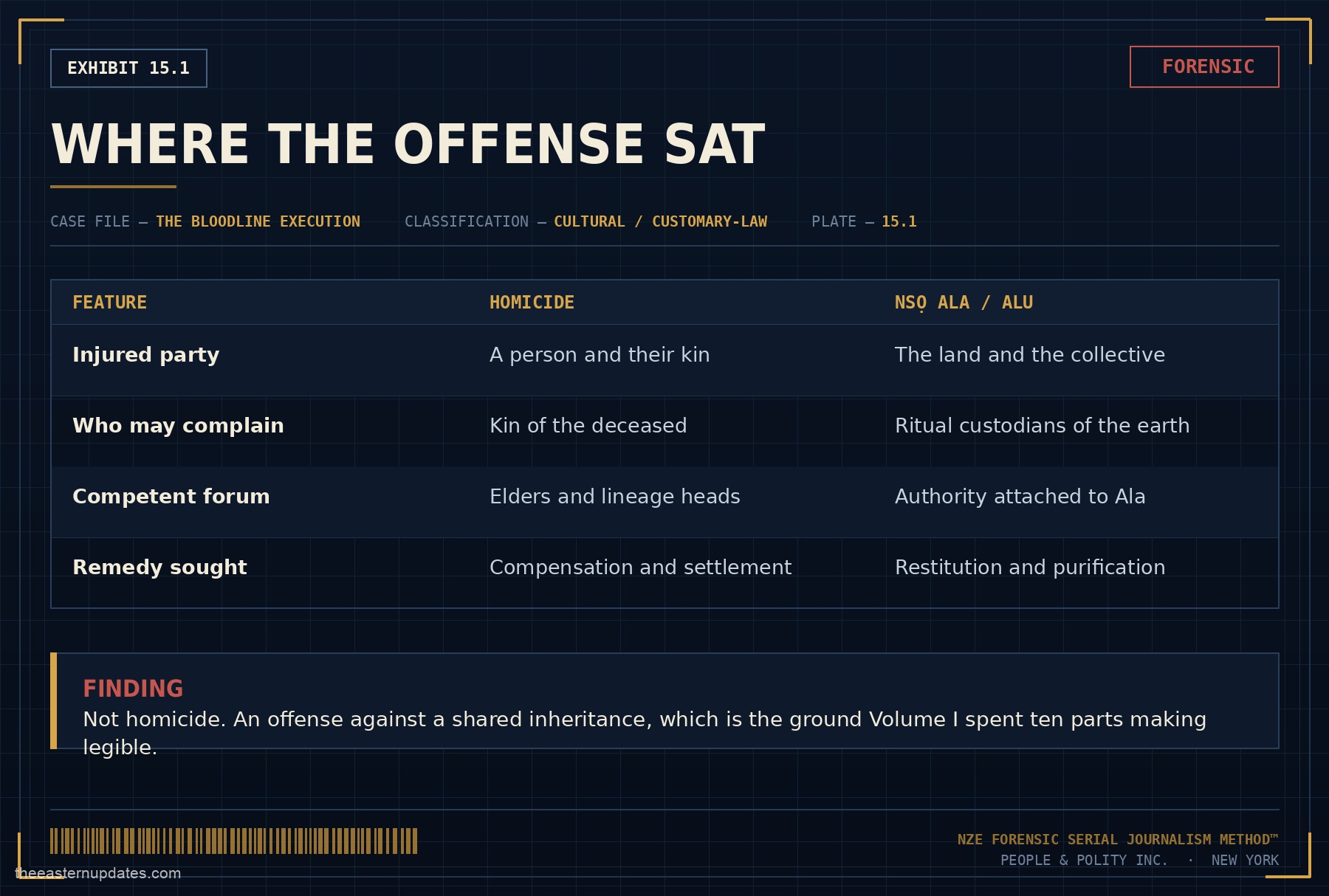
Ala, the earth, held a jurisdiction unlike any other in the Igbo order. Guardian of morality and of fertility together, she was the ground in every sense the word carries, and offenses against her carried the name alu or nsọ ala, abomination, a category reserved for acts believed to defile the land itself rather than to injure a particular victim (Uchendu, 1965; Afigbo, 1981). Placement inside that category tells us a great deal. Complaint did not belong to an individual, because the injured party was the collective and the soil beneath it. Remedy ran toward restitution and purification rather than toward punishment of a wrongdoer for a wrong done to another person. Judgment fell to those holding ritual authority over the land, not to the kin of anybody bereaved.
Otu aka ruta mmanụ, ọ zụọ ọha ọnụ. One finger dipped in oil leaves the whole company greasy, and the saying is quoted wherever a private act is understood to soil people who were nowhere near it. Igbo pollution logic worked in exactly that direction, which is why abomination could not be settled privately between the parties and why concealment was itself part of the offense rather than a way of escaping it. Something hidden went on defiling, since the land could not be cleansed of a thing nobody had named.
Read also: The Bloodline Execution — Part 14
Comparative placement inside the category tells us more than the label alone. Abomination was not a residual bin for anything disapproved of; it gathered acts believed to strike at the conditions of collective life, and communities differed considerably about what belonged in it (Afigbo, 1981; Uchendu, 1965). Reading the neighbors of an offense is standard method in any legal system, and it is available here. Where a community placed a severance beside acts understood to defile the land, the reasoning concerned the land. Where it sat closer to breaches of obligation between kin, the reasoning concerned duty. Establishing which neighbors it kept, locality by locality, does more to fix its meaning than any general statement about Igbo belief.
Procedure repays equal attention, since a category with no procedure is a sentiment. Complaint arose from those holding ritual responsibility for the land or from kin who had learned of the matter. Diagnosis and determination fell to specialists whose authority rested on their relation to Ala rather than on any office resembling a magistracy. Remedy, examined in Part 16, ran toward restitution. Nothing in that sequence resembles a prosecution, and forcing it into criminal vocabulary would misdescribe it as thoroughly as calling it a private medical decision would.
Read also: The Bloodline Execution — Part 13
Here the argument of this volume collects the payoff of Volume I. Concealment is not incidental to the wrong under customary reasoning; it is the mechanism by which the wrong is preserved. Volume I found the compound working as an evidence machine, converting private conduct into public fact. Nsọ ala reveals the same architecture operating in the moral register: a wrong required naming before it could be remedied, and a wrong kept from the community’s knowledge remained permanently open. Modern secrecy does not merely evade the customary judgment. On the system’s own terms it perpetuates the injury it was designed to close.
Objections arrive with real force, and two of them must be printed at full strength. Reconstruction is the first. Everything known about this category descends through twentieth-century ethnography, colonial administrative writing, and living memory, all of it recorded after missions and courts had already begun reshaping what people would say and to whom. Colonial-era compilers gathered detail no one else preserved, yet they gathered it as agents of an administration seeking to govern through custom, and their categories frequently tidied what they found. Any account built on that material is an inference about the past rather than a report from it, and this installment marks the distinction rather than papering over it (Radcliffe-Brown & Forde, 1950; Afigbo, 1981).
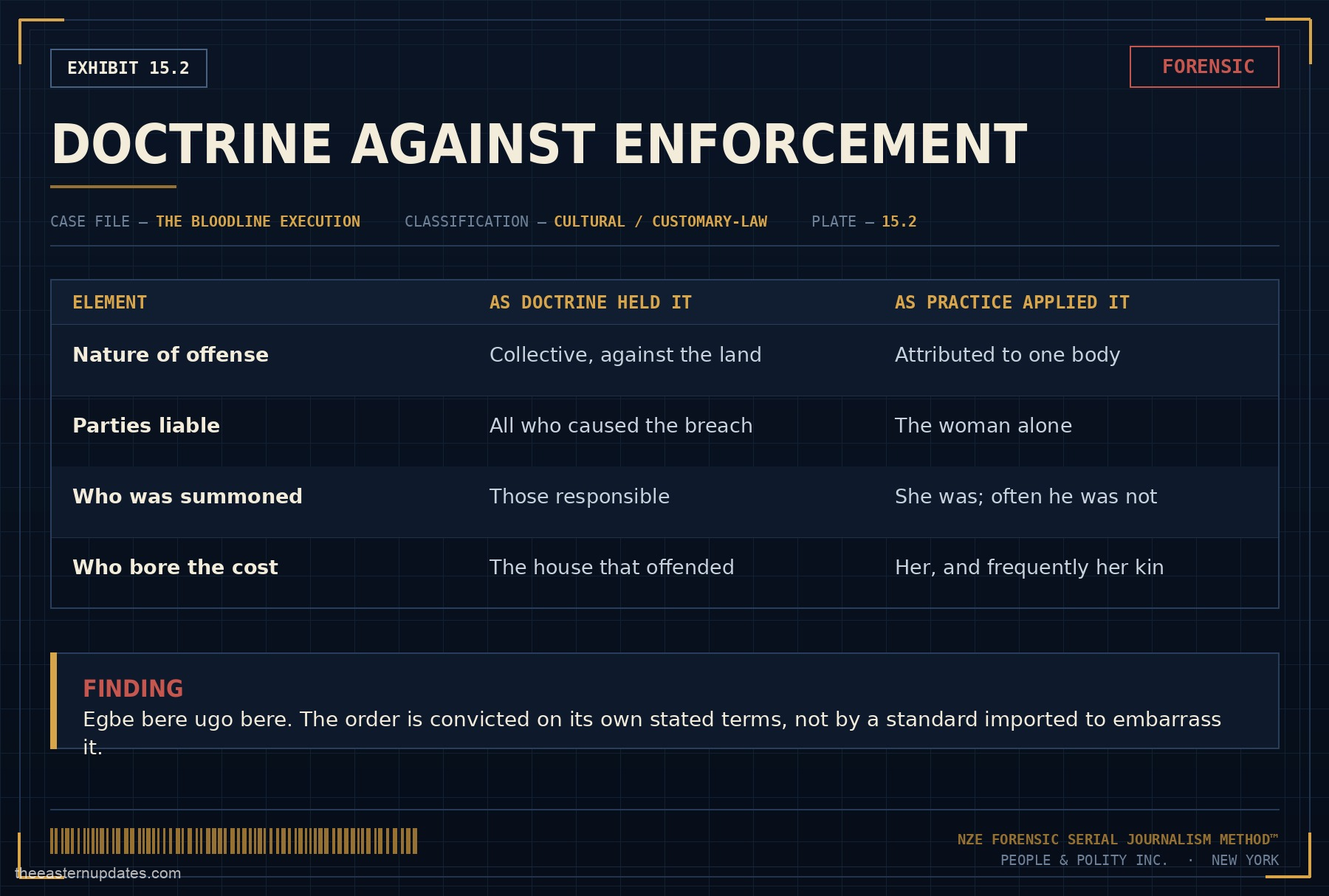
Enforcement is the second, and it cuts deeper. Whatever the theory held about a collective offense, punishment in practice fell on women. She was named, she was cleansed, she carried the cost and the memory, while the man whose conduct produced the pregnancy frequently stood outside the proceeding altogether. Describing a beautifully collective jurisprudence while ignoring its wholly asymmetric application would be apologetics rather than analysis.
Egbe bere ugo bere, nke si ibe ya ebela, nku kwaa ya. Kite and eagle each hold a right to perch, and whichever denies the other should lose the wing it flew in on. Igbo thought produced that principle and applied it unevenly, which is precisely the finding this part returns rather than the embarrassment it hides. Offense was defined as collective; sanction was distributed by sex. Gap between the two is not a flaw in the reconstruction but the strongest evidence in the installment, and it convicts the customary order on its own stated terms rather than by an imported standard. Volume I convicted the counterfeit compound the same way, using evidence that vindicated the ordered one.
Concealment and pollution interact in a way that repays close attention, since it produces the most counterintuitive finding in the installment. Where a wrong is understood to defile land held in common, a community carrying an unnamed abomination is carrying an unremedied one, whether or not anybody knows. Logic of that kind sounds alien until its practical effect is stated: it made secrecy dangerous to everyone rather than merely shameful to one person, and it therefore created a collective interest in disclosure that no modern arrangement supplies. Neighbors under such a system had reason to want a matter surfaced. Neighbors under the present arrangement have every reason to want it kept quiet, since disclosure now threatens only the reputations of the people disclosing.
Terminology varies enough that a careless reporter will manufacture a false consensus. Words rendered in English as abomination cover a range of gravity, and communities twenty miles apart apply them to different acts with different consequences attached (Afigbo, 1981). Recording the term as given, in the dialect given, with the informant’s own gloss beside it, is the minimum standard. Substituting a single scholarly term across all localities would produce exactly the museum text the Customary Evidence Protocol was written to prevent.
Colonial courts did something to this category that deserves recording, because it bears directly on why nothing remains to convene. Administrations governing through custom recognized what they could translate into their own categories and disregarded what they could not. Offenses with an identifiable individual victim survived translation. Offenses against the land, requiring ritual authority to hear and ritual remedy to close, translated into nothing a magistrate could apply, and they fell away from the enforceable order while continuing to exist in belief (Meek, 1937; Mair, 1969; Afigbo, 1981). Result was not a community freed from an oppressive category so much as one left holding a wrong it could still recognize and no longer address. Part 18 develops the point, and Part 16 shows what was lost when the remedy went with the jurisdiction.
Reporting this part means working in named localities and refusing to generalize beyond them. Terminology varies, the severity assigned to particular acts varies, and the ritual authorities competent to hear a matter vary between communities lying twenty miles apart. A single account of “the Igbo view” would be worth nothing. Several accounts, each anchored to a place and a source, and set against one another where they differ, produce something a reader can check.
Forensic question closing Part 15 asks what the category did rather than what it was called. In this locality, on this account, who could bring the complaint, who was competent to hear it, what remedy was prescribed, on whom did the sanction actually land, and which party to the conduct was never summoned at all?
Field Protocol
Named localities only, with terminology recorded in the dialect given. Ritual authorities on jurisdiction and remedy; women elders separately on enforcement; adult children on what they witnessed. Colonial-era written sources are usable and are cited with an explicit note on the conditions of their collection.
Evidence Docket
Seven authorities, five verified and two reserved. Meek is entered with an explicit note on the conditions of colonial collection. Reserved are a source on Christianity and Igbo religious practice and a peer-reviewed article on contemporary Igbo customary law, both chosen for locality match.
Full bibliographic entries are not repeated here. Every source cited above is compiled once, in APA 7 form and alphabetically by author, in the Standing Record at the close of this volume and in the reference section of the PDF edition, each entry carrying a note of the parts that cited it and of the setting in which its fieldwork was conducted.