




















|
Listen to article
|
When the Child Became a Person
Naming, Incorporation, and the Hard Problem at the Center of This Volume
Forensic classification: Ethnographic analysis; customary-law analysis.
Everything argued so far can be dismantled in one sentence, and an honest volume prints the sentence itself rather than waiting for a reviewer to supply it. If Igbo custom did not treat the unborn as a person, then a series claiming to speak for that custom while mourning a severed line has smuggled in a foreign theology and dressed it in ancestral cloth. Readers deserve to know at once that the sentence has force, that it is not being evaded, and that this installment was written to meet it rather than to survive it.
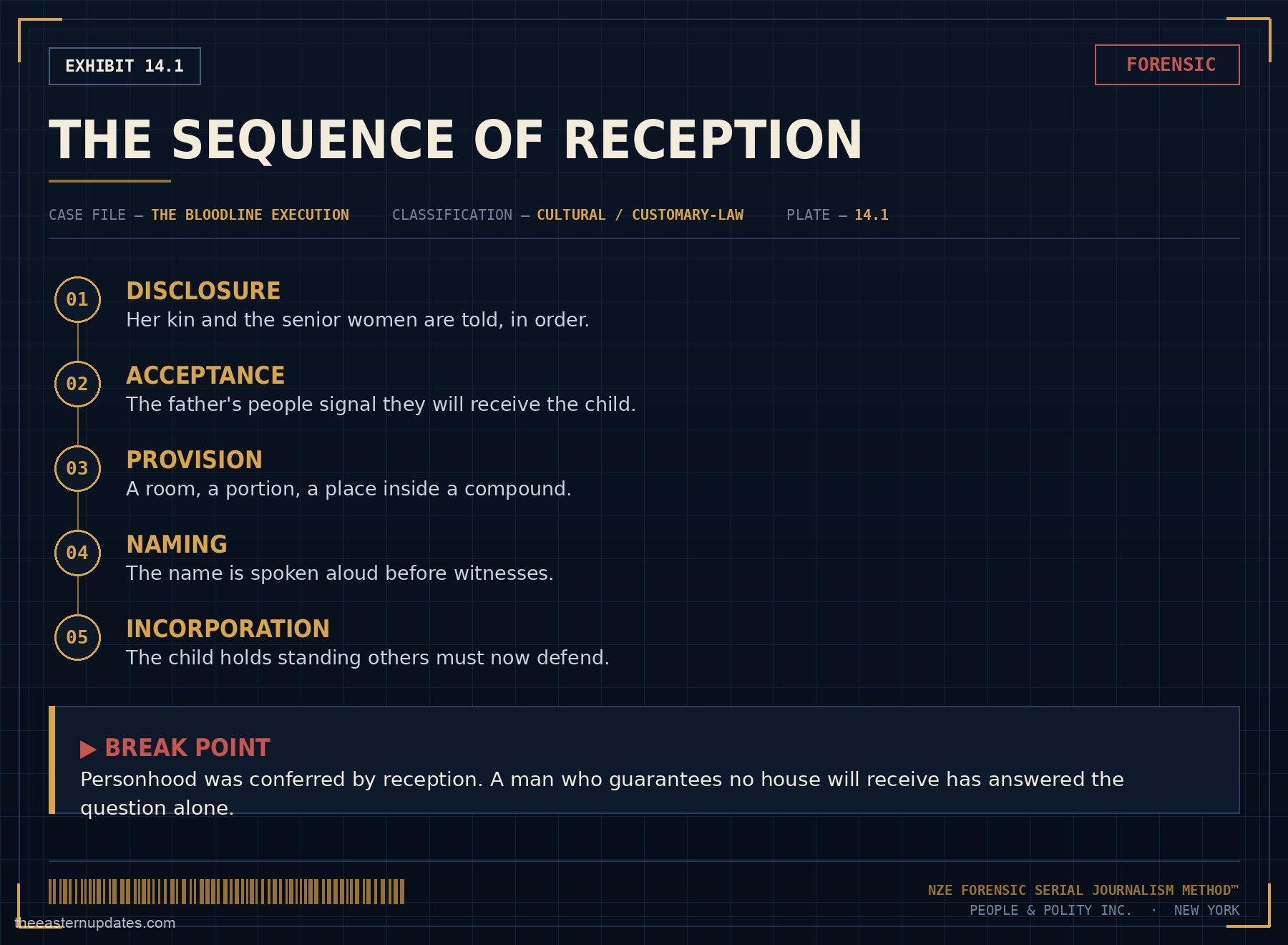
Facts first, before any argument is built on them. Personhood across much of West Africa arrived by stages rather than at a stroke. A child was received, named, incorporated into a house, and only progressively established as a full member of the living community, with the decisive markers social rather than biological (Uchendu, 1965; Fortes, 1949). Agbasiere, working from inside Igbo society as both member and trained ethnographer, treats the Igbo idea of person as something constructed through relation, cosmology, and placement rather than conferred automatically by birth (Agbasiere, 2000). Naming carried much of that weight, and the name itself was rarely arbitrary, compressing ancestry, circumstance, prayer, and sometimes an unresolved family quarrel into a word the family would speak for the rest of a lifetime (Uchendu, 1965; Afigbo, 1981; Onukawa, 2000).
Onye kwe, chi ya ekwe. Agreement precedes arrival, and the adage is normally used of a person’s own consent summoning the assent of his chi. Applied to the matter here it points at something the modern debate keeps missing: Igbo thought located personhood in a relationship rather than in a substance, and the naming system carries the evidence: chi names encode a person’s life force and its relation to a wider order, which is why a name was read as a statement about placement rather than as a label (Onukawa, 2000). A being became somebody by being received by somebody, which means the question worth asking is not when a life begins but who was supposed to do the receiving.
Read also: The Bloodline Execution — Part 13
Two conclusions follow, and the volume takes both. First, conceded without reservation: the customary offense was not homicide, and no part of this series will claim it was. Where the severance was treated as a wrong, the wrong was pollution of the earth and breach of duty owed to a lineage, which Part 15 examines in its own right. Anyone reading Volume II in search of an ancestral warrant for treating abortion as murder will not find one here, and the absence is a finding rather than an omission.
Second conclusion, and the one that carries the volume forward: relocating personhood into the act of reception does not weaken the case against concealment. Strengthening it is nearer the truth. If a child became a person by being received into a house, then a man who ensures that no house will ever receive a child has not stood aside from the question of personhood. He has answered it, privately, in advance, and on his own authority. Custom placed that decision with a community precisely because it was too consequential to leave with one interested party. Concealment takes the community’s decision and hands it to the person with the most to lose by deciding honestly.
Reception was material before it was metaphysical, which is what makes the relocation reportable rather than philosophical. Receiving a child meant a house that would take it in, a woman’s kin informed and satisfied, a father’s people prepared to speak a name aloud, provision arranged, and a place identified within a compound that already had places in it. None of that happened by sentiment. Each step required somebody to act, spend, or declare, and each left behind a person who could afterward be asked what they had done (Uchendu, 1965; Agbasiere, 2000). Volume I built its entire case on that property, and Part 14 simply carries it one stage earlier in the sequence.
Read also: The Bloodline Execution — Part 12
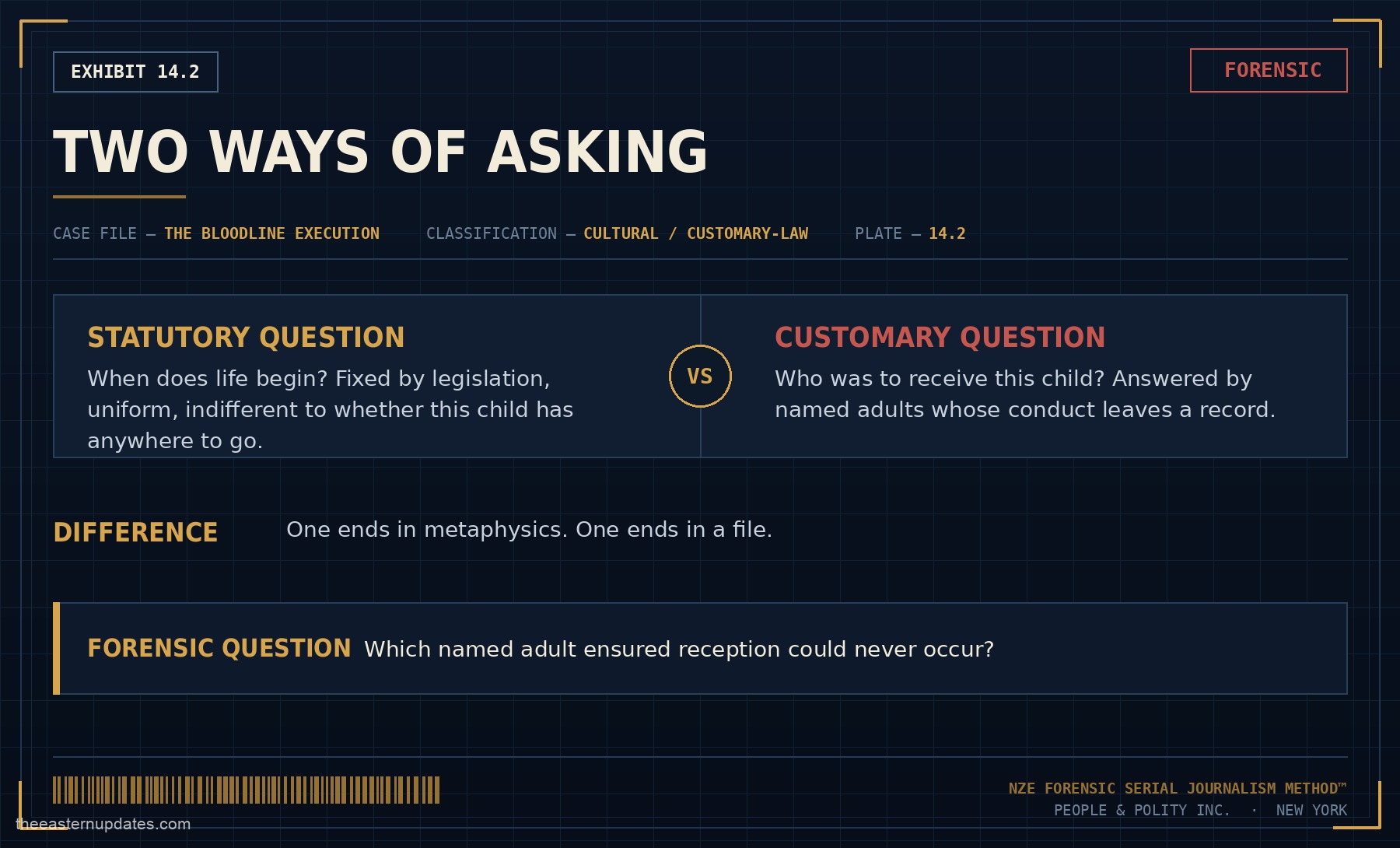
Modern law answers the same question differently and answers it badly for this volume’s purposes. Statutory personhood attaches at a moment fixed by legislation, uniform across every household in a jurisdiction, indifferent to whether any particular child has anywhere to go. Customary reasoning asked about reception and therefore asked about people. Neither framework is adopted wholesale here, since the volume’s business is conduct rather than metaphysics, but the contrast explains why a series grounded in African custom cannot simply borrow the statutory question and expect the borrowed answer to mean anything on the ground.
Objections run in both directions here, and printing only the convenient one would forfeit the installment. From one side comes the charge already answered above, that the series has imported a theology. From the other comes something sharper and less often said aloud: gradual personhood was itself a mechanism for absorbing infant death, for tolerating the quiet disposal of children born in circumstances a community would not accept, and in some recorded practice for far worse. Presenting it as an elegant relational philosophy while passing over what it permitted would be its own dishonesty. Twin infanticide alone stands in the Igbo record as evidence that a system conferring personhood by stages could also withhold it, at scale, from children who had committed nothing but the manner of their birth (Afigbo, 1981; Uchendu, 1965).
Neither objection is fatal, and taking them together produces the actual finding. Gradual personhood is no model for anybody’s ethics, and this volume does not propose it as one. What it supplies is evidence about where the customary system placed the moral weight, and it placed that weight on the conduct of the living rather than on the status of the unborn. Offense against the earth, duty owed to a line, obligation running from named adults toward a life they had jointly begun: each of these can be tested against a record, which is what the Three-Voice Rule requires and what the status question could never deliver.
Onye wetara ọjị wetara ndụ. Kola brought into a gathering brings life with it, and the saying works because it fuses a physical act with a social one until the two cannot be separated. Naming operated on the same principle. Speaking a child’s name in front of witnesses was not commentary upon a fact already established; the speaking was the establishing, and its public character was the whole of its force. A name conferred in the open acquired custodians other than the man who might later wish to retract it (Uchendu, 1965; Agbasiere, 2000). Concealment produces the mirror image, a life that no one may speak of, held by nobody, deniable by everybody.
Field reporting on this installment demands more care than any other in the volume, because elder testimony about personhood is exactly the sort of material that hardens into museum text under a credulous interviewer. Men will describe a coherent system. Women frequently describe its exceptions, its silences, and the specific children it declined to receive. Ritual authorities will state the rule as it should have operated. Contradiction among the three is not interference to be filtered out but the substance of the part, and the installment should print the disagreement rather than resolving it into a tidy account nobody actually gave.
Volume I’s Part 2 supplies the closing link, and it should be made explicit rather than left for a reader to notice. That installment argued that the deepest injury a society can do to a child is to leave it unnamed, and it defined the manufactured condition of standing withheld as something adults inflict rather than something a child is. Part 14 finds the same manufacture operating one stage earlier. A child never received is a child never named, and the machinery producing both outcomes is identical: a man positioned to confer standing who arranges instead that the question will never be publicly asked.
One caution belongs in the text and not in a note. Reconstructing a precolonial category from twentieth-century ethnography and living memory is an inference, not an observation, and the sources carrying most of the weight here were assembled after missions, courts, and schools had already reshaped what people were willing to say (Radcliffe-Brown & Forde, 1950; Afigbo, 1981). Marking the boundary between what is attested and what is reasonably inferred costs the volume nothing it should want to keep. Blurring that boundary would cost it the readers it most needs.
Forensic question closing Part 14 states the relocation plainly. Not when this life became a person, which custom answered socially and modern law answers by statute, but this: which named adults were positioned to receive this child, what did each of them do, and who acted to guarantee that reception could never occur?
Field Protocol
Elders on naming and incorporation, women separately and at length, ritual authorities last. Ask for cases rather than rules, since a rule recited is a rule improved. Record every point of disagreement and print it. Attested material and inferred material are marked differently in the text.
Evidence Docket
Seven authorities, six verified and one reserved. Onukawa carries the chi concept in naming; Afigbo and Uchendu the twin-infanticide record that the installment refuses to pass over. Reserved is a comparative source on staged infant personhood in West African societies.
Full bibliographic entries are not repeated here. Every source cited above is compiled once, in APA 7 form and alphabetically by author, in the Standing Record at the close of this volume and in the reference section of the PDF edition, each entry carrying a note of the parts that cited it and of the setting in which its fieldwork was conducted.