




















The Room Without Witnesses
Where a Pregnancy Ends When There Is No Compound
Forensic classification: Documentary record; public-health evidence; institutional analysis.
Concealment has a geography, and geography can be mapped. Far from an abstraction about modern morals, it consists of physical places present in every city this series covers: a clinic keeping no register, a pharmacy counter where a question earns a quiet answer, a borrowed room, a journey taken alone to a town where nobody knows the traveler’s family. A reporter can stand in each of them, which is what keeps this installment documentary rather than philosophical, and the volume should keep it so.
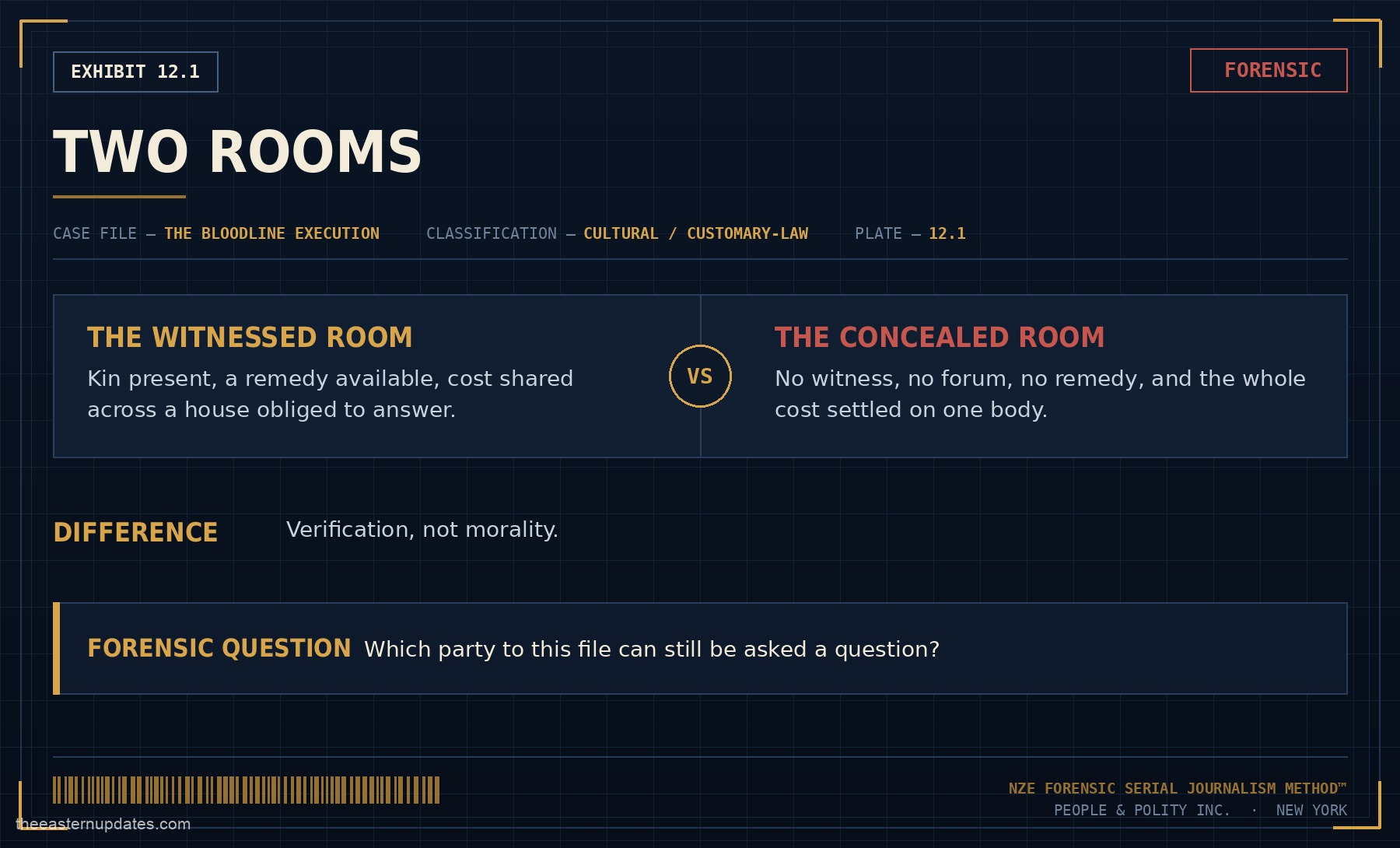
Publicity protects, Volume I argued, calling the compound an evidence machine because ceremony served as its filing system, because her kin remembered the negotiation and neighbors saw who entered the household, and because a child grew up surrounded by people who could afterward be asked what they had seen. Everything here is that mechanism running backward. Absent a witness there is nothing to verify; absent verification nobody can be held; and once nobody can be held, physical consequence settles entirely on one body, a body being the only party to the arrangement that cannot be kept off the record.
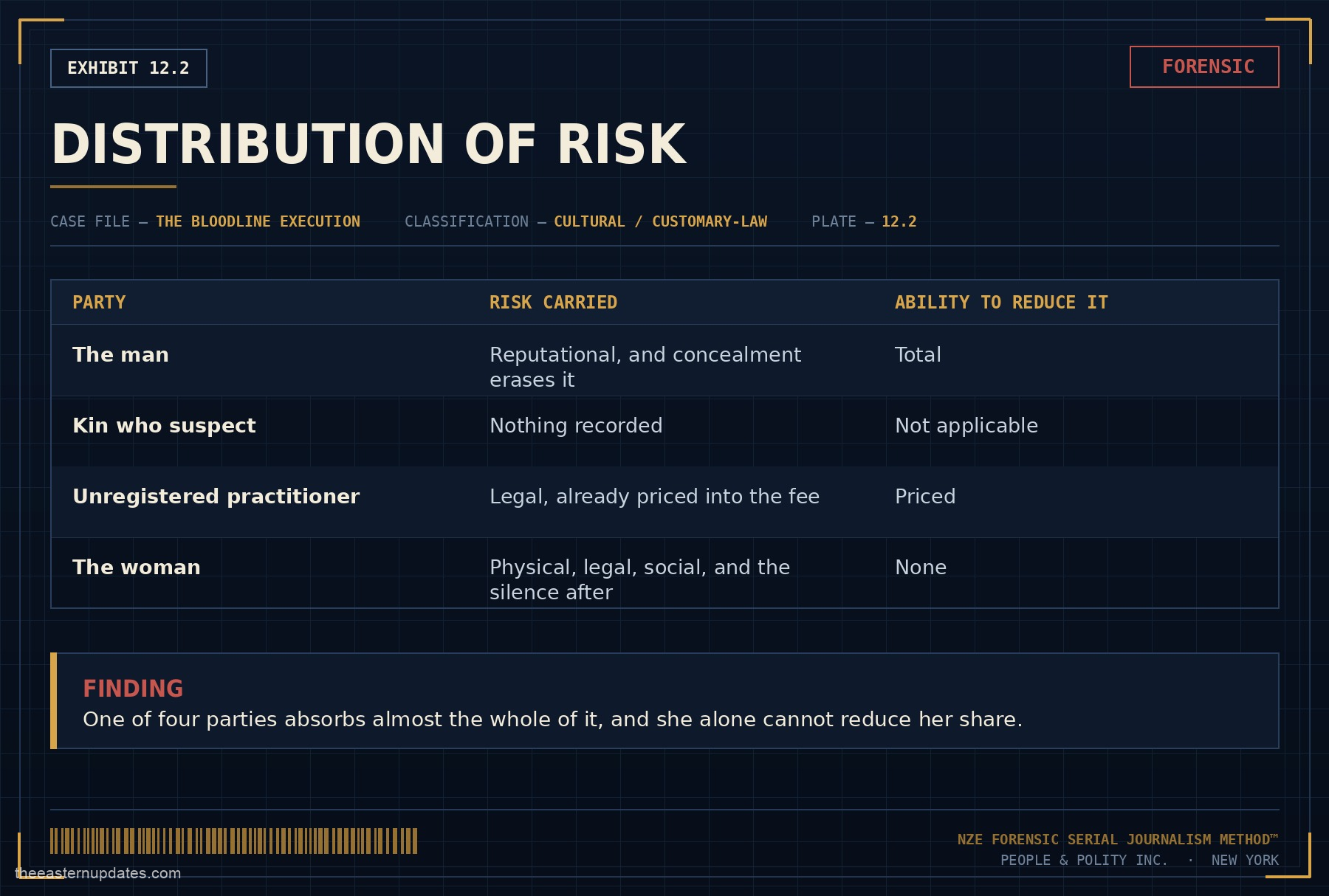
Risk distributes unevenly enough to constitute the finding, and it should reach a reader as a chart before arriving as a sentence. His exposure is reputational, and concealment exists to erase it. Kin who suspect and stay quiet carry nothing whatever. A practitioner working outside any register carries legal exposure already priced into his fee. She carries the physical consequence, the legal exposure, the social cost should the arrangement fail, and the weight of the silence afterward. Four parties to one transaction, and the party absorbing almost the whole of it is the only one who cannot reduce her share.
Read also: The Bloodline Execution — Part 11
Public-health literature deserves more care than a polemic usually affords. Figures on incidence and complication in Nigeria are estimates assembled from survey and facility data, carrying ranges rather than points, and this series will lose the readers it most wants by quoting a headline number stripped of its methodology. Sayable without strain is the direction of the evidence and its consistency. Where a procedure is legally restricted and socially unspeakable it does not become rare; it becomes late, unregistered, and dangerous, with harm concentrating among the young, the poor, and the unmarried, which is to say among women holding least standing in the arrangements this volume examines (reserved: Guttmacher Institute, current Nigeria estimate; World Health Organization technical guidance). Reported here with sources named and uncertainties stated, that pattern is presented without describing any procedure or naming any substance, a forensic series having no business functioning as an instruction manual in either direction.
Here the objection turns on the series itself, and it lands. These rooms exist because of criminal statute and social shame. Moral vocabulary of the sort being built in these pages, the language of severance and abomination and a line cut, feeds the shame directly. A volume mourning what happens in unregistered rooms while sharpening the disgrace that drives women into them has joined the harm it claims to document, and no quantity of forensic apparatus changes what it does to the woman reading it.
Read also: The Bloodline Execution Volume II — OVERVIEW
No clever answer exists, and reaching for one would be worse than silence. Concede the mechanism, then follow the evidence where it actually goes, which is somewhere a punitive reader will find unwelcome. Restriction and shame do not reduce the number of pregnancies ending. They raise what she pays for ending one, pushing the event later, further from care, and deeper into the hands of people answerable to nobody. Any series calling itself forensic rather than rhetorical is bound by that finding, and the finding says plainly that criminal statute is no remedy for anything Volume II describes. Part 18 develops the point against all three successor institutions. Stating it here matters because a reader just shown the room deserves to know at once that nobody proposes locking the door from outside.
Two observations keep this installment honest, and both cut against an easy reading of it. Custom kept rooms of its own. Concealment was not abolished by the old order so much as given its own version, and ethnography holds hidden pregnancies, girls sent to distant relatives, women who carried the consequence of an unsanctioned union in silence and were punished when the silence broke (Uchendu, 1965; Bledsoe et al., 1998). Volume I never argued the compound eliminated secrecy. Its claim was that the compound made secrecy expensive and therefore rarer, and that where secrecy occurred anyway a mechanism survived for addressing it afterward. Narrower, and the only version the evidence supports. Ebe onye dara ka chi ya kwaturu ya gets quoted in these situations to close a conversation, and it repays noticing how conveniently the fatalism arrives, always after the fall and always from people who were standing nearby.
Somebody is being paid. Operating as an economy rather than a mood, concealment has suppliers: an intermediary taking a share for an introduction, a practitioner charging a premium precisely because no register exists, transport, a room, a person who will say nothing for a fee. Every participant monetizes the absence of a witness, and none of them appears in accounts of this subject written from a moral standpoint, which concentrate almost wholly on the woman and the unborn while leaving the supply chain unexamined. Forensic accounting cannot afford the omission. Where a market has formed around the impossibility of asking questions, that market is itself evidence about the arrangement producing it.
Pharmacies deserve particular attention, since they occupy the place a network of women once held. Older arrangements put knowledge about pregnancy in the hands of mothers, senior wives, and midwives who lived within reach and could be held responsible by name for what they advised (Bledsoe et al., 1998). Retail counters replaced that circle with a transaction, and a transaction ends when the money changes hands. Nobody follows up. Nobody is answerable for a wrong answer, and the person giving it frequently has no way of knowing how far along she is or what else she has already taken. Substituting anonymity for accountability while calling it progress describes a good deal of what happened to reproductive knowledge in the African city, and a reporter can document the substitution simply by counting how many people in a given case could still be named a year later.
Registers, meanwhile, do something a moral argument cannot. Written entries survive the memory of interested parties, resist quiet revision, and give a woman a document to put in front of somebody when her account is disputed. Volume I found the same property in ceremony: a witnessed marriage produced facts a man could not later edit alone. Absence of any register in the rooms described here is therefore not an incidental feature of poor infrastructure but the specific service being purchased, and a series that intends to propose remedies in Volume III should mark the point now. Whatever is built to replace the compound will have to produce records, or it will reproduce the room.
Follow the money and the transport rather than the woman. Governing the reporting here, that instruction works as method and as ethic together. Payments can be traced, journeys reconstructed, intermediaries interviewed, and whoever supplied the address identified along with what they knew about the practitioner they recommended. All of it comes from records and third parties, and establishing it shifts the reporting away from her body toward the arrangement that placed her in the room, where this volume has said its charge belongs.
One closing observation ties the room back to Volume I. Compounds made concealment expensive. No man could maintain a hidden pregnancy where his mother knew every woman in the village and his wife’s kin lived four compounds away. Urbanization, Christianity, and the cash economy hollowed the public marriage process without replacing the protections it carried, leaving many unions legally invisible and many children institutionally exposed (Nwoko, 2020; Mair, 1969; Chae & Agadjanian, 2022). Modern cities sell him privacy as a service. An unregistered clinic, an untraceable transfer, a town far enough that no face gets recognized: none of these is a failure of the system he lives in. They are amenities, and he is the customer. She is not the customer. She is the party against whom the amenity is deployed, and she settles the bill in a currency he does not carry.
Field Protocol
Documentary and third-party work. Registers where they exist, their absence where they do not. Payment traces, transport, and the intermediary who supplied the address. Three voices apply here as elsewhere, drawn from the arrangement rather than the household: the practitioner or pharmacist who supplied, the intermediary who introduced, and the kin member who knew and stayed quiet. No procedure or substance enters the text. Her account comes last, alone, and is used only with her consent.
Evidence Docket
Seven authorities, five verified and two held in reserve. Reserved entries are the current Guttmacher estimate of abortion incidence and complications in Nigeria and the World Health Organization technical guidance in force, both to be cited from the live publication with ranges and methodology carried into the text.
Full bibliographic entries are not repeated here. Every source cited above is compiled once, in APA 7 form and alphabetically by author, in the Standing Record at the close of this volume and in the reference section of the PDF edition, each entry carrying a note of the parts that cited it and of the setting in which its fieldwork was conducted.