




















|
Listen to article
|
The Line That Was Cut
Severance, Descent, and What a Lineage Loses When a Pregnancy Ends in Silence
Forensic classification: Cultural investigation; customary-law analysis; lineage reconstruction.
A ledger can be read in two directions. Volume I read the compound’s forward, entry by entry, and found a birth converted into public fact by people whose memories a father could not later edit. Reverse the direction and different questions surface: not the arrival but the absence, not a child fed but an obligation already incurred toward one, not what a house gained but what it was holding when the account changed without its knowledge.
Handled carelessly, this second reading becomes the oldest weapon there is. Saying a lineage held an interest in a pregnancy sits one sentence away from saying a lineage held authority over a woman’s body, and the second sentence has licensed enormous cruelty in every society that produced it. Only the first is advanced here. Establishing what kind of interest is at issue, and above all identifying who was supposed to discharge it, takes the rest of this installment.
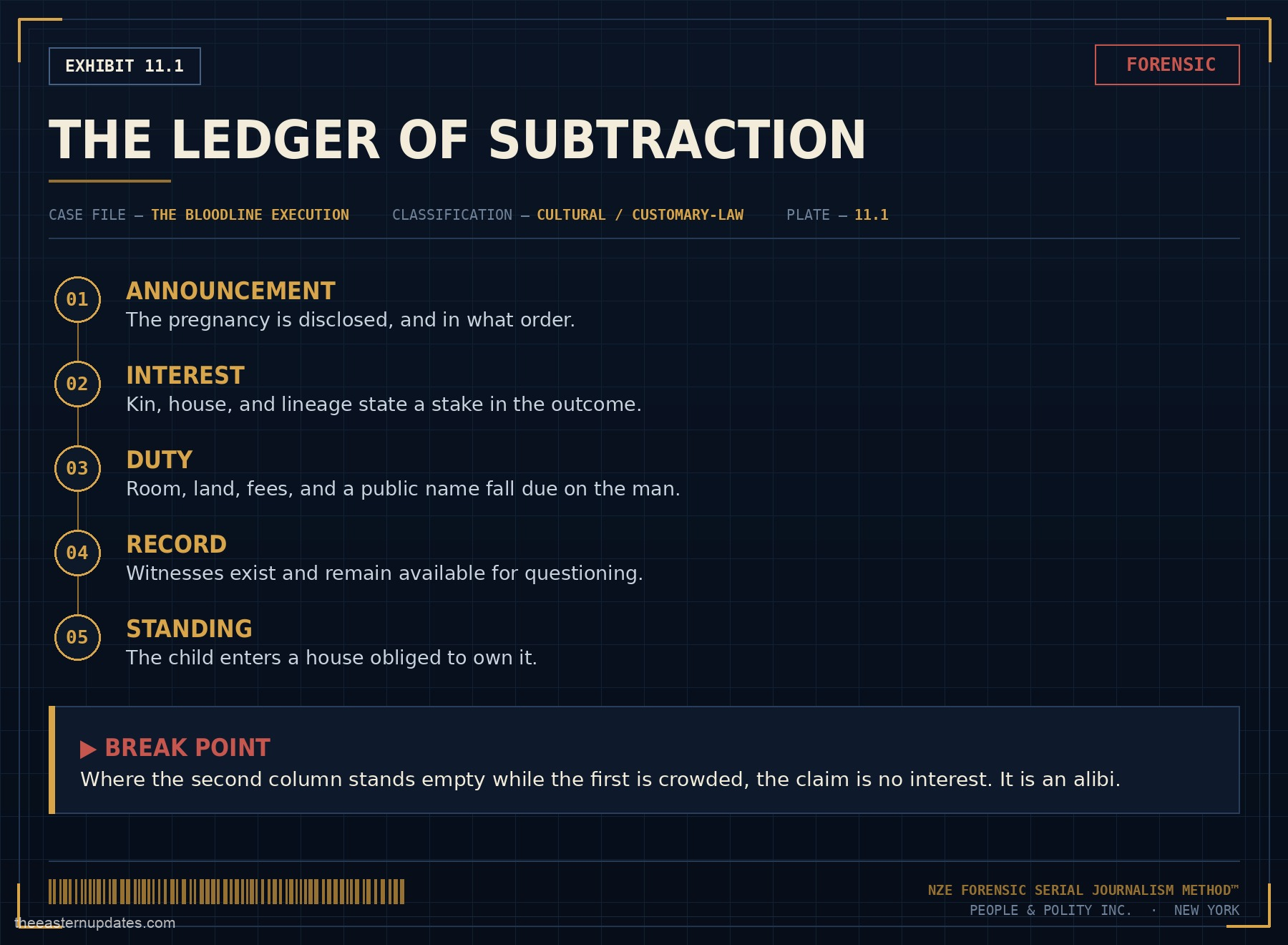
Begin with the compound’s conduct once a pregnancy was announced, since the institution moved rather than approved. Provision was arranged ahead of the birth. A house was identified, a farm or a room or a portion of trade set aside, elders and mothers informed in a sequence everyone understood, and the man’s obligations fixed in front of people who remained available for questioning. Literature Volume I relied on describes all this without romance. Fortes among the Tallensi and Uchendu in Igboland both present descent as a structure of claims rather than of feelings, and a claim is something for which a person can be made to answer (Fortes, 1949; Uchendu, 1965). Marriage itself moved as a treaty between families rather than a private understanding between two people, binding farms, ritual duty, and rules of succession into one arrangement (Radcliffe-Brown & Forde, 1950).
Read also: The Bloodline Execution Volume II — OVERVIEW
Aka nri kwọọ aka ekpe, aka ekpe akwọọ aka nri. Neither hand comes clean alone, and the saying is generally aimed at people who take without returning. Such is the interest under discussion: an obligation arriving with the announcement, arriving as a bill, carrying his name at the top. Set beside it whatever the concealed arrangement produces and the contrast does most of the work. No house is identified there, nothing is set aside, elders hear nothing, and no duty attaches to any person at any stage. Then, at the hour she must decide, an interest materializes out of nowhere, voiced by the man or his mother or a pastor, expressed as a firm opinion about her conduct and unaccompanied by one obligation anybody intends to meet.
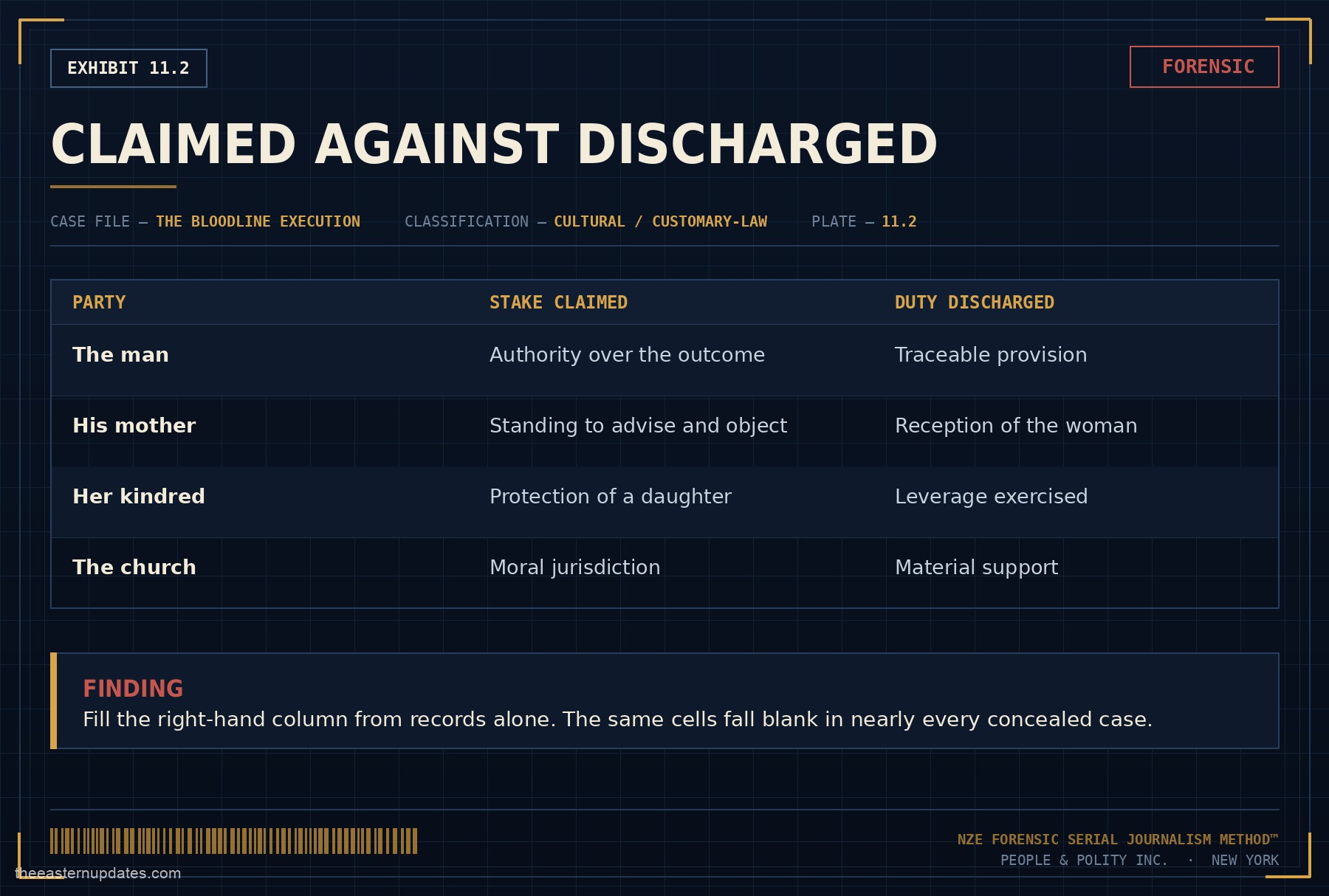
An interest surfacing only at the hour of decision, silent through every hour of provision, is not an interest in a child. Call it what it is, an alibi, and then demonstrate the pattern with files rather than asserting it with adjectives.
Demonstration means reconstructing lineages. Take three families, follow three generations of each, build two columns. Into the first goes every party claiming a stake in a pregnancy: the man, his mother, his brothers, her own kin, the church, whoever spoke at all. Into the second goes every duty discharged, meaning money that moved and can be traced, a room prepared, fees paid, a name promised before witnesses. Gap between them is the finding. Across the compounds Volume I described, both columns run to roughly the same length, which is how a working institution looks on paper. Across the concealed arrangements examined here, the left is crowded and the right is bare, and the same column falls bare nearly every time.
Igbo practice supplies detail enough to make that comparison concrete. Inside a recognized union a pregnancy was announced in an order, and the order was itself a form of accounting. Her mother and the senior women learned early, holding as they did the practical knowledge and the work of arranging care. His mother learned soon after, which mattered greatly, since she stood best placed to hold him to his obligations and least able to claim ignorance later. Wider kin learned as the pregnancy became visible, by which time arrangements had been made or their absence had become a subject of comment (Uchendu, 1965; Agbasiere, 2000). Every stage produced somebody available for questioning. Concealment inverts the sequence exactly: those learning first can compel nothing, and those able to compel are precisely the people the arrangement exists to keep in the dark. Ụmụnna bụ ike, and a man who has arranged for his kindred to know nothing has arranged, quite deliberately, that she face the matter without strength.
Women hold a reading of lineage interest of their own, and this volume weakens itself by leaving it out. A woman’s standing in the compound was tied to her children, and Volume I recorded the cost of that tie honestly. What it recorded alongside is that the tie ran in both directions. Mother of a recognized house held a claim on land, on her children’s schooling, on a hearing when the family met, and on a place at her husband’s burial that could not be removed without a public fight. Continuity of a line was frequently her strongest asset rather than a duty pressed on her from above, and the women defending these arrangements most fiercely in the ethnographic record are seldom the ones who were coerced into them (Agbasiere, 2000). Presenting lineage interest as exclusively male protects nobody. It erases the women who held it.
Read also: The Bloodline Execution — Part 10
Burial is where a missing entry finally announces itself, which is why this part reaches forward to Volume I’s Part 6 rather than treating inheritance as somebody else’s subject. Compounds front-loaded the paperwork: payments made, ranks fixed, recognitions spoken while the man still lived and could be contradicted. Concealed arrangements front-load nothing and leave a courtroom to reconstruct a life he spent hiding. Severance sits inside that same logic. A pregnancy ended in silence removes a claimant nobody can now identify, from a line whose surviving members will one day be asked to prove who belongs to it, and the proof they will reach for is exactly the record he declined to create (Nwoko, 2020; Chae & Agadjanian, 2022).
Now the objection, at full strength, since it is the most serious in the volume and does not weaken with repetition. Kin interest in a woman’s womb is the very claim used to force women into bearing across every society that ever advanced it, including this one, including within living memory. Dressed in the language of obligation it remains a lever, and men who read this series and quote it will not be hunting for their bill. They will be hunting for their leverage, and this part will have handed it to them.
Much of that lands, and the series should say so plainly: such language has served as a lever, it is serving as one now, and nothing written here can stop a man from misusing it. What remains within the volume’s power is refusing to let the misuse pass unnamed. An interest in a child generating no provision is not a weaker form of the customary claim but a different thing wearing its clothes, and Volume I convicted that impostor once already under another name. A man wanting plural wives while refusing plural duties had not inherited an African institution; he had forfeited it. A man claiming a lineage’s stake in a pregnancy he arranged to conceal, funded in cash, and hid from his own mother forfeits it by the identical test.
One further loss belongs on this ledger, and modern argument lacks the vocabulary for it. Within a descent-based order a severance subtracted from a memory as well as from a house. Dead were held in place by the living, the living by those coming after, and a thinning line thinned the capacity to remember and to be remembered. Caldwell and Caldwell came nearer to actuarial reasoning than to poetry in setting out the cultural logic of high fertility across sub-Saharan Africa, where children served as security, labor, defense, and continuity in a world offering no other insurance (Caldwell & Caldwell, 1987). None of which settles a moral question on its own, and no such claim is made here. Established instead is that the interest was real, was shared, and was understood by those holding it as a stake in something genuinely capable of being lost.
Forensic question closing Part 11 is therefore narrow and answerable. Not what a lineage is owed in the abstract, which belongs in a seminar, but this: in this house, in this case, what did each claimant do about the pregnancy before the decision was taken, and whose name stands in the left column while the right one stays empty?
Field Protocol
Three lineages, three generations each. Establish what every household knew and at what point. She is interviewed first and alone, then the man, then a third party present at the time. Where his account of his obligations conflicts with the material record of what he provided, that conflict is the paragraph.
Evidence Docket
Seven authorities support this installment, all verified against the publisher record. Fortes and Radcliffe-Brown and Forde carry the structure of descent as claim; Uchendu and Agbasiere the Igbo announcement sequence; Caldwell and Caldwell the cultural logic of high fertility.
Full bibliographic entries are not repeated here. Every source cited above is compiled once, in APA 7 form and alphabetically by author, in the Standing Record at the close of this volume and in the reference section of the PDF edition, each entry carrying a note of the parts that cited it and of the setting in which its fieldwork was conducted.