




















|
Listen to article
|
The Old Order on Trial
Polygyny, Christianity, Colonial Law, Feminist Critique, and the Battle Over African Family Memory
Forensic classification: Cultural investigation; documentary record; customary-law and kinship analysis.
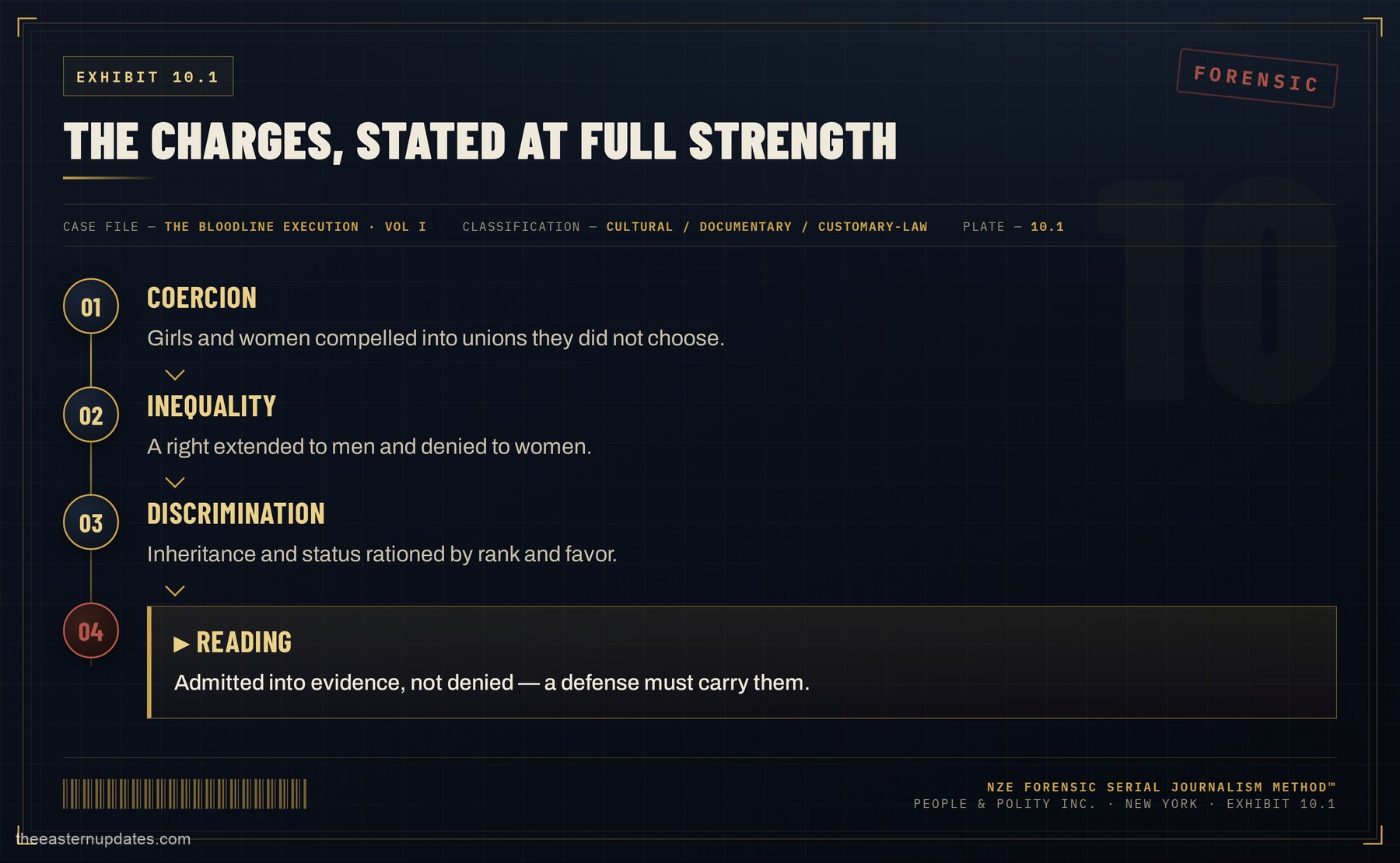
The last part of Volume I places African polygyny before its accusers — missionary Christianity, colonial law, statutory monogamy, liberal rights discourse, feminist critique, urban respectability, the language of public health — and grants at the outset that the accusers are not frivolous. Women have been harmed in plural homes. Girls have been coerced. Inheritance has discriminated. Men have abused custom. Children have suffered where resources were thin and favoritism strong. A defense that cannot admit this is propaganda, and this series will not offer one.
The charges deserve their full weight. Christianity and colonial law recast plural marriage first as sin and then as legal nullity, and in doing so sometimes shielded women from coercion the compound tolerated (Agadjanian, 2020; Mair, 1969). The feminist critique correctly names the asymmetry at the institution’s core: a right extended to men and withheld from women is not neutral, whatever social function it serves. The economic critique quantifies real costs, arguing that polygyny distorts marriage markets and suppresses investment (Tertilt, 2005). And the public-health literature spent a generation, with genuine data, classifying polygyny as a harmful cultural practice. None of this can be honestly dismissed.
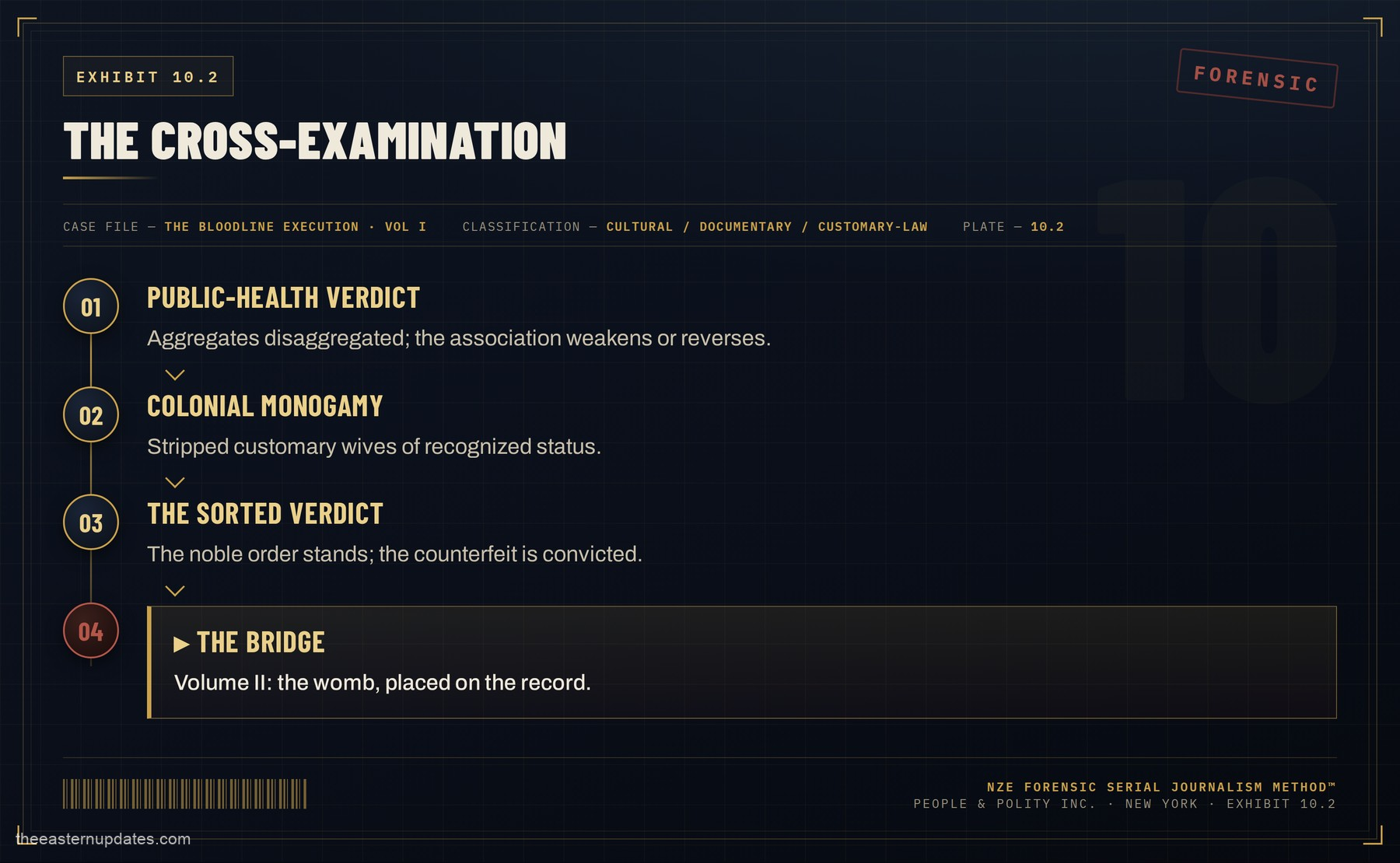
But an honest trial cross-examines the accusers too, and here the record has shifted under them. The public-health verdict in particular has not survived its own scrutiny: when the aggregated data behind the harmful-practice label were disaggregated, the association weakened, vanished, or reversed, and the field’s own reviewers now urge a more nuanced stance (Lawson et al., 2015; Lawson & Gibson, 2018). Colonial monogamy law, meanwhile, did not reliably protect women; it frequently stripped customary wives of recognized status and left them worse off, converting co-wives into legally invisible dependents. The accusers arrived certain, and several of their certainties have not aged well.
Read also: The Bloodline Execution — Part 9
The verdict Volume I returns is therefore narrow and, direct, because it is narrow, defensible. Polygyny is not vindicated as such, and it is not condemned as such. What survives cross-examination is the distinction the whole volume has pressed: the ordered, provisioned, witnessed compound — where duty outran appetite and the woman and child held standing — is a serious institution the caricature cannot touch; the disordered counterfeit — coercive, hidden, unprovided — is guilty of most of what the accusers describe, and the same evidence convicts it (White, 1988; Zeitzen, 2008). The trial does not acquit the institution wholesale. It sorts it.
And it prepares the ground the series will now stand on. If descent was a working institution with real obligations — if a child was a claimant and a woman a person with a place — then the questions Volume II will raise about the womb and its concealment are not moralizing abstractions but continuations of the same forensic argument: who is owed what, by whom, on what record (Chae & Agadjanian, 2022). Volume I built the floor and tried the old order honestly upon it. Volume II will ask what that order’s collapse has cost the most defenseless party of all.
Read also: The Bloodline Execution — Part 8
Part 10 is assembled as a trial transcript: the accusation stated at full strength, the evidence for it weighed, the cross-examination entered, and the verdict tied to the record rather than to sentiment on either side. It is the model the whole series follows — not a defense and not a prosecution, but a case built until the finding can survive appeal.
Forensic Diagram Set
Evidence Docket
Seven-source APA 7 record for this installment. Entries verified for authorship and publication details.
Agadjanian, V. (2020). Condemned and condoned: Polygynous marriage in Christian Africa. Journal of Marriage and Family, 82(2), 751–768. https://doi.org/10.1111/jomf.12624
Chae, S., & Agadjanian, V. (2022). The transformation of polygyny in sub-Saharan Africa. Population and Development Review, 48(4), 1125–1162. https://doi.org/10.1111/padr.12524
Lawson, D. W., & Gibson, M. A. (2018). Polygynous marriage and child health in sub-Saharan Africa: What is the evidence for harm? Demographic Research, 39, 177–208. https://doi.org/10.4054/DemRes.2018.39.6
Lawson, D. W., James, S., Ngadaya, E., Ngowi, B., Mfinanga, S. G. M., & Borgerhoff Mulder, M. (2015). No evidence that polygynous marriage is a harmful cultural practice in northern Tanzania. Proceedings of the National Academy of Sciences, 112(45), 13827–13832. https://doi.org/10.1073/pnas.1507151112
Mair, L. P. (1969). African marriage and social change. Frank Cass.
Tertilt, M. (2005). Polygyny, fertility, and savings. Journal of Political Economy, 113(6), 1341–1371.
White, D. R. (1988). Rethinking polygyny: Co-wives, codes, and cultural systems. Current Anthropology, 29(4), 529–572.