
















|
Listen to article
|
The Compound Against Chaos
Customary Polygyny as Social Insurance Against Abandonment, Illegitimacy, and Lineage Fragmentation
Forensic classification: Cultural investigation; documentary record; customary-law and kinship analysis.
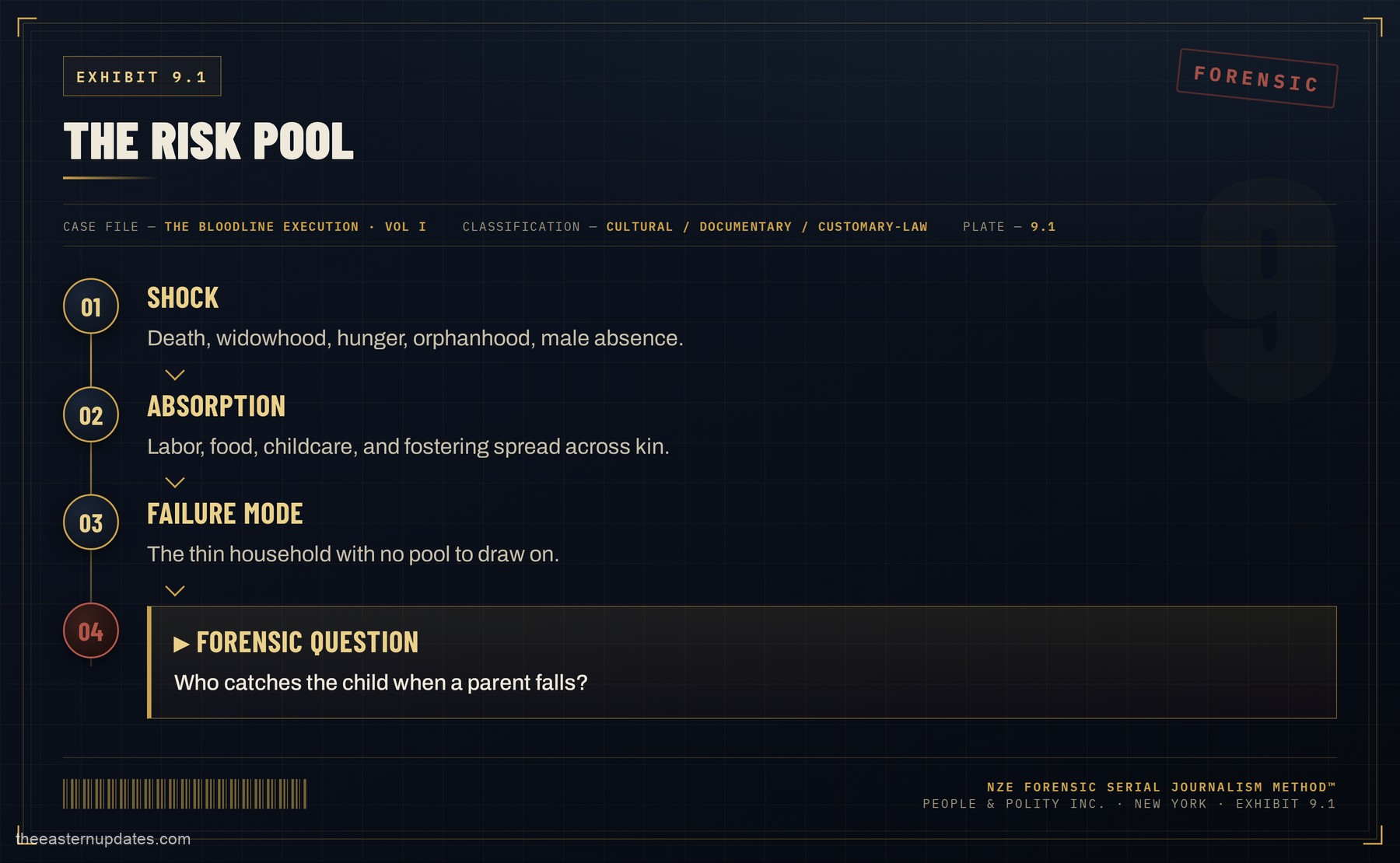
The compound was a social-insurance device before insurance became paperwork. It absorbed shocks — death, infertility, widowhood, child mortality, hunger, labor shortage, orphanhood, old age, failed harvests, the absence of men — that routinely break the thin nuclear household, especially in its urban form. The old compound was built to bend without breaking.
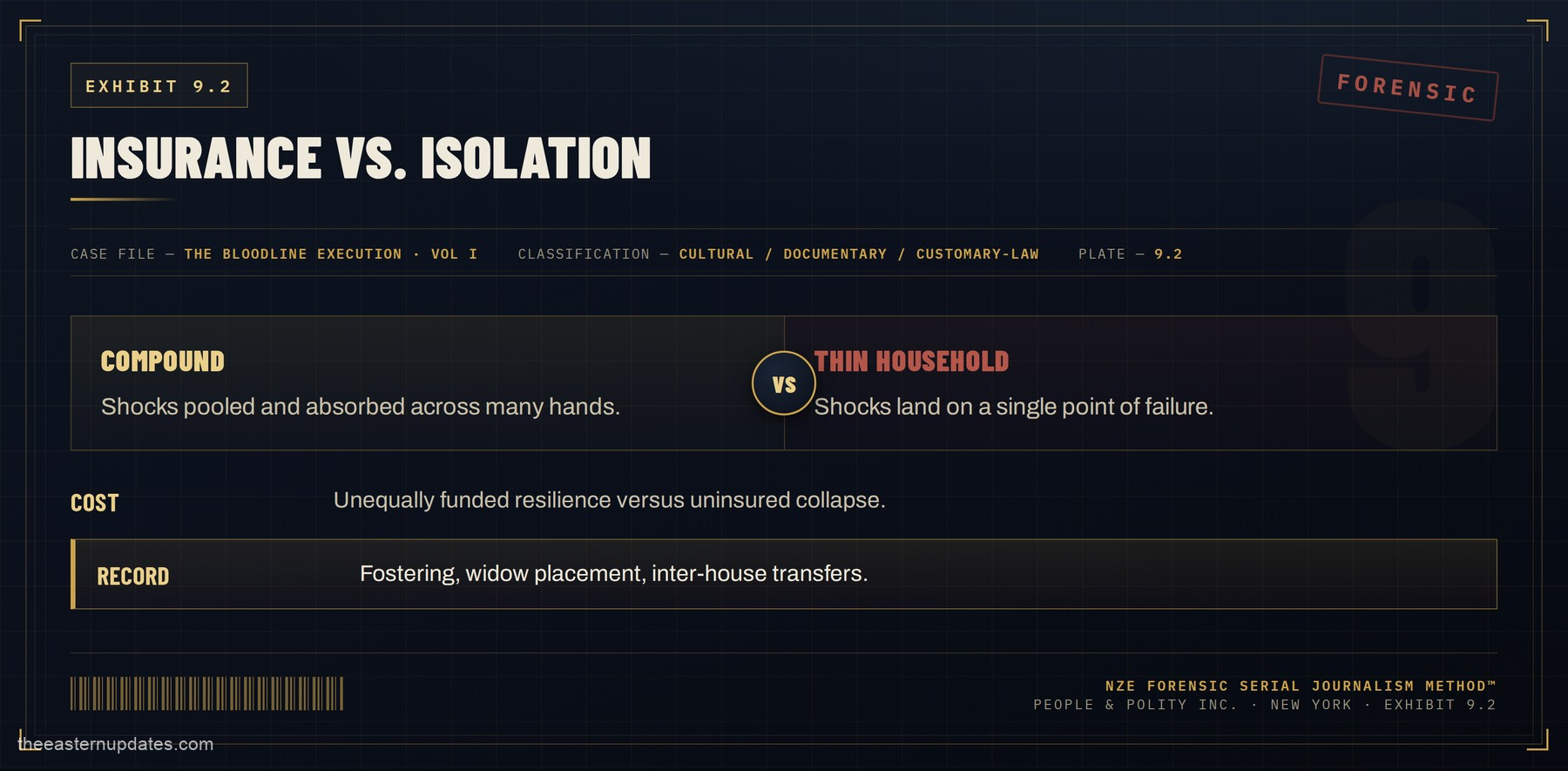
This is not nostalgia; it is institutional analysis. A large kin household could spread labor, food, childcare, and elder care across more bodies and more hands. Co-wives who were rivals in good times could become each other’s emergency support in bad ones; a child who lost a mother could remain inside a known house rather than falling through to the street (White & Burton, 1988; Fortes, 1949). Where an anthropologist sees kinship, an actuary sees risk-pooling — and the compound pooled exactly the risks a subsistence world produced in abundance.
Read also: The Bloodline Execution — Part 8
Read this way, even the demographic features the modern critic dislikes acquire a logic. High fertility, plural marriage, and wide fostering were not failures to modernize; they were a considered response to precarity in a world without pensions, insurance, or reliable medicine (Caldwell & Caldwell, 1987; Goody, 1973). And the evidence that the resilience was real, not only claimed, survives in the food-security and household data: where the provisioning structure held, polygynous households were not the fragile units the aggregate once implied, and their members could weather shocks that isolated households could not (Lawson et al., 2015; Murdock, 1959).
The objection is fair and pointed: insurance that pools risk on the backs of women is not benign, and resilience can be a euphemism for female labor absorbing every shock the household meets. The series accepts the charge as a limit on the argument, not a refutation of it. The compound’s insurance was real and it was unequally funded — both are true. But the modern alternative it is measured against is not a generous welfare state; for most of the people in question it is nothing at all — the isolated urban household with no pool to draw on, where a single death or lost job is catastrophic. To notice that the compound absorbed shocks is not to deny who carried the weight; it is to ask what replaced it, and to observe that for many the honest answer is: nothing did.
Read also: The Bloodline Execution — Part 7
The disappearance of the compound, then, is not simply moral progress; it is the removal of an insurance system that has not been replaced. The secret second family, the abandoned mother, the child raised on intermittent transfers — these are not only moral failures. They are uninsured risks that the old order used to pool and the new order leaves to fall where they land (Chae & Agadjanian, 2022).
Part 9 reconstructs the compound as a risk-pooling system: who was absorbed when a parent died, how orphans and widows were placed, how food and labor moved between houses in a bad season. Set against the modern cases of children left uninsured by concealment, the contrast measures exactly what was lost when the pool was dismantled and nothing took its place.
Forensic Diagram Set
Evidence Docket
Seven-source APA 7 record for this installment. Entries verified for authorship and publication details.
Caldwell, J. C., & Caldwell, P. (1987). The cultural context of high fertility in sub-Saharan Africa. Population and Development Review, 13(3), 409–437.
Chae, S., & Agadjanian, V. (2022). The transformation of polygyny in sub-Saharan Africa. Population and Development Review, 48(4), 1125–1162. https://doi.org/10.1111/padr.12524
Fortes, M. (1949). The web of kinship among the Tallensi. Oxford University Press.
Goody, J. (1973). Bridewealth and dowry in Africa and Eurasia. In J. Goody & S. J. Tambiah (Eds.), Bridewealth and dowry (pp. 1–58). Cambridge University Press.
Lawson, D. W., James, S., Ngadaya, E., Ngowi, B., Mfinanga, S. G. M., & Borgerhoff Mulder, M. (2015). No evidence that polygynous marriage is a harmful cultural practice in northern Tanzania. Proceedings of the National Academy of Sciences, 112(45), 13827–13832. https://doi.org/10.1073/pnas.1507151112
Murdock, G. P. (1959). Africa: Its peoples and their culture history. McGraw-Hill.
White, D. R., & Burton, M. L. (1988). Causes of polygyny: Ecology, economy, kinship, and warfare. American Anthropologist, 90(4), 871–887. https://doi.org/10.1525/aa.1988.90.4.02a00060