


|
Listen to article
|
Mistresses Without a Compound
Modern Monogamy, Secret Women, Hidden Children, and Broken Lineages
Forensic classification: Cultural investigation; documentary record; customary-law and kinship analysis.
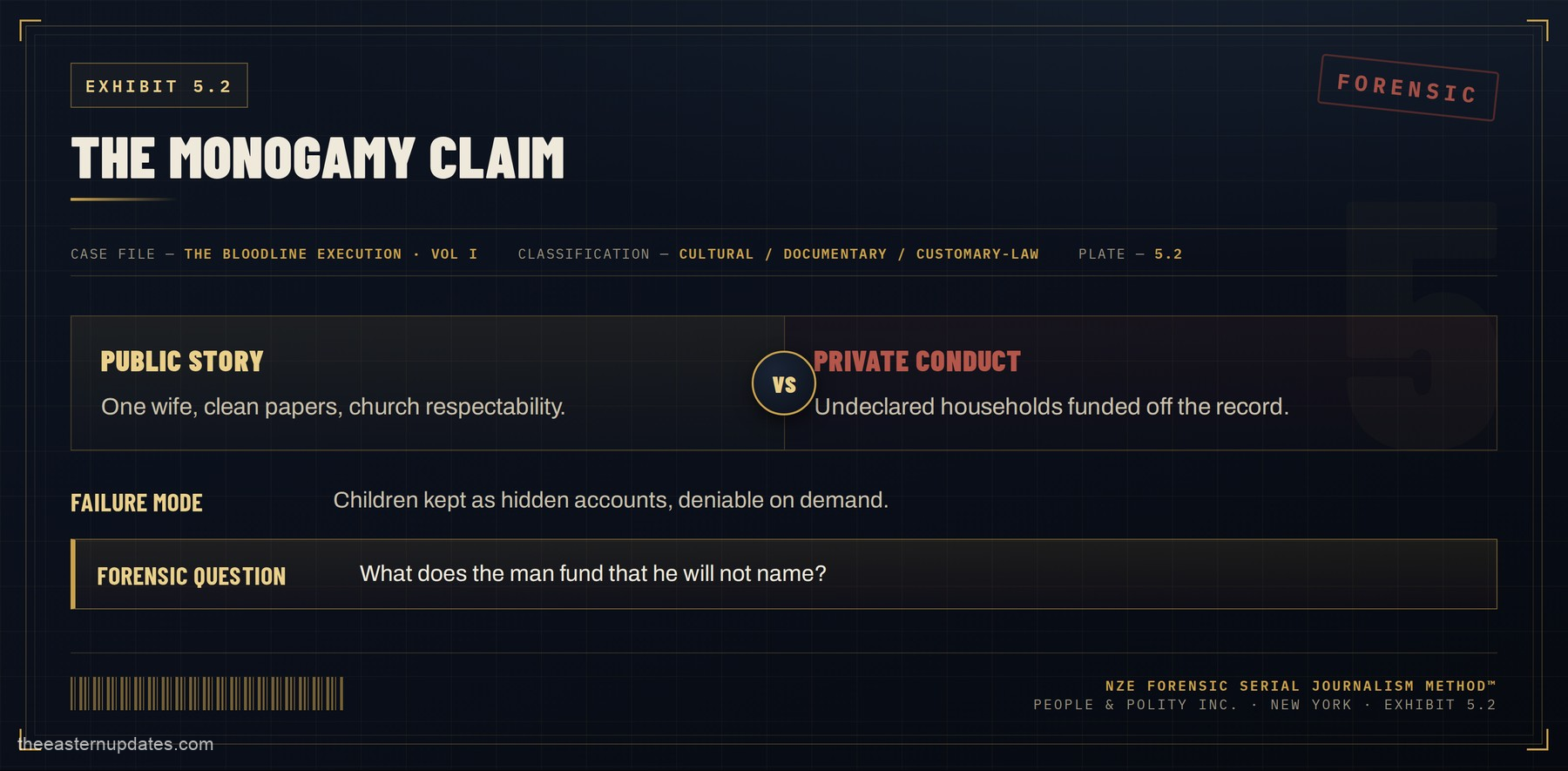
The modern man who ridicules polygyny often practices it with his body while denying it with his mouth. He keeps one legal wife, one church photograph, one public address — and, off the record, a private corridor of women who are never given a lawful place. His papers are clean, so he calls himself a monogamist. His conduct files a different report.
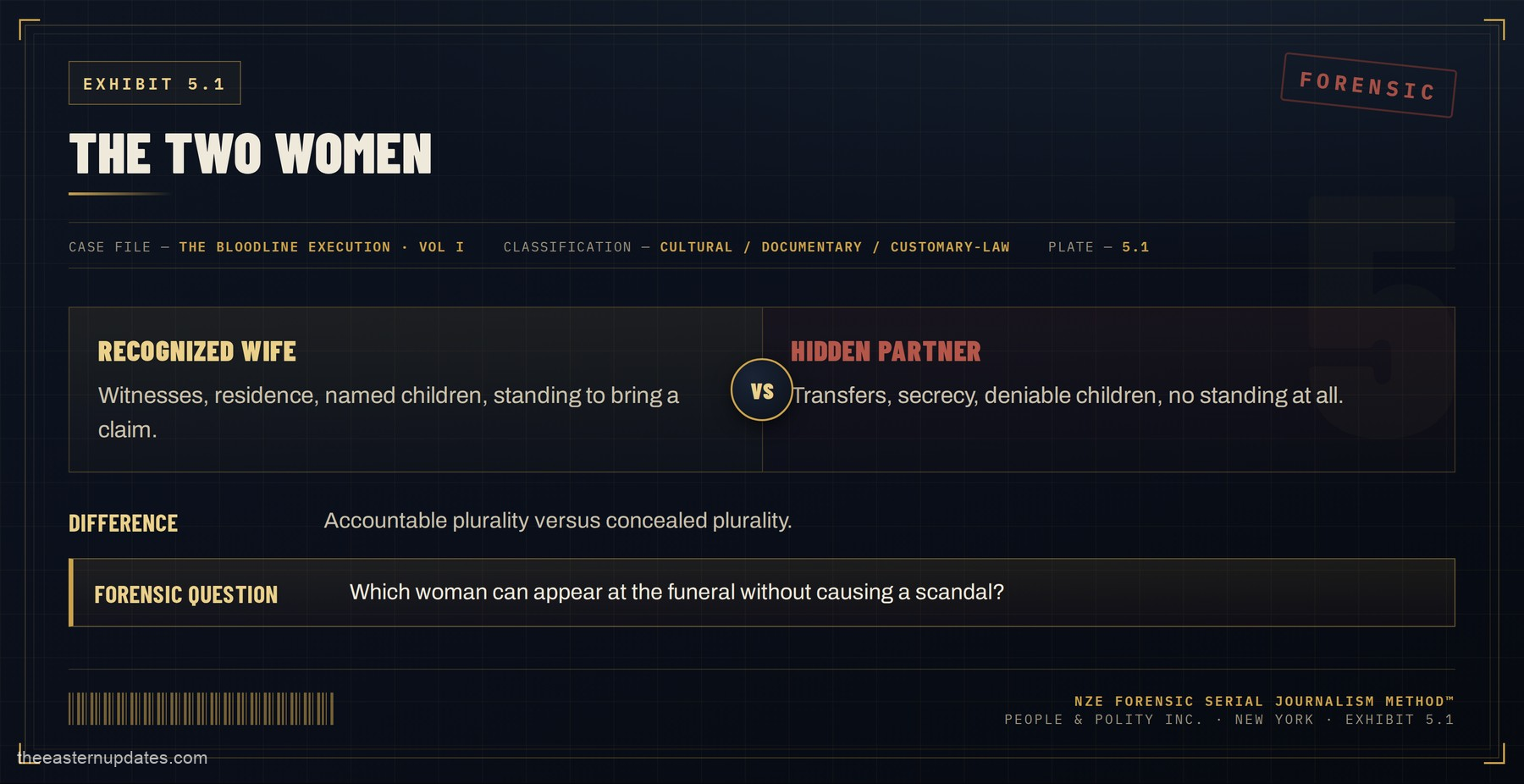
This is the fraud the noble order exposes, and the exposure is the point of Part 5. The question is not whether monogamy can be honorable — of course it can, and at its best it is. The question is whether a society that preaches monogamy while quietly normalizing hidden plural sex has earned the right to sneer at the ancestral compound. A recognized co-wife, whatever tensions she carries, occupies a different social world from a mistress kept outside the gate; her children stand on different ground from children funded in secret and denied in public (Agadjanian, 2020). The old order at least required a man to declare what he was doing. The modern arrangement rewards him for concealing it.
The difference is not moral hair-splitting; it is a difference in the evidence a child inherits. The recognized wife has witnesses, residence, and a paternal house that must own her children. The secret partner has a phone number, a set of transfers, and a man’s assurance that he will settle things later — assurances that evaporate at the first funeral. Scholars of African marriage have tracked how urbanization, Christianity, and the cash economy hollowed the public marriage process without replacing its protections, leaving many unions legally invisible and many children institutionally exposed (Nwoko, 2020; Mair, 1969). What is presented as modern monogamy is often disordered polygyny with the accountability stripped out.
Read also: The Bloodline Execution — Part 4
It will be said that this romanticizes the compound to shame the modern individual — that the mistress is a free adult, not a victim, and that a consenting private arrangement is nobody’s business. Sometimes that is true, and the series does not pretend every informal union is a crime. But consent between adults does not settle the position of the child, who consented to nothing and bears the full cost of concealment: the missing surname, the contested inheritance, the funeral at which he is introduced as a stranger. The compound’s claim was never that private feeling is forbidden. It was that a child’s standing is too important to be left to private feeling — and on that narrow point the ancestral order was not more primitive than the modern city but more responsible.
There is also a quieter cruelty in the modern form. The recognized co-wife could fight in the open — summon her kin, press her claim, shame a neglectful husband before people who mattered. The hidden woman cannot, because her leverage depends on the secrecy that also traps her; to demand recognition is to detonate the arrangement she survives inside (Bledsoe, Banja, & Hill, 1998). She is asked to carry the reproductive consequences of a union the man refuses to acknowledge, and to carry them silently. The compound, for all its inequities, did not run on that particular silence.
In the field, Part 5 documents the gap between the monogamous claim and the plural practice — the men who publicly deride polygyny while maintaining second and third households off the books, and the children those households produce. The reporter follows the money and the recognition separately: who is funded, who is named, who appears in the will, who is admitted at the burial. The distance between the two is exactly the fraud this part convicts.
Forensic Diagram Set
Evidence Docket
Seven-source APA 7 record for this installment. Entries verified for authorship and publication details.
Agadjanian, V. (2020). Condemned and condoned: Polygynous marriage in Christian Africa. Journal of Marriage and Family, 82(2), 751–768. https://doi.org/10.1111/jomf.12624
Bledsoe, C., Banja, F., & Hill, A. G. (1998). Reproductive mishaps and Western contraception: An African challenge to fertility theory. Population and Development Review, 24(1), 15–57.
Chae, S., & Agadjanian, V. (2022). The transformation of polygyny in sub-Saharan Africa. Population and Development Review, 48(4), 1125–1162. https://doi.org/10.1111/padr.12524
Mair, L. P. (1969). African marriage and social change. Frank Cass.
Nwoko, K. C. (2020). The changing nature and patterns of traditional marriage and family formation in southeast Nigeria. Journal of Historical Sociology, 33(4), 681–692. https://doi.org/10.1111/johs.12295
Uchendu, V. C. (1965). The Igbo of Southeast Nigeria. Holt, Rinehart and Winston.
Zeitzen, M. K. (2008). Polygamy: A cross-cultural analysis. Berg.