



















|
Listen to article
|
The Child Is Not an Accident
Fertility as Collective Obligation and the African Refusal to Treat Pregnancy as Waste
Forensic classification: Cultural investigation; documentary record; customary-law and kinship analysis.
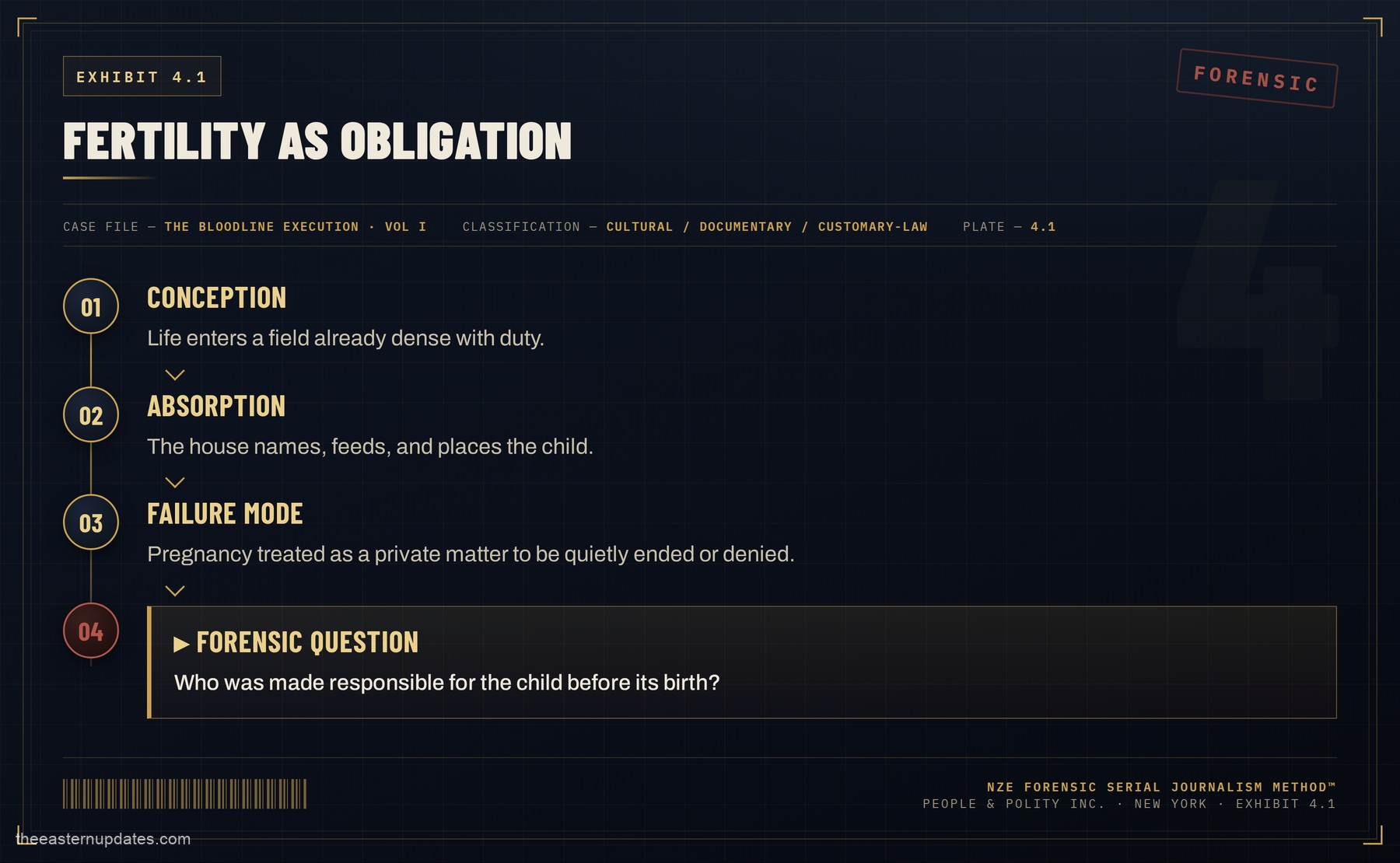
A society discloses its moral temperature in what it does with a pregnancy. In the old African compound a pregnancy was never the private property of appetite; it touched ancestry, land, a woman’s standing, the labor of the household, ritual memory, and the continuity of the house itself. The child was expected to arrive into a field already dense with obligation — a field waiting to absorb it, name it, feed it, and place it. That expectation is the true distance between customary fertility and modern convenience, and it is the ground this volume prepares for the argument still to come.
Polygyny sat inside that fertility order rather than beside it. It was one of the ways a lineage insured itself against a brutal arithmetic — high child mortality, unstable harvests, warfare, disease, widowhood, infertility, and the constant demand for hands — and the demographers who reconstructed the cultural logic of African fertility found exactly this: children were not a private indulgence but a collective security, valued, sought, and socially owned in ways the modern nuclear calculus does not capture (Caldwell & Caldwell, 1987). A man with more than one wife did not merely widen his sexual access; he deepened his obligations — more houses to provision, more succession to order, more life to place. The moral claim beneath noble polygyny was never that a man may do as he pleases. It was the harder proposition that life, once begun, must be absorbed, named, fed, and given a place.
This matters because the modern argument often proceeds as if fertility were simply a cost to be minimized, a private burden with no social meaning. Ancestral societies did not reason that way, and it would be an error to read their pro-natalism as ignorance of hardship. They knew hunger, overwork, and the death of children more intimately than the modern critic ever will; their embrace of fertility was a considered answer to precarity, not a failure to notice it (Caldwell & Caldwell, 1987; Fortes, 1949). In a descent-based world a child was continuity itself — the future in which the dead kept a place, the labor that fed the old, the name that carried a house forward. To waste a pregnancy was not a neutral private act; it was a subtraction from a shared inheritance.
Read also: The Bloodline Execution — Part 3
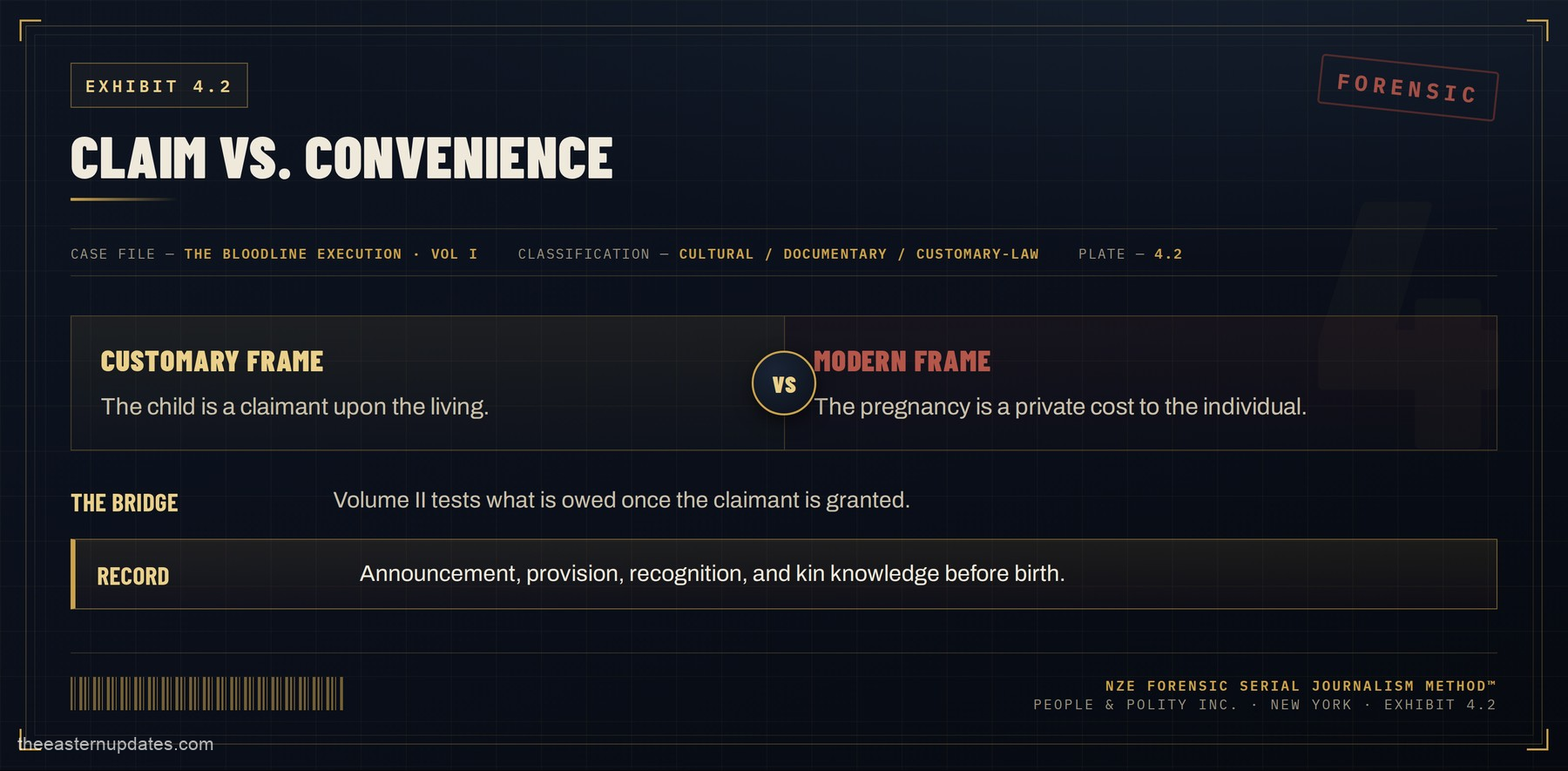
The modern objection is serious and deserves its full weight: a woman is not a vessel of lineage, and a fertility order that treats her womb as collective property can imprison her in bearing and rearing she did not choose. This series does not wave that away, and it will not defend any arrangement that coerces a woman’s body or reduces her to reproduction — coercion is precisely the counterfeit it prosecutes. But there is a distance between honoring a woman’s standing and accepting the modern premise that a pregnancy is a purely private event with no claimant but the individual will. The African order located the matter differently: the child was already a member of a family that owed it duties before it drew breath, and those duties fell first on the man and the kin who had made themselves responsible. To insist on that prior claim is not to diminish the woman. It is to refuse to let the man — and the society behind him — treat the life he helped begin as disposable the moment it becomes inconvenient.
Here the volume lays, deliberately and in the open, the floor on which Volume II will stand. If a child is a claimant upon the living — named into a house, owed provision, seated at an inheritance — then a pregnancy cannot be treated as mere private inconvenience, and its ending in secrecy cannot be treated as an event without remainder. That is the argument the next volume will press, and it is stated here as a claim to be tested rather than a verdict to be assumed. The reader is owed the logic plainly: establish that descent was a working institution with real obligations, and the later reckoning with abortion has somewhere to stand; deny it, and that reckoning floats. Volume I builds the floor. Volume II will ask what is owed once the floor is standing.
None of this licenses cruelty toward the women who face these decisions under pressure, and the series should resist the temptation to moralize at them rather than at the men and structures that abandon them. The forensic question is not aimed at the frightened; it is aimed at the arrangement that produces the fright — the secret union, the denied paternity, the man who enjoys the woman, fears the child, and negotiates his responsibility downward until she carries the whole weight alone. The old compound’s answer was to force the claim into the open early, so that neither a child nor a mother could be quietly subtracted from the record.
In the field, Part 4 should map how fertility was actually valued and governed in specific compounds: how a pregnancy was announced and to whom, which elders and mothers were told, how provision was arranged before birth, and how a community treated a man who tried to deny a coming child. Set the ideal against the breach — the houses that honored the claim beside those that evaded it — and let the contrast, tested against three voices and the material record, carry the argument that a child was meant to be absorbed, not erased.
Forensic Diagram Set
Evidence Docket
Seven-source APA 7 record for this installment. Entries verified for authorship and publication details.
Agadjanian, V. (2020). Condemned and condoned: Polygynous marriage in Christian Africa. Journal of Marriage and Family, 82(2), 751–768. https://doi.org/10.1111/jomf.12624
Bledsoe, C., Banja, F., & Hill, A. G. (1998). Reproductive mishaps and Western contraception: An African challenge to fertility theory. Population and Development Review, 24(1), 15–57.
Caldwell, J. C., & Caldwell, P. (1987). The cultural context of high fertility in sub-Saharan Africa. Population and Development Review, 13(3), 409–437.
Chae, S., & Agadjanian, V. (2022). The transformation of polygyny in sub-Saharan Africa. Population and Development Review, 48(4), 1125–1162. https://doi.org/10.1111/padr.12524
Fortes, M. (1949). The web of kinship among the Tallensi. Oxford University Press.
Goody, J. (1973). Bridewealth and dowry in Africa and Eurasia. In J. Goody & S. J. Tambiah (Eds.), Bridewealth and dowry (pp. 1–58). Cambridge University Press.
Uchendu, V. C. (1965). The Igbo of Southeast Nigeria. Holt, Rinehart and Winston.