

















|
Listen to article
|
The House That Named Every Child
Public Paternity, the Naming Rite, and the African Refusal of Lineage Erasure
Forensic classification: Cultural investigation; documentary record; customary-law and kinship analysis.
The deepest injury a society can do to a child is not to starve it but to unname it. A poor child with a known father, a known house, and a known people holds something hunger cannot take — a place from which to be defended. A child with money but no acknowledged line, no settled paternal house, no uncontested surname, no seat at any inheritance, lives a quieter destitution that no balance repairs. The ordered African compound was built, among other things, against that second poverty. It gave a child an address in the world before the world could file it under inconvenience.
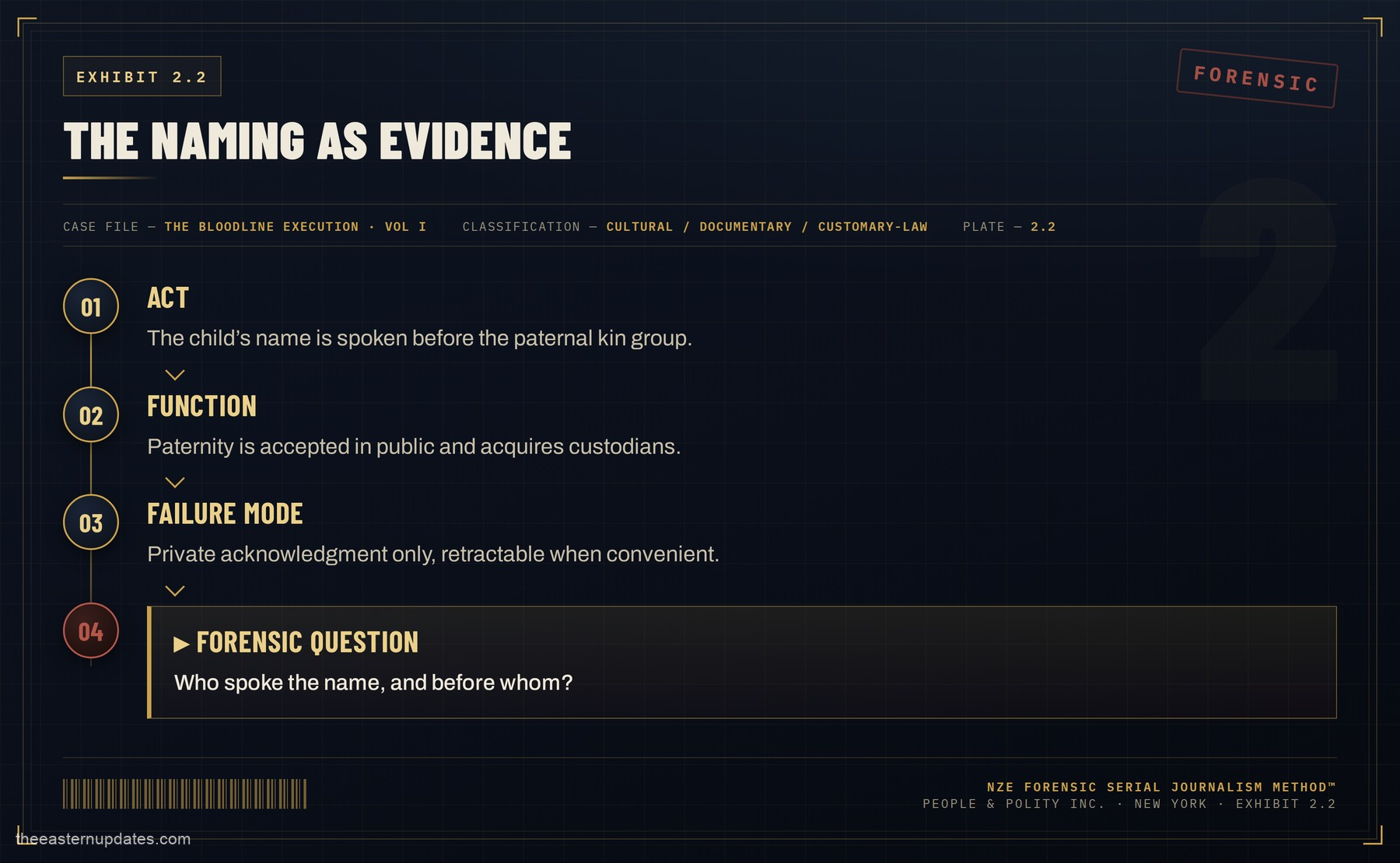
Naming carried that weight, and it was never decoration. Across much of the continent a name was a compressed archive — ancestry, prayer, the circumstances of a birth, a rank, sometimes an open family quarrel — and to confer it in public was to accept a child as one’s own before witnesses who would remember (Uchendu, 1965). Once spoken over a recognized child in a recognized house, the name became difficult to retract. The father might still be cruel and the paternal kin might still quarrel, but the founding fact now had custodians other than the man who might wish to deny it. The child was no longer an unsigned document.
Igbo practice shows the mechanism with unusual clarity. Marriage there was never reduced to the private feeling of a couple; it advanced through kin inquiry, family consent, bridewealth, and ceremonial exchange, moving the woman into a new and witnessed web of relations (Uchendu, 1965; Agbasiere, 2000). Scholars who have tracked how this family-centered order bent under Christianity, schooling, and urban migration nonetheless find its underlying logic intact: a legitimate union was a public transfer of obligation, not merely licensed access, and a child born inside it could be addressed through the father’s line with far less dispute (Nwoko, 2020; Afigbo, 1981). The ceremony was, in effect, the registry — and in a society whose records lived in memory, the registry had to be crowded with people.
A word must be said plainly about a hard term. When this series uses bastardy, it does not fling a slur at a child; it names a wound that adults inflict. The word marks a manufactured condition — biological presence without institutional standing: no settled paternal house, no secure surname, no reliable path to inheritance, no public economic claim. The child caught inside that condition is its victim, never its author, and Volume I indicts the arrangement that produces it, not the innocent who inherits it. Naming, done in the open, was the customary refusal of precisely this manufacture.
The modern reply is that the naming order was patriarchal machinery — that it bound a woman’s worth to her sons and a child’s worth to a father’s whim. There is truth in the charge, and an honest defense takes it: a system that made recognition the father’s prerogative could make cruelty his prerogative too. But recognition-in-public and denial-in-private are not moral equals, and the woman’s protection lay precisely in the publicity. A wife whose entry had been witnessed, whose bridewealth two families remembered, whose child had been named before the kin group, held leverage a secret partner has never possessed. The order did not guarantee justice; it created the conditions — witnesses, records, standing — under which injustice could at least be named and contested. In the modern private arrangement that is very often the one thing missing.
Modernity did not invent male irresponsibility; it privatized it. The city supplies rooms without witnesses; money quietly replaces the kin who used to watch; a man fathers children across neighborhoods and later pleads confusion. Some women carry pregnancies in fear, because recognition would expose an affair or offend a wife protected by civil paper. The children become hidden accounts — school fees moved by discreet transfer, birth records left vague — until a funeral arrives and the concealed family appears at the edge of the crowd while the public family performs surprise. The compound was designed to make that scene impossible, because it refused to let a birth stay private long enough to be denied.
Read also: The Bloodline Execution — Part 1
This is why the defense of polygyny in this series begins with the child and the woman, not the man. Men are forever trying to hijack the subject, to make plural marriage sound like a trophy of male power; that reading is not merely distasteful but backward. A customary household earns defense only where it secures the child’s right to be known and the woman’s right not to be kept as a shadow. The man who wants plural wives while refusing plural duties has not inherited an African institution. He has forfeited it — and this series will say so with his name attached wherever the record allows.
Read also: The Bloodline Execution — Overview
Carried into the field, Part 2 is an exercise in tracing names. Take several families and follow how children born to recognized wives, to informal partners, and to disputed unions were actually treated — in the school register, the church record, the family meeting, the burial rite, the inheritance talk. Who carried the child at the naming? Who paid the fees? Did the child bear the father’s surname from birth or acquire it late? Did the paternal grandmother receive the child or turn from it? Those particulars, laid side by side, separate blood from belonging, and they are where the argument stops being sentiment and becomes a file.
Forensic Diagram Set

Evidence Docket
Seven-source APA 7 record for this installment. Entries verified for authorship and publication details.
Afigbo, A. E. (1981). Ropes of sand: Studies in Igbo history and culture. University Press Ltd.
Agbasiere, J. T. (2000). Women in Igbo life and thought. Routledge.
Mair, L. P. (1969). African marriage and social change. Frank Cass.
Nwoko, K. C. (2020). The changing nature and patterns of traditional marriage and family formation in southeast Nigeria. Journal of Historical Sociology, 33(4), 681–692. https://doi.org/10.1111/johs.12295
Radcliffe-Brown, A. R., & Forde, D. (Eds.). (1950). African systems of kinship and marriage. Oxford University Press.
Siegel, B. (1996). African family and kinship. In A. A. Gordon & D. L. Gordon (Eds.), Understanding contemporary Africa (2nd ed., pp. 221–247). Lynne Rienner.
Uchendu, V. C. (1965). The Igbo of Southeast Nigeria. Holt, Rinehart and Winston.