




















The Noble Compound
How African Polygyny Turned Fertility Into Public Duty, Child Recognition, and Lineage Security
Forensic classification: Cultural investigation; documentary record; customary-law and kinship analysis.
The first mistake in the modern case against African polygyny is small and fatal: it pictures a bedroom. Once the compound is imagined as an arrangement for sex, everything else follows wrongly, because the institution was never organized around the bed. It was organized around land, rank, labor, succession, and the recognition of children, and its authority rested not on desire but on obligations a man had to meet in public. A husband did not acquire wives as private companions. He stood before two families, a line of bridewealth witnesses, the custodians of ritual, and a village with a long memory, and each woman entered a house already furnished with a name, a place, a maternal line, and a future claim carried by her children. Strip the ceremony of its obligations and no compound is left — only a man and his appetites, which is precisely the modern thing the old order existed to prevent.
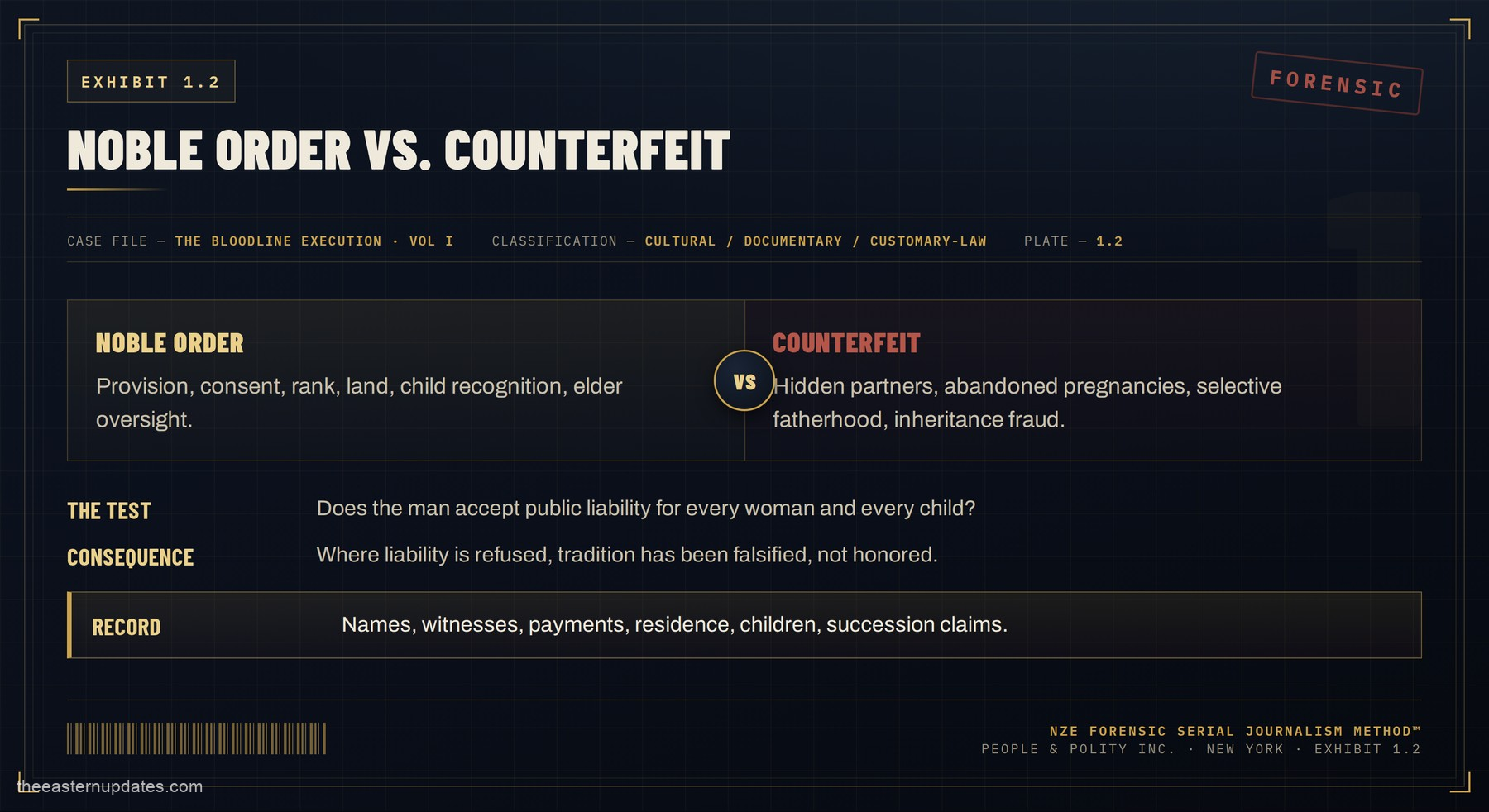
This is why the ordered compound must be separated, cleanly and at the outset, from the carelessness that now borrows its language. Customary polygyny was not permission; it was a schedule of burdens that fell due before any privilege was enjoyed. The man was expected to feed the house, secure land for each wife’s children, answer to elders, keep co-wife order without cruelty, protect the young, and leave an inheritance legible enough to survive his death. While those duties held, the compound was an institution. The moment they collapsed it ceased to be noble — and the same custom that had honored the provider turned its instruments against the defaulter: gossip, shame, the withdrawal of standing, the intervention of the wife’s kin. The order was never a license a man held for life. It was a performance reviewed continuously by people with the power to humiliate him.
The anthropological record, read honestly, supports this reading and refuses the caricature. Marriage in most customary African societies was not a private contract between two isolated individuals but a treaty between families that bound farms, lineages, ritual duties, and rules of succession into one arrangement (Radcliffe-Brown & Forde, 1950). Goody (1973) placed plural marriage inside the productive logic of agrarian life, where wives and children were not ornaments of male vanity but the labor and continuity on which a house survived. Mair (1969) traced how these institutions bent under colonial rule, Christianity, and the cash economy without simply dissolving. None of this work describes a paradise; all of it describes law. The child born into such an order was not an accident dropped into society. The child belonged somewhere — could be named, placed, defended, disciplined, and remembered — which is a great deal more than the modern city reliably offers the children conceived behind its private doors.
Three achievements of the ordered compound deserve to be named precisely, because each is something the modern arrangement has quietly lost.
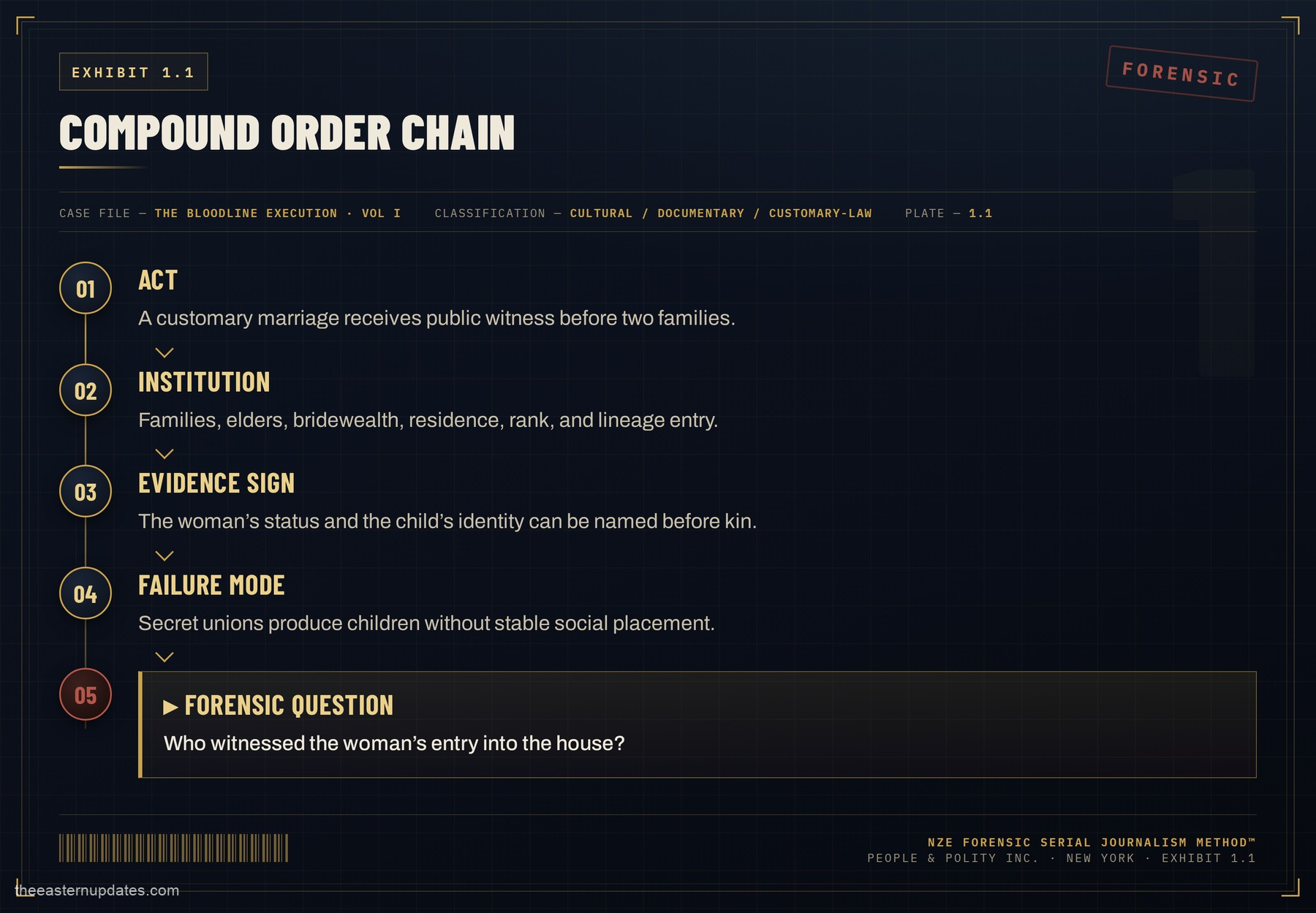
The first is that it made fertility public. A pregnancy inside the compound did not hide behind an apartment door or a hotel register; it entered a field of witnesses. Elders could ask questions, mothers could intervene, co-wives could compete — and could also cook, nurse, warn, accuse, and testify. A child grew up inside a web of recognition wider than one couple’s private feeling, and so was not left to the mood of a single man. This is the difference between a birth society is obliged to notice and a birth it is free to deny, and that difference is rarely small.
The second is continuity, and here the compound answered an arithmetic the modern critic seldom reckons with. In societies where land, memory, and ritual passed through descent, and where mortality, infertility, widowhood, and child loss were constant companions, children were survival itself — labor, defense, care in age, and the future in which the dead went on living. Polygyny belonged to that economy. It was one of the ways a house insured itself against the hard odds of agrarian life, which is why, in the comparative record, it appears tied to ecology and production rather than to appetite (Goody, 1973; White & Burton, 1988).
Read also: The Bloodline Execution — Overview
The third is that it made female status visible. A recognized wife held a social title — senior wife, junior wife, mother of the house, farm custodian, ritual participant — and a title is a claim its holder can press. This did not abolish hardship, and it must not be dressed up as though it did: favoritism, jealousy, and unequal provision were real, and the woman who lived them did not experience her title as a comfort. But visibility was the design, and visibility is a form of protection. A wife married in the open before both families stood on ground that a secret mistress, a discarded girlfriend, or a hidden mother — whose child is denied at the graveside because the man’s public family refuses her — has never been given.
Here the modern objection must be met head-on rather than side-stepped, because it is a serious one. Did the compound not license male domination, trap women in rivalry, and ration a child’s chances by the accident of which wife bore it? Sometimes it did, and an honest defense concedes it. But the empirical record locates that harm with a precision that vindicates the argument of this series rather than refuting it. When the association between polygyny and poor child health is examined within communities instead of across them, it weakens or reverses, and children living with a resident, provisioning father fare better than the aggregate ever implied; the damage concentrates where paternal presence and provision are absent (Lawson et al., 2015; Lawson & Gibson, 2018). The senior, recognized wife is repeatedly found to do well. It is the unranked, unprovided, later union that carries the cost. That is not a case against the ordered compound. It is a case against exactly what this series calls the counterfeit — drawn, tellingly, from the same evidence that acquits the genuine article.
So the compound must be judged as any institution is judged: by whether it delivered what it promised. By that measure it was, among other things, an evidence machine. In a world where most records lived in memory, the ceremony was the filing system. A wife’s kin remembered the negotiation; the husband’s kin remembered the terms; neighbors saw who entered the household; children grew up surrounded by people who could later testify. A hidden affair produces weak facts — a promise, a transfer, a photograph, a denial. A wife in a compound produces strong ones: recognition, ceremony, residence, witnesses, and children seen and named by the paternal line. That difference decides whether a child is treated as blood or as rumor, and it is very often the whole of a child’s future.
The compound also imposed, almost as a by-product, a public theory of male maturity. A man’s household was a standing exhibition of his discipline. If his wives went hungry, people saw it. If his children ran untrained, people saw it. If he humiliated the first wife to flatter a younger one, people saw that too. Public life did not abolish cruelty, but it made concealment expensive — and the modern private household too often does the reverse, sheltering the offender better than the injured. There is no nostalgia in the observation. It is simply what the comparison shows.
The institutional claim on which the whole series rests can now be stated without exaggeration. African polygyny deserves defense only where it converts biological power into social duty; where it fails that conversion it collapses into domination and forfeits the name. But where the conversion held — where provision, recognition, rank, and succession were real and reviewable — the compound was one of the oldest and most effective African mechanisms ever devised for keeping women and children from being abandoned in the dark after male desire had passed. That is the ideal this volume defends. It is also, precisely, the standard by which the volume convicts the men who have betrayed it.
A closing word on how Part 1 should be carried into the field, since the argument is only as strong as the file beneath it. The reporter’s task is not to gather opinion but to reconstruct compounds: how wives were introduced, how children were named, how farms were allocated, how disputes were heard, and how a man was shamed when he failed to provide. Men must be interviewed apart from women, because male testimony alone will overstate order and bury injury; the strongest passages will come from the contradictions between the two, tested against whatever the land records, fee receipts, and burial rolls actually show. Three voices at minimum, across three generations — the elder who states the rule, the woman who carried its cost, the adult child who inherited its consequence. Assembled that way, the compound stops being a memory to be admired or scorned and becomes what this series needs it to be: a case, on the record, that the reader can check.
Forensic Diagram Set

Evidence Docket
Seven-source APA 7 record for this installment. Every entry has been verified for authorship, place of publication, and identifier.
Agadjanian, V. (2020). Condemned and condoned: Polygynous marriage in Christian Africa. Journal of Marriage and Family, 82(2), 751–768. https://doi.org/10.1111/jomf.12624
Goody, J. (1973). Polygyny, economy and the role of women. In J. Goody (Ed.), The character of kinship (pp. 175–190). Cambridge University Press.
Lawson, D. W., & Gibson, M. A. (2018). Polygynous marriage and child health in sub-Saharan Africa: What is the evidence for harm? Demographic Research, 39, 177–208. https://doi.org/10.4054/DemRes.2018.39.6
Lawson, D. W., James, S., Ngadaya, E., Ngowi, B., Mfinanga, S. G. M., & Borgerhoff Mulder, M. (2015). No evidence that polygynous marriage is a harmful cultural practice in northern Tanzania. Proceedings of the National Academy of Sciences, 112(45), 13827–13832. https://doi.org/10.1073/pnas.1507151112
Mair, L. P. (1969). African marriage and social change. Frank Cass.
Radcliffe-Brown, A. R., & Forde, D. (Eds.). (1950). African systems of kinship and marriage. Oxford University Press.
White, D. R., & Burton, M. L. (1988). Causes of polygyny: Ecology, economy, kinship, and warfare. American Anthropologist, 90(4), 871–887. https://doi.org/10.1525/aa.1988.90.4.02a00060