



















|
Listen to article
|
The First Wife and the Law of Order
Seniority, Rank, and the Internal Law That Separates a House From a Marketplace of Injuries.
Forensic classification: Cultural investigation; documentary record; customary-law and kinship analysis.
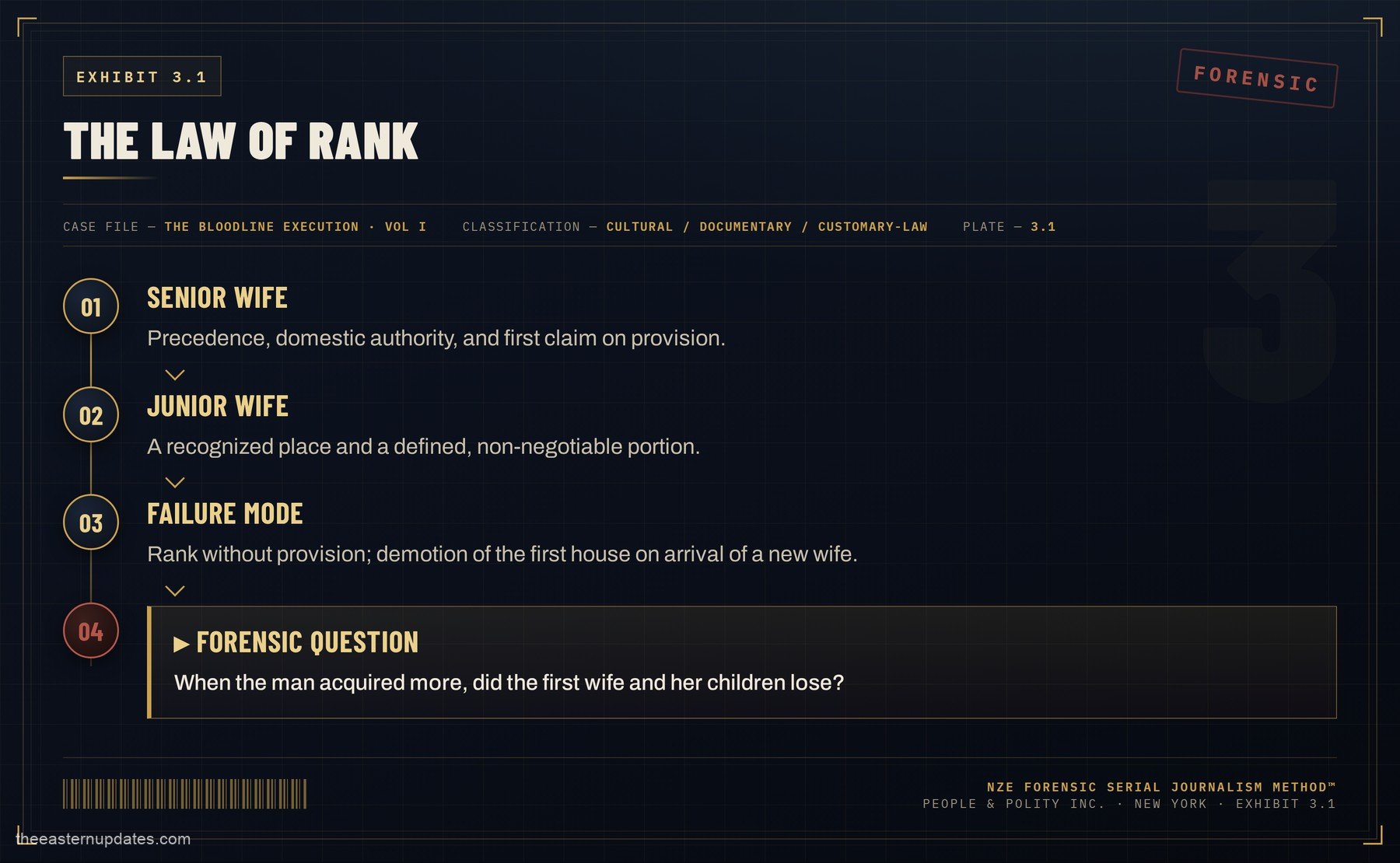
The first wife is the hinge on which every defense of polygyny turns, and the point at which the lazy ones break. A man who treats his first wife as a discarded foundation once a younger woman arrives has not practiced a noble order; he has practiced expansion without justice, and no appeal to tradition redeems it. In many African settings seniority was not sentiment but constitution — order of entry, maternal rank, ritual precedence, domestic authority, and real political weight among the women of the house. The senior wife was frequently the man’s first witness and the standing test of his discipline, and a house that demoted her had begun to rot from its foundation.
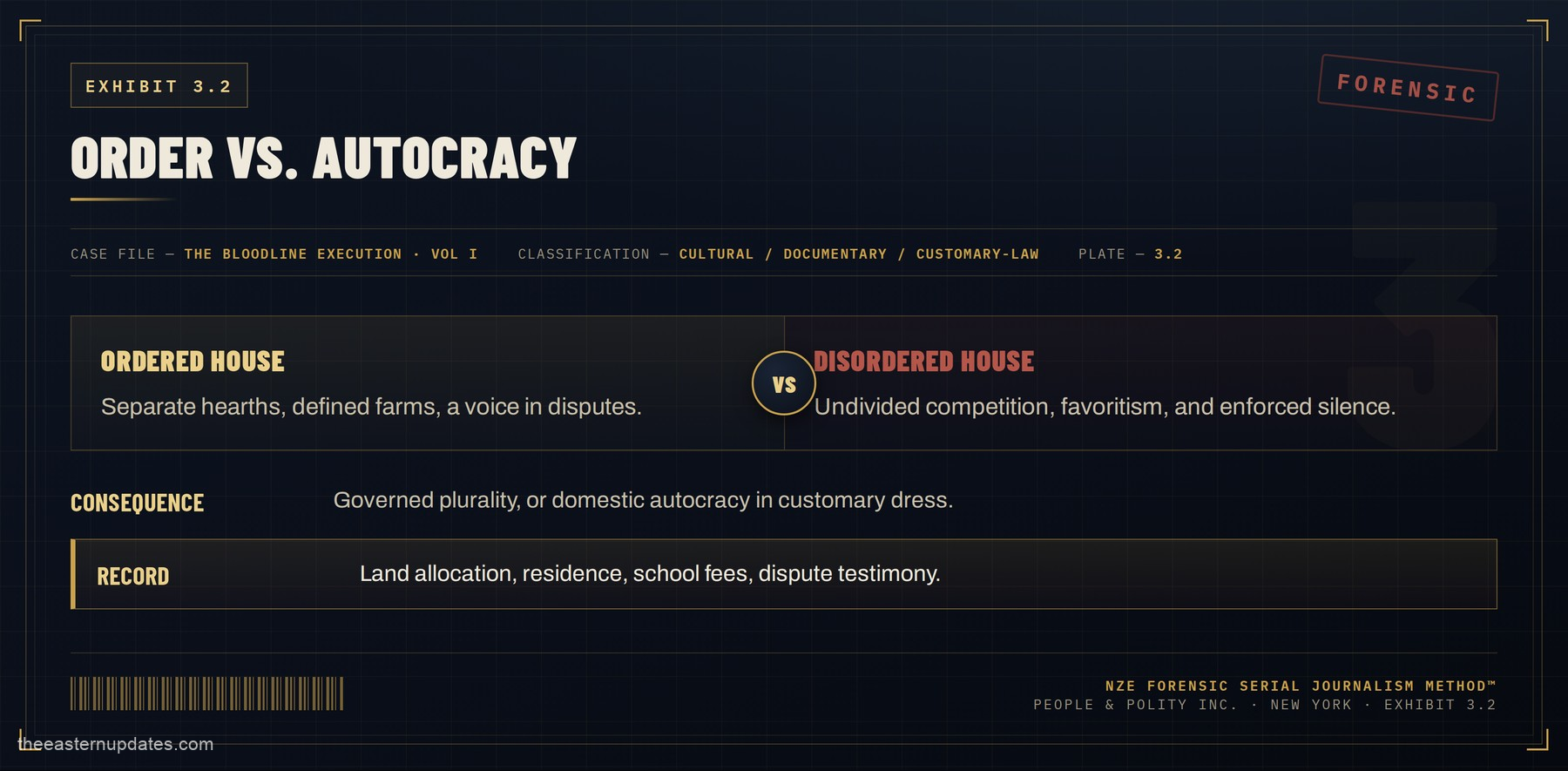
Strip a polygynous household of rank and it stops being a household; it becomes a marketplace of injuries. Every woman competes without rule, every child inherits its mother’s resentments, and the man floats above the wreckage as judge, beneficiary, and offender at once — which is not order but domestic autocracy dressed in custom. Against exactly this, customary systems built structure, unevenly and imperfectly: senior and junior stations, separate hearths, defined farms, known kitchens, ordered access, mother-house identities for the children. These were not quaint arrangements. They were the load-bearing rules that kept plurality from collapsing into a war of all against all.
Read also: The Bloodline Execution — Part 2
Here the empirical record does the argument a striking service, because it shows that rank was not merely a courtesy — it tracked welfare. In rural Ethiopia, Gibson and Mace found that the fortunes of polygynously married women depended sharply on rank: first wives did better than monogamously married women and markedly better than second or third wives, and the pattern echoed in the children, whose nutritional status fell with their mother’s position in the house (Gibson & Mace, 2007). The larger Tanzanian evidence points the same way — where a provisioning husband is resident and the senior house intact, outcomes are good, and the harm the surveys detect concentrates among later, less-provided unions (Lawson et al., 2015). Read carelessly, this is a fact about polygyny; read carefully, it is a fact about order. The senior, recognized, provisioned wife is not the victim of the system. She is evidence that the system, when its internal law held, worked as designed — and the suffering junior wife is evidence of the law’s breach, not its intent.
The objection presses hard here: is a defense of seniority not simply a defense of a hierarchy that ranked women against one another for a man’s benefit? The concession must be honest. Rank could harden into cruelty; a senior wife could lord her position over a junior; a favored house could starve a neglected one. But the alternative the modern critic imagines — plural union without rank — is not gentler; it is worse, because it removes the only rules that ever restrained the competition. The comparative and demographic literature is blunt about where harm clusters: not in the ranked, provisioned senior house, but in the unranked, unprovided, often non-resident later union — the arrangement closest to the modern secret second family (White, 1988; Lawson et al., 2015). Rank was not the disease. It was the imperfect medicine, and pulling it out did not cure the patient; it only hid the symptoms behind an apartment door.
The senior wife also functioned, in the better-ordered houses, as something the modern private arrangement lacks entirely: an internal check on the husband. She had standing to be consulted, to object, to summon her own kin, to shame a man drifting toward favoritism or neglect. Where custom gave her that standing, a man could not remake the household around his latest desire without cost. Zeitzen’s cross-cultural survey underlines the point that plural marriage was rarely the free playground of male whim it is caricatured as; it was a governed institution with offices, expectations, and levers of restraint, and the senior wife often held the first of those levers (Zeitzen, 2008; Radcliffe-Brown & Forde, 1950).
Read also: The Bloodline Execution — Part 1
The forensic test for Part 3 therefore fixes on the treatment of the first wife as the diagnostic of the whole house. Was her seniority materially real — expressed in land, residence, the education of her children, a voice in disputes — or simply verbal? Did the arrival of a junior wife diminish her provision, or was the order expanded without robbing the foundation? A single question sorts the noble house from the counterfeit: when the man acquired more, did the first wife and her children lose? Where the answer is yes, tradition has been invoked to license a demotion custom never sanctioned.
In the field, the senior wife must be interviewed in her own right and out of her husband’s hearing, and her account set against the material record — whose farm is whose, whose children stayed in school, who eats first and who eats last. The adult children of both senior and junior houses should be heard, because they carry the consequences their parents will minimize. Three voices again, drawn from the ranks of one compound: the husband’s account of his fairness, the senior wife’s account of her standing, the junior house’s account of its portion — laid against land, fees, and residence until the ledger, not the man, delivers the verdict.
Forensic Diagram Set
Evidence Docket
Seven-source APA 7 record for this installment. Entries verified for authorship and publication details.
Gibson, M. A., & Mace, R. (2007). Polygyny, reproductive success and child health in rural Ethiopia: Why marry a married man? Journal of Biosocial Science, 39(2), 287–300. https://doi.org/10.1017/S0021932006001441
Lawson, D. W., James, S., Ngadaya, E., Ngowi, B., Mfinanga, S. G. M., & Borgerhoff Mulder, M. (2015). No evidence that polygynous marriage is a harmful cultural practice in northern Tanzania. Proceedings of the National Academy of Sciences, 112(45), 13827–13832. https://doi.org/10.1073/pnas.1507151112
Mair, L. P. (1969). African marriage and social change. Frank Cass.
Radcliffe-Brown, A. R., & Forde, D. (Eds.). (1950). African systems of kinship and marriage. Oxford University Press.
Uchendu, V. C. (1965). The Igbo of Southeast Nigeria. Holt, Rinehart and Winston.
White, D. R. (1988). Rethinking polygyny: Co-wives, codes, and cultural systems. Current Anthropology, 29(4), 529–572.
Zeitzen, M. K. (2008). Polygamy: A cross-cultural analysis. Berg.