




















|
Listen to article
|
The Inheritance War
How Unregulated Desire Produces Lawsuits, Orphans, and Family Collapse
Forensic classification: Cultural investigation; documentary record; customary-law and kinship analysis.
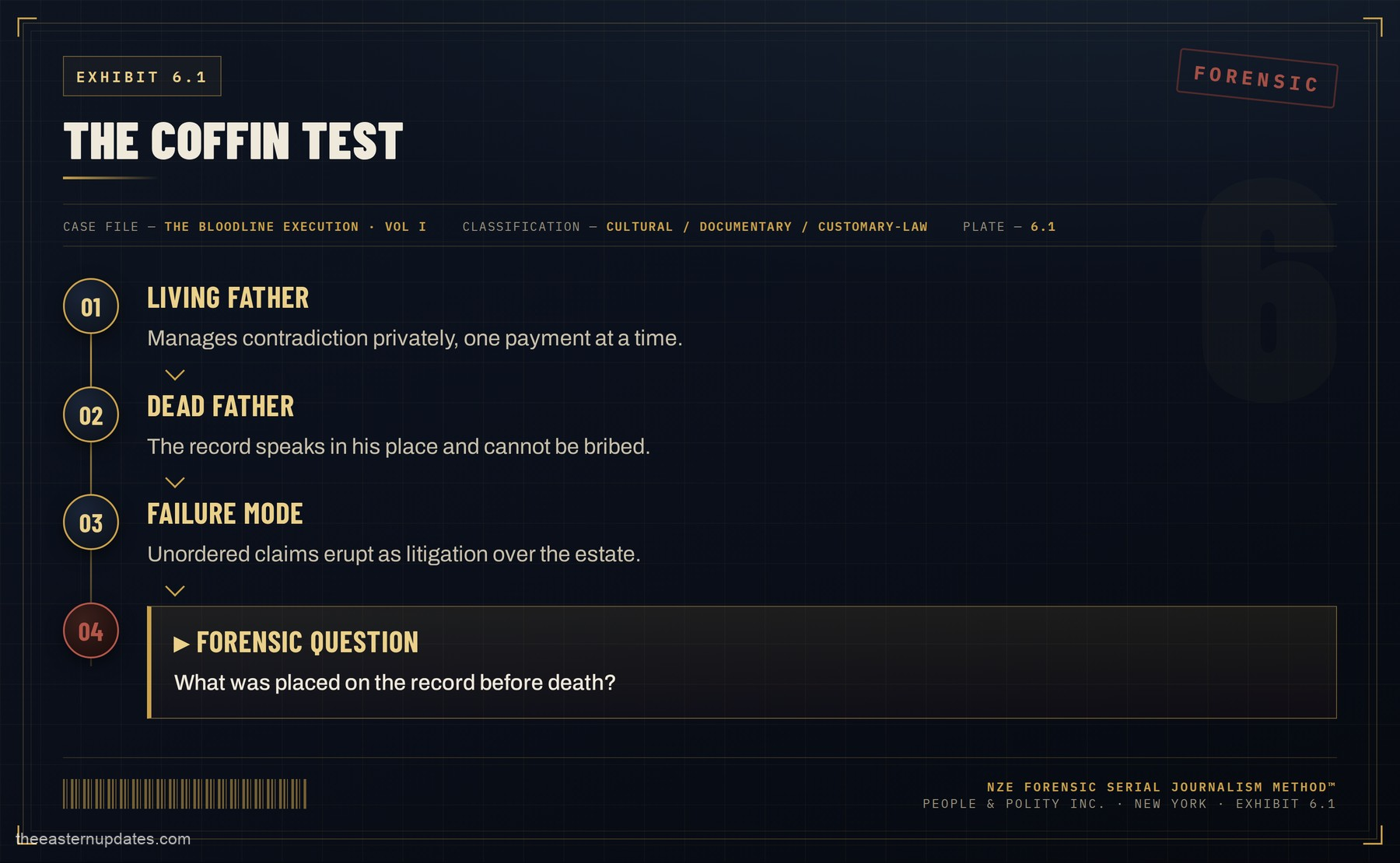
The coffin is where sexual secrecy comes to trial. While a man lives he can manage his lies — pay one child in cash, placate one woman by phone, threaten another into silence, and perform respectability on Sunday. Death removes his voice and leaves only the record, and the record is rarely kind. Then the house begins to bleed.
Inheritance disputes in polygynous and hidden-plural families are seldom accidents. They are the delayed detonation of reproductive facts that were never ordered while the father lived. Which children are heirs? Which wife held status? Which union counted? Was bridewealth paid? Did a statutory marriage silently void a later customary one? Did the man acknowledge the child, and does acknowledgment even matter under the applicable law? These questions arrive all at once, at the graveside, among people with money at stake and grief for cover.
Read also: The Bloodline Execution — Part 5
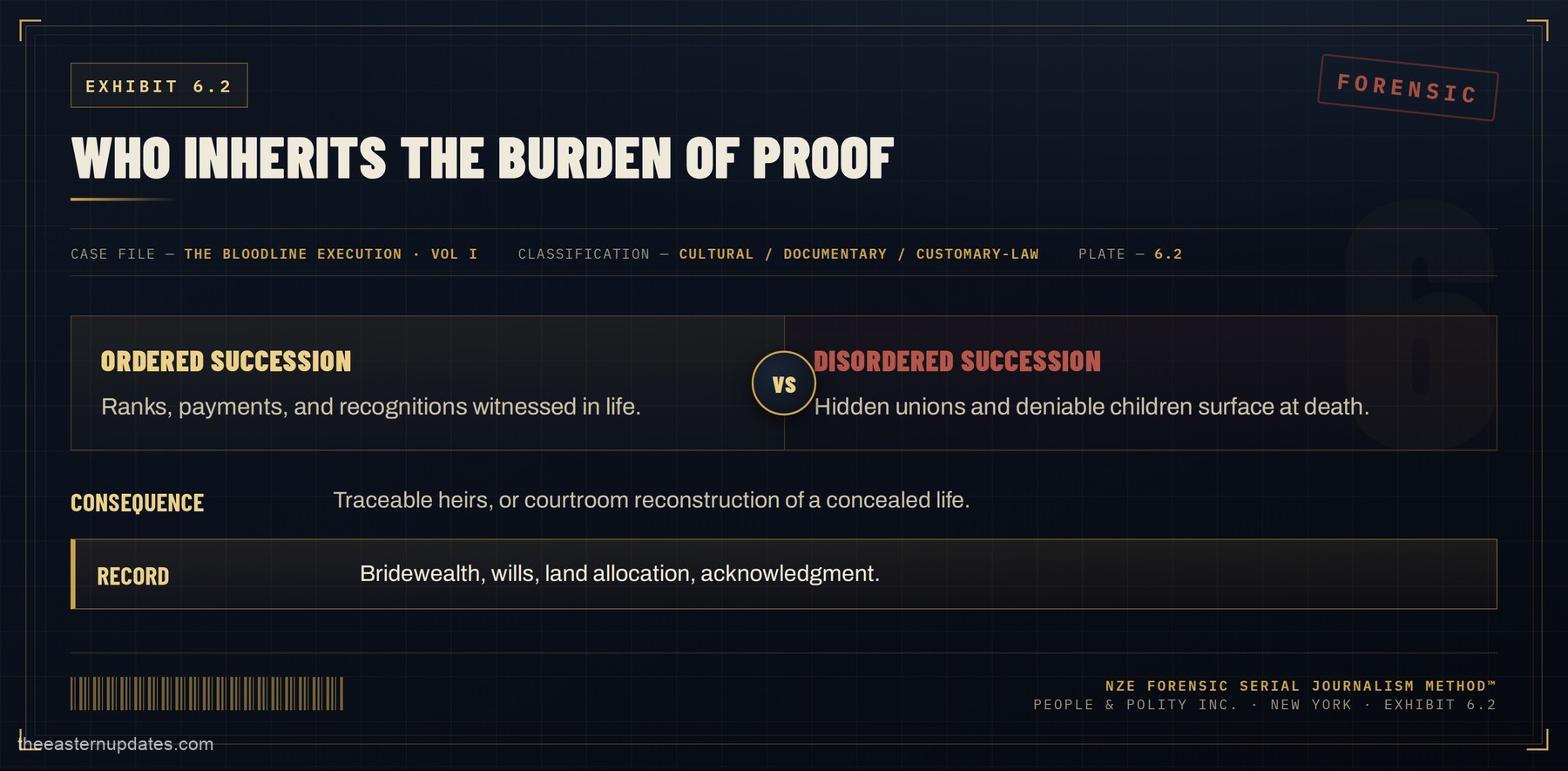
This is where the economic literature on polygyny becomes forensic evidence rather than theory. Marriage in these systems moved real assets — bridewealth, land, labor, livestock — and the demand for wives tracked their economic productivity, not just male desire (Jacoby, 1995; Goody, 1973). Where those transfers and entitlements were witnessed and recorded, succession could be traced; where they were hidden, succession becomes litigation. The ordered compound did not abolish inheritance conflict, but it front-loaded the paperwork: the payments, the ranks, the recognitions were public facts before the man died. The secret family front-loads nothing and leaves the courts to reconstruct a life the man spent concealing.
The critic will answer that polygyny is itself the engine of these wars — that multiplying wives multiplies claimants and guarantees conflict, and that monogamy is simply cleaner. There is real force here, and the economic case is not trivial: Tertilt’s modeling suggests that plural marriage, by driving bride-prices and skewing investment, carries measurable costs at the scale of a whole economy (Tertilt, 2005). The series concedes the cost and answers on the narrower ground it actually holds: the disorder that fills the courts is produced not by plurality as such but by unrecorded plurality. A ranked, witnessed compound with a known succession generates fewer graveside surprises than a monogamous man with three undocumented households. The war is a war of missing records, and it is worst precisely where the union was hidden.
The victims of that war are almost always the weakest parties — the junior house, the unacknowledged child, the widow whose customary marriage the man never regularized. They inherit not property but a burden of proof, forced to establish in a courtroom the recognition the father withheld in life (Murdock, 1959; Radcliffe-Brown & Forde, 1950). The noble order’s cruelty, where it failed, was open and could be contested. The counterfeit’s cruelty is posthumous, and it lands on the people least able to bear it.
Part 6 is built from actual succession records: wills and their absence, contested letters of administration, land disputes, and the testimony of who was fed and named while the father lived. The forensic question is singular and decisive — what did the man put on the record before he died? — because everything the house fights over afterward is the answer to it.
Forensic Diagram Set
Evidence Docket
Seven-source APA 7 record for this installment. Entries verified for authorship and publication details.
Goody, J. (1973). Bridewealth and dowry in Africa and Eurasia. In J. Goody & S. J. Tambiah (Eds.), Bridewealth and dowry (pp. 1–58). Cambridge University Press.
Jacoby, H. G. (1995). The economics of polygyny in sub-Saharan Africa: Female productivity and the demand for wives in Côte d’Ivoire. Journal of Political Economy, 103(5), 938–971.
Murdock, G. P. (1959). Africa: Its peoples and their culture history. McGraw-Hill.
Radcliffe-Brown, A. R., & Forde, D. (Eds.). (1950). African systems of kinship and marriage. Oxford University Press.
Tertilt, M. (2005). Polygyny, fertility, and savings. Journal of Political Economy, 113(6), 1341–1371.
Uchendu, V. C. (1965). The Igbo of Southeast Nigeria. Holt, Rinehart and Winston.
White, D. R., & Burton, M. L. (1988). Causes of polygyny: Ecology, economy, kinship, and warfare. American Anthropologist, 90(4), 871–887. https://doi.org/10.1525/aa.1988.90.4.02a00060