


|
Listen to article
|
The Husband Under Customary Trial
Why Polygyny Was Never a License for Male Irresponsibility
Forensic classification: Cultural investigation; documentary record; customary-law and kinship analysis.
A man is not entitled to polygyny because he is male. He is answerable to it because he claims it. The moment he invokes tradition he places himself under a heavier burden, not a lighter one — and it is precisely this burden that modern men who quote custom are trying to escape.
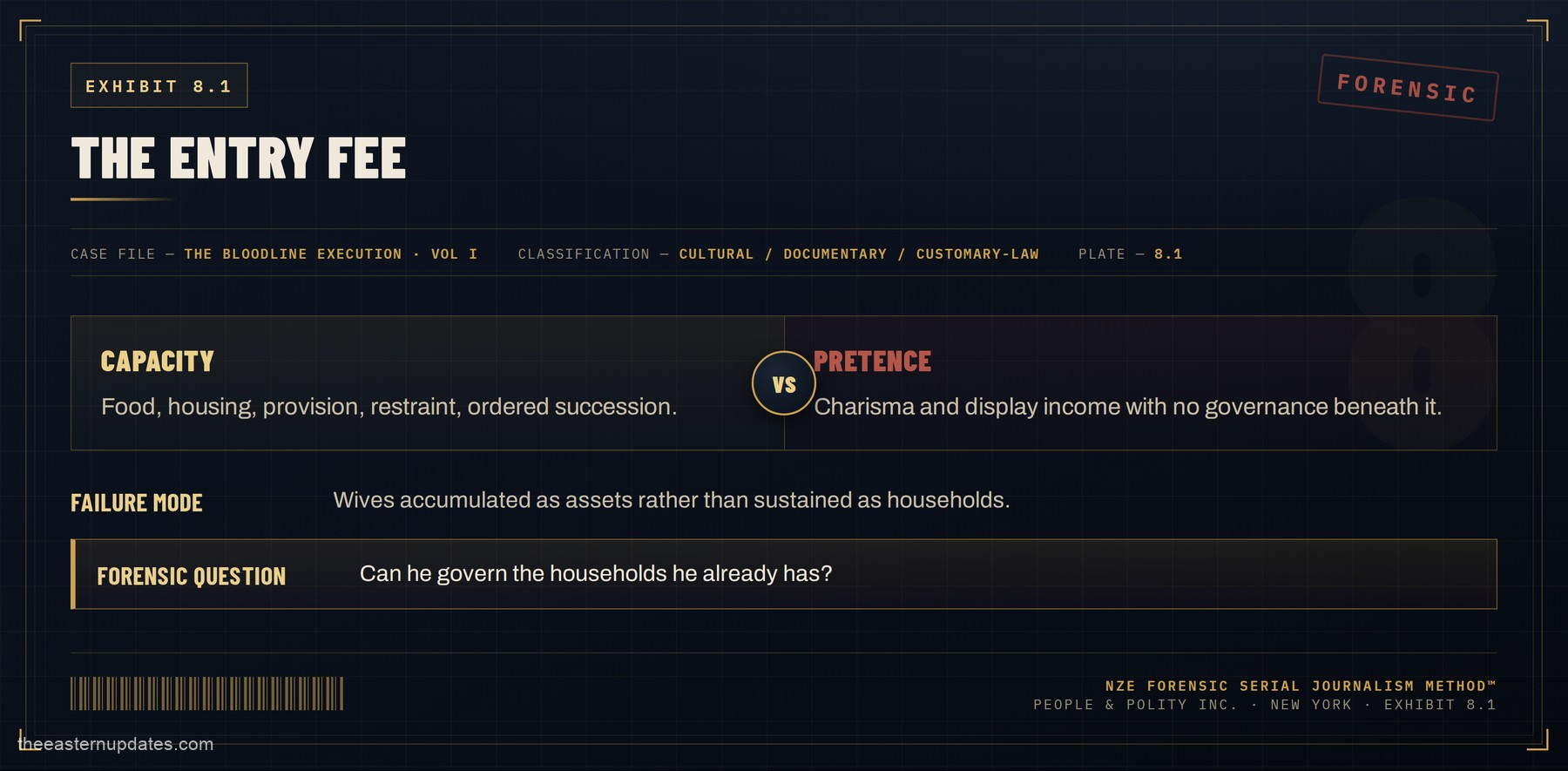
Customary polygyny demanded capacity, and capacity meant far more than charisma or a salary sufficient for weekend display. It meant food security, housing, the organization of farm or trade, public acknowledgment, child support, sexual restraint, accountability to elders, and a succession a man ordered before he died. A man who cannot govern one household has no standing to multiply them. Desire is not competence, and the old order knew the difference even when individual men did not.
Read also: The Bloodline Execution — Part 6
The economic record supports the point that plural marriage was, at its foundation, a productive and provisioning institution rather than a license for appetite. The demand for wives tracked their economic contribution, and polygynous households were frequently the ones that commanded more land and labor — not because the men were more lustful, but because the household was a unit of production that a capable man could expand and an incapable one could not sustain (Jacoby, 1995; Goody, 1973). Capacity was the entry fee. Where it was absent, the arrangement collapsed into the very disorder the modern critic mistakes for the essence of polygyny.
Read also: The Bloodline Execution — Part 7
Here the strongest economic critique must be met, not dodged. Tertilt argues that polygyny, by rationing women through high bride-prices, distorts investment and depresses savings across an economy — a serious, quantified case that plural marriage carries costs beyond any single household (Tertilt, 2005). The series does not wave this away. It draws the line where the evidence draws it: the aggregate costs Tertilt models rise exactly where polygyny detaches from capacity and provision — where wives are accumulated as assets rather than sustained as households. That is not a defense of the counterfeit; it is a further indictment of it. The trial of the husband and the economic critique of polygyny are prosecuting, in the end, the same defendant — the man who takes without the capacity to sustain.
This is why Volume I refuses to let polygyny be discussed as a male privilege. The invocation of custom is a summons, and the customary court — elders, kin, the wife’s family, the watching village — existed to try the man who answered it (White, 1988; Mair, 1969). A society that kept the plural form but dismantled the court kept the privilege and abolished the trial. That, and not plurality as such, is the modern catastrophe: not too many wives, but too few judges.
Part 8 assembles the case against specific men: what they provided, what they withheld, whether the elders could still discipline them, whether the wives’ kin retained any leverage, and how succession was left. The standard is capacity, and the record either shows it or exposes its absence. Desire is easy to prove; competence is what the file is built to test.
Forensic Diagram Set

Evidence Docket
Seven-source APA 7 record for this installment. Entries verified for authorship and publication details.
Goody, J. (1973). Bridewealth and dowry in Africa and Eurasia. In J. Goody & S. J. Tambiah (Eds.), Bridewealth and dowry (pp. 1–58). Cambridge University Press.
Jacoby, H. G. (1995). The economics of polygyny in sub-Saharan Africa: Female productivity and the demand for wives in Côte d’Ivoire. Journal of Political Economy, 103(5), 938–971.
Mair, L. P. (1969). African marriage and social change. Frank Cass.
Tertilt, M. (2005). Polygyny, fertility, and savings. Journal of Political Economy, 113(6), 1341–1371.
Uchendu, V. C. (1965). The Igbo of Southeast Nigeria. Holt, Rinehart and Winston.
White, D. R. (1988). Rethinking polygyny: Co-wives, codes, and cultural systems. Current Anthropology, 29(4), 529–572.
Zeitzen, M. K. (2008). Polygamy: A cross-cultural analysis. Berg.