




















|
Listen to article
|
The Man Who Was Never Charged
Male Authorship of the Decision and the Disappearance of the Second Party
Forensic classification: Cultural investigation; customary-law analysis.
Volume I spent a whole installment putting a husband on trial. Part 8 established that a man invoking custom took on the heavier burden rather than the lighter one, that capacity was his entry fee, and that a customary court of elders, kin, and a watching village existed precisely to try him when he failed. It closed on a sentence this series has been building toward since: the modern catastrophe is not too many wives but too few judges.
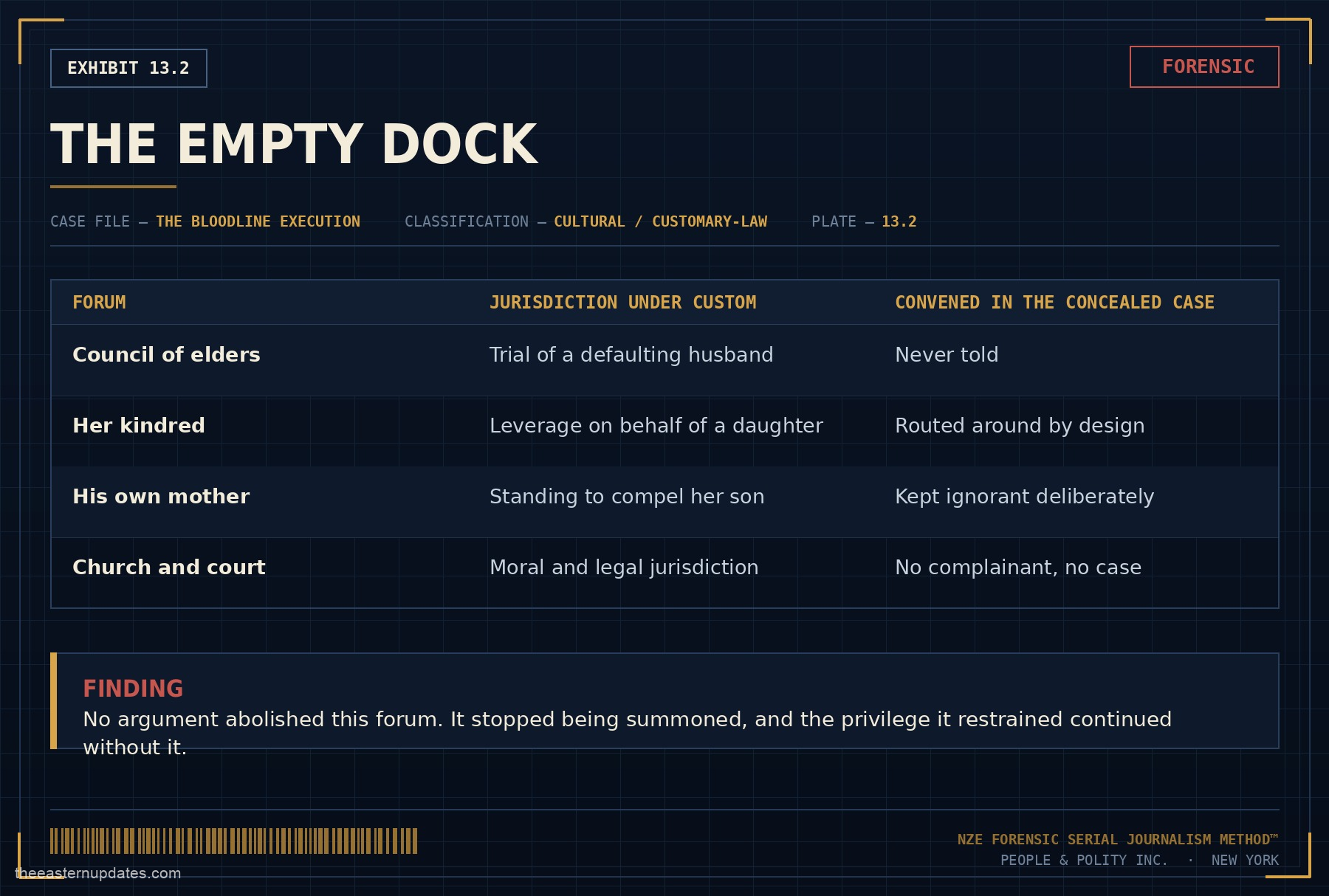
Collection falls due here. Inside a concealed union a pregnancy ends and no proceeding of any kind convenes. Elders hear nothing. Her kin hear nothing, and in many cases are the specific people the concealment was designed to defeat. Churches learn of it in confession if at all, and learn of it from her. Courts have neither jurisdiction nor complainant. His own mother, who under the order Volume I described would have been among the first informed and the loudest to intervene, is kept ignorant by design. Every forum custom built for examining a man’s conduct toward a woman and a coming child is either absent or has been routed around, and the routing is his work (White, 1988; Mair, 1969).
Agwọ emeghị nke o ji bụrụ agwọ, ụmụaka achịrị ya hie nkụ. Anything that stops behaving according to its nature invites children to pick it up and tie firewood with it, and the customary court has been picked up. Nothing abolished it. No argument was ever mounted that a man should cease being answerable for the pregnancies he causes. Summoning simply stopped, and men learned quickly enough what the silence permitted.
Read also: The Bloodline Execution — Part 12
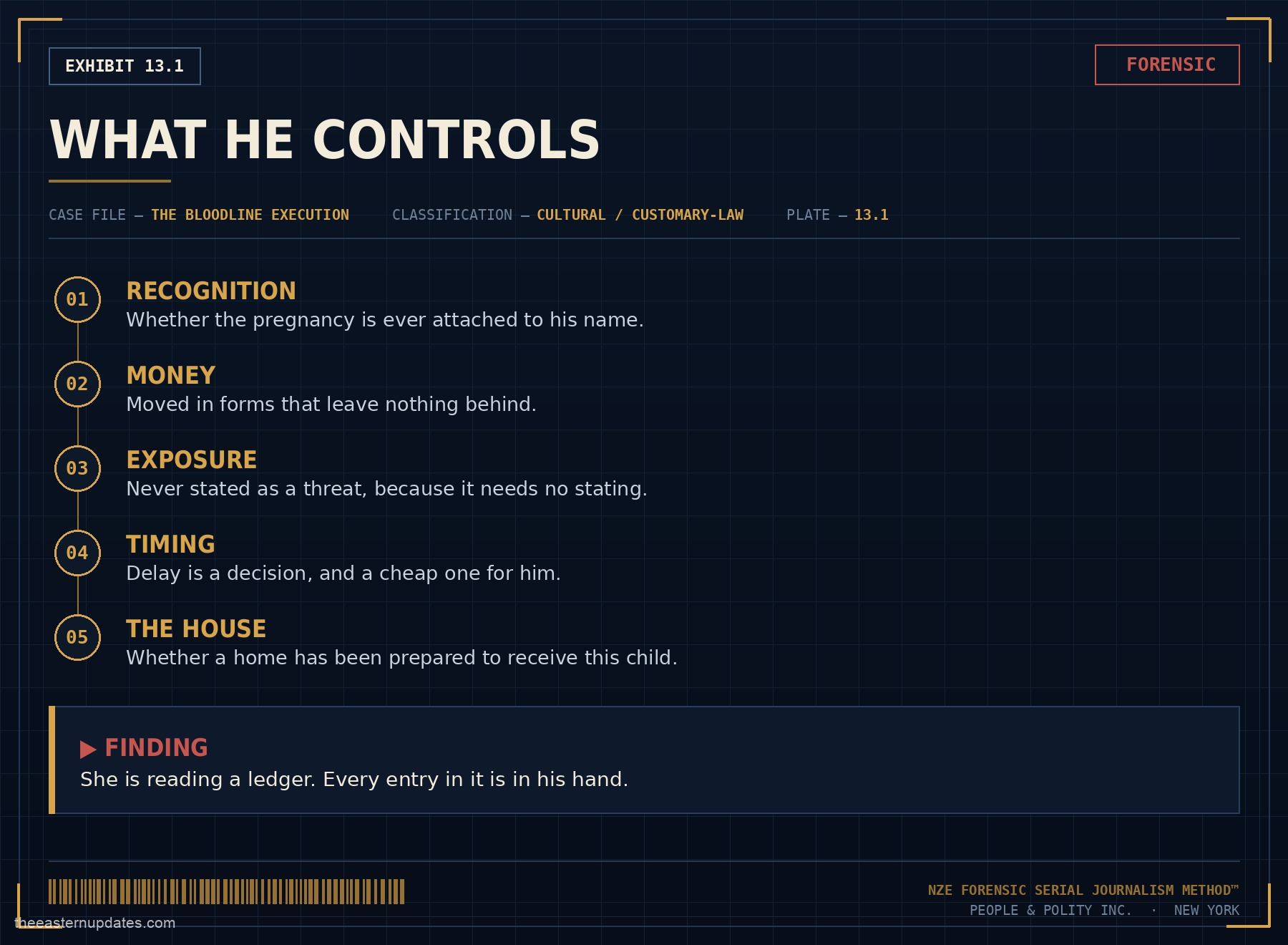
Consider what he actually controls, since the argument rests there. Recognition sits with him, meaning whether the pregnancy is ever attached publicly to his name. Money sits with him too, and inside a concealed arrangement it moves in forms leaving nothing behind. Exposure is his instrument, rarely spoken as a threat because speaking is unnecessary; both parties know what disclosure would cost her, what it would cost him, and how little the two figures resemble each other. Timing belongs to him as well, delay being a decision and a cheap one. Above all he determines whether any house has been prepared to receive this child. Doing that arithmetic makes a woman neither irrational nor callous. She is reading a ledger, and every entry in it is in his hand.
Scholarship does not use the word authorship, having been built to ask different questions. Described consistently, though, is a decision taken under conditions of dependency and non-recognition. Bledsoe and her colleagues, working on reproductive management in West Africa, found women navigating obligations and relationships rather than exercising an isolated preference, with the shape of the navigation set by what the men and households around them would and would not acknowledge (Bledsoe et al., 1998). Agadjanian’s work on unions condemned and condoned at once describes the same structure from the institutional side: arrangements everybody knows about and nobody will formalize, recognition permanently available in principle and permanently withheld in practice (Agadjanian, 2020).
Immediately the objection arrives, and it deserves its best form. Calling him the author makes her a puppet. Stripping her of the single decision the modern world has granted outright, and doing so in the name of protecting her, is the oldest move in the repertoire of men who write about women. Worse, it patronizes the very women this volume claims to privilege, many of whom will say without hesitation that the decision was theirs and that they would take it again.
Read also: The Bloodline Execution — Part 11
Authorship and agency are separate things, and holding them apart is what the rest of this installment depends on. She may decide freely, deliberately, and with full ownership of the decision, while conditions under which she decided were written by somebody else. Both facts stand without competing. Volume I drew the same line around a junior wife who chose her marriage and then found her house unprovided; her choice was real, his failure was real, and the series declined to settle the tension by pretending one of them had not happened. Naming whoever set the conditions erases nobody. It keeps him in the file, where custom put him and from which the modern arrangement has quietly removed him.
A test separates the honest version of this claim from the dishonest one, and it should be applied to every case reported. Ask what would have had to change for the decision to have gone differently, then ask who held power to change it. Where the answer is a house that would receive the child, a name spoken publicly, or fees paid without a scene, those are things one party could have supplied and did not. Where nothing he could have done would have altered her decision, record that too, in the same typeface. Part 19 exists to ensure such cases enter the text rather than being filed quietly as inconvenient.
Mmadụ bụ chi ibe ya. Each person stands as guardian spirit to the next, which in customary reading is less a compliment than an assignment of liability, and it explains why the old order treated a man’s private conduct toward a woman as the village’s business (Zeitzen, 2008; White, 1988). Volume I’s capacity test applies to him without ambiguity. Part 8 set the entry fee for any man invoking the customary order: food security, housing, the organization of trade or farm, public acknowledgment, child support, accountability to elders, and a succession ordered before death. Unable to govern one household, that installment argued, a man has no standing to multiply them. Multiplication is not what the man in a concealed union has done. He has multiplied dependents while declining to constitute a household at all, the identical failure at lower cost to himself, and he has arranged the reproductive consequence of a union so that it generates no obligation on him in any forum, customary or statutory or religious. By Volume I’s own standard he is no modern man who has left custom behind. He is a defaulter, and the single thing that has changed is that no institution will now say so aloud.
Traces remain, a man arranging concealment being nonetheless a man performing a series of documented acts. Transfers pass through accounts and applications. Messages survive. Intermediaries can be found and interviewed. His later denials are frequently made in front of witnesses, at family meetings and at funerals, and those witnesses can be asked what they heard. Distance between what he told her privately and what he told his family publicly is often the entire case, and it can be established without asking her to relive anything.
Friends and colleagues occupy a category the file usually ignores, and they should be interviewed rather than treated as background. Concealment on this scale rarely runs on one man’s discretion; it runs on a small circle of peers who knew, who supplied a contact or a loan or an alibi, and who said nothing at the time. Under the old order such men would themselves have been exposed, since a village that could shame a defaulter could also shame the neighbors who covered for him (Mair, 1969; Zeitzen, 2008). Modern professional life offers them permanent cover, and their silence costs them nothing at all. Naming that circle, where the reporting supports it, restores something the customary court did automatically, which was to make complicity visible alongside the offense.
Funerals make the pattern visible, and reporters should work backward from ones already held rather than waiting for the next. Volume I described the scene: a concealed family standing at the edge of the crowd while the public family performs surprise. Cases examined here carry an additional figure, a woman present at the burial of a man whose child she did not carry to term at his insistence, holding no standing of any kind at the graveside, with no claim to press and nobody to tell (Agadjanian, 2020; Nwoko, 2020). She is the most thoroughly unrecorded party in the entire series, existing in numbers no register captures, the register having been the thing he was avoiding.
Closing this installment is the plate the volume has been building toward since Part 8, and the simplest image in the series: Volume I’s customary court, drawn exactly as it was drawn there, elders in place, kin in place, village in place, and the dock empty. Part 25 will ask whether anything can be seated in it again.
Field Protocol
Build the case from his traces rather than from her account. Transfers, messages, intermediaries, and witnesses to his later denials. She is interviewed once, alone, after documentary work is complete, so nothing is asked of her that the file could have answered. Where his account conflicts with the record, print both.
Evidence Docket
Seven authorities, six verified and one reserved. The reserved entry is a study of male partner involvement in abortion decision-making in sub-Saharan Africa, selected during reporting for locality match.
Full bibliographic entries are not repeated here. Every source cited above is compiled once, in APA 7 form and alphabetically by author, in the Standing Record at the close of this volume and in the reference section of the PDF edition, each entry carrying a note of the parts that cited it and of the setting in which its fieldwork was conducted.