





















|
Listen to article
|
The Church, the Clinic, and the Statute
Three Institutions That Took the Jurisdiction and What Each Delivered
Forensic classification: Legal and institutional analysis; documentary record.
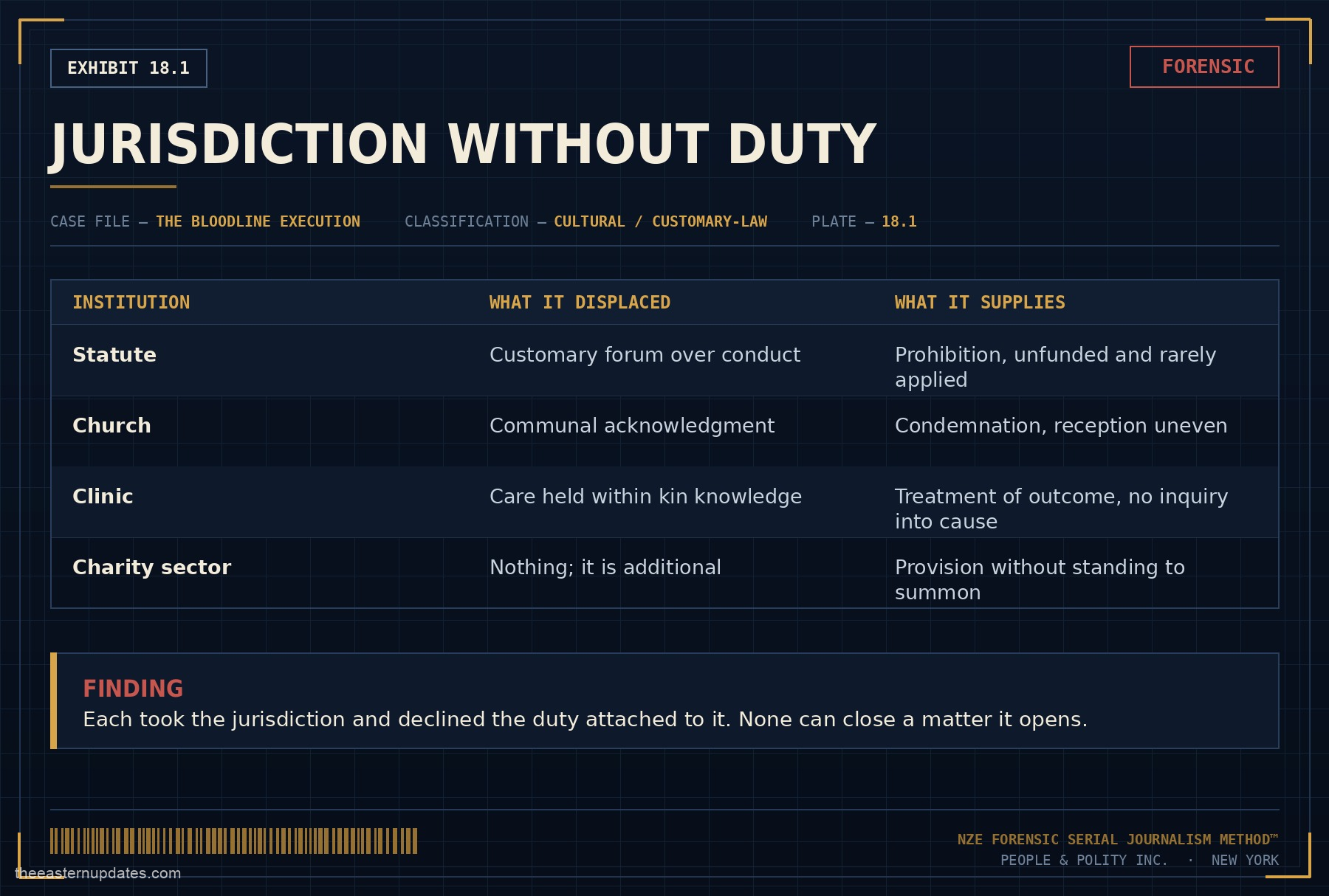
Volume I closed by trying the accusers of polygyny rather than accepting their charge sheet at face value, and the exercise produced its sharpest findings. Missionary Christianity, colonial law, statutory monogamy, and the public-health verdict were each given full weight, then cross-examined, and several of their certainties failed the examination. Part 18 repeats that operation on a different set of defendants. Custom held a jurisdiction over the womb, described across Parts 15 through 17. Three institutions took it over. One test applies to all three, and it is the test Part 16 established: did each deliver the protection it displaced, and does it possess any mechanism for closing a matter it has opened?
Statute answers first because its answer is shortest. Nigerian criminal provisions on abortion descend from colonial drafting and survive in a dual system, with different codes governing different parts of the federation, and their practical operation bears almost no resemblance to their text. Prosecutions are rare. Indirect rule established the pattern, recognizing customary authority only where it could be translated into categories a magistrate could apply and quietly retiring whatever resisted translation (Meek, 1937). Deterrence today falls not on the act but on the care surrounding it, so that women present late, present frightened, and present to people who answer to nobody. Volume II already entered this finding in Part 12 and is bound by it here: restriction raises the price she pays without lowering the number of pregnancies that end. Jurisdiction was claimed. Nothing whatever was provided, and no matter has ever been closed by it.
Churches answer second, and their answer is more complicated because their contribution is real. Congregations feed women whose kin have turned away, absorb children nobody else will house, and supply belonging to people the city has stripped of it. Agadjanian’s work on the same denominations is the most useful comparison available, since it documents institutions whose formal rule and actual practice diverge sharply, condemning polygyny in doctrine while accommodating it in the pew (Agadjanian, 2020). Divergence of that kind is not hypocrisy so much as institutional survival, and it operates against a marital landscape that has itself been shifting for decades, with informal and unregistered unions expanding as formal ones contract (Chae & Agadjanian, 2022). What matters for this installment is who the divergence protects. Where a rule is enforced against her and suspended for him, the flexibility has a direction, and the direction is the finding.
Read also: The Bloodline Execution — Part 17
Onye ji onye n’ala ji onwe ya. Holding another down keeps you on the ground beside them, and the saying is aimed at people who mistake dominance for advantage. Applied to institutions, it identifies what each of these three has actually purchased with its jurisdiction. A church that condemns without receiving loses the woman and keeps the doctrine. A clinic that treats without asking keeps its patient list and loses the case. A statute that criminalizes without funding keeps its authority and forfeits any claim to protect anybody. Each retains the power it inherited by declining the duty attached to it, and each is diminished by the arrangement it has chosen.
Clinics answer third, and their position deserves the most careful statement of the three. Medicine has saved lives that custom could not reach, and post-abortion care exists as a recognized clinical category precisely because clinicians refused to let a legal prohibition become a death sentence. Nothing in this volume disparages that. Boundary of the clinical mandate is where the problem sits. A woman arrives with a complication, is treated, and is discharged, and at no point does the institution meet the man whose withheld recognition produced the decision, the kin who enforced the silence, or the household economy that priced the child out of reach. Clinical practice treats an outcome. Causation lies entirely outside its jurisdiction, and it is nobody’s brief.
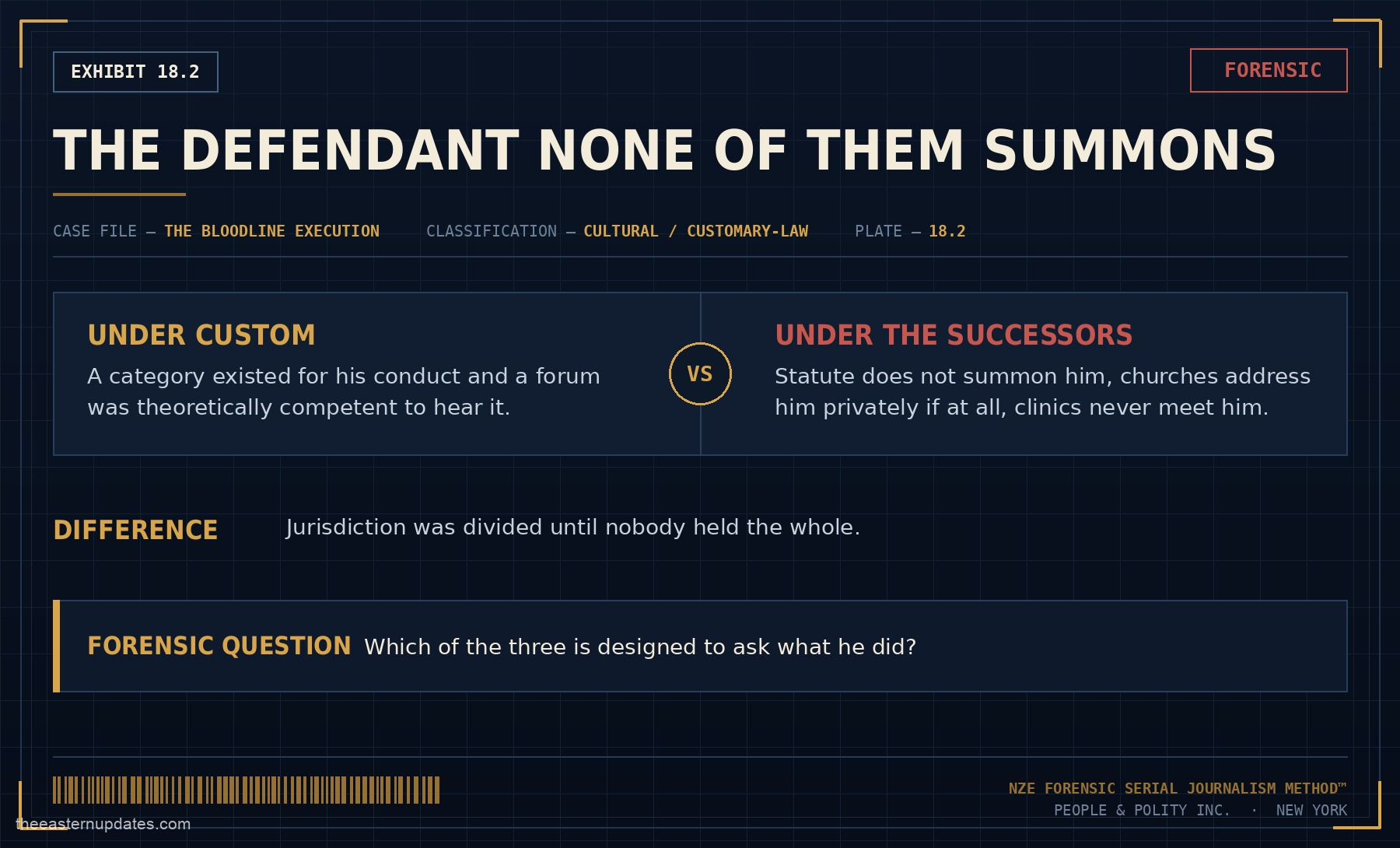
Absence of the man from all three jurisdictions is the structural finding of Part 18, and it connects directly to the empty dock of Part 13. Statute does not summon him. Churches address him rarely and privately, if at all. Clinics never see him. Custom, whatever its failures of enforcement, at least held a category into which his conduct fell and a forum theoretically competent to hear it (Mair, 1969). Southeastern Nigerian practice supplies the local version, where the public marriage process carried obligations that later arrangements simply dropped without replacing (Nwoko, 2020). Modern institutions divided the jurisdiction among themselves and, in the division, lost the defendant entirely. Not one of the three is designed to ask what he did.
Read also: The Bloodline Execution — Part 16
Obtainability decides how much of this can be proved, and a reporter should know before starting what exists on paper. Prosecution figures, where any authority compiles them, establish how rarely the statute operates. Court records establish what happens when it does. Denominational teaching is published, congregational practice is not, and the gap between them has to be built from the accounts of women who approached named congregations and from clergy willing to describe what they actually do. Clinical protocols are written down, and post-abortion care data exist in aggregate where facilities report. Each institution therefore leaves a documentary trail sufficient to convict or acquit it, which is why this installment is documentary before it is testimonial.
Closure supplies the sharpest test of the three, and applying it produces the same answer each time. Asking what it would take for any of these bodies to declare a matter finished exposes that none of them has a concept of finishing. Statute contemplates prosecution, not settlement. Churches offer absolution to the penitent while the conduct of the other party remains outside the sacrament entirely. Clinics discharge, which ends an episode of care without ending anything else. Part 16 recovered a customary machinery in which acknowledgment, restitution, and public performance produced a settled matter that people afterward stopped raising. Nothing in the modern arrangement performs that work, and no institution has been asked to.
Charitable and non-governmental provision constitutes a fourth quasi-jurisdiction and belongs in the file rather than in a footnote. Organizations supplying counseling, shelter, school fees, or transport frequently do more material good than any of the three institutions tried here, and they operate almost entirely outside customary, statutory, and ecclesiastical authority. Absence of standing is precisely their limitation. They can feed a woman and cannot summon a man, which makes them a supplement to provision rather than a replacement for jurisdiction, and the distinction should be drawn carefully so that generosity is not mistaken for a remedy.
Objection at full strength runs as follows, and it is not weak. Comparing three modern institutions unfavorably against an idealized customary system is the oldest trick in cultural conservatism, and it works by holding the present to its actual record while holding the past to its stated intentions. Clinics save women that shrines killed. Courts secure maintenance that elders could not compel. Churches receive women whose villages would have expelled them. Any account that inverts this is nostalgia wearing a forensic costume.
Concession is total on the facts and narrow on the conclusion. Every one of those claims should be entered with evidence, and the volume gains nothing by minimizing them. What the indictment actually alleges is narrower than the objection assumes. Nobody is charged here with being worse than a shrine. Each is charged with having taken a jurisdiction and declined the duty that came with it, and the charge is proved by their own conduct rather than by comparison with anything. A statute that criminalizes while funding no alternative, a church that condemns while receiving nobody, and a clinic that treats a complication while never meeting its cause are each convicted on their own terms.
Younger men are watching all three institutions, and what they observe is that a pregnancy fathered in secret produces no summons from any of them. Volume I found the modern catastrophe to be too few judges rather than too many wives, and Part 18 supplies the mechanism by which the judges disappeared. Nothing was abolished. Jurisdiction was divided so thoroughly among three bodies that none retained responsibility for the whole, and a defendant answerable to everyone in principle became answerable to nobody in fact.
Reporting this part is documentary before it is anything else. Statute and reported cases, prosecution statistics where they exist and their absence where they do not, church teaching set against recorded pastoral practice in named congregations, clinical protocols and post-abortion care records. Each institution should be assessed on what it does rather than on what it announces, and the gap between the two is available in writing for all three.
Forensic question closing Part 18 stays with the test. In this jurisdiction, for this institution: what protection did it displace, what does it supply in place of that protection, whose acknowledgment does it require, and has it ever closed a single matter it opened?
Field Protocol
Documentary work first, in three files. Statute, reported cases, and prosecution records. Church teaching, congregational practice, and the accounts of women who sought help from named congregations. Clinical protocols and post-abortion care data. Three voices again: institutional authority, the woman who approached it, and a third party who observed what followed.
Evidence Docket
Seven authorities, five verified and two reserved. Reserved are a current legal analysis of the applicable Nigerian criminal and penal provisions, cited by section from the statute rather than from commentary, and the World Health Organization guidance in force at drafting.
Full bibliographic entries are not repeated here. Every source cited above is compiled once, in APA 7 form and alphabetically by author, in the Standing Record at the close of this volume and in the reference section of the PDF edition, each entry carrying a note of the parts that cited it and of the setting in which its fieldwork was conducted.

