




















|
Listen to article
|
The Cleansing of the Woman
Purification, Reinstatement, and Whether Custom Restored Her or Only Marked Her
Forensic classification: Ritual record; gender and status analysis.
Delicacy is required here and delicacy is not the same as evasion. This installment concerns a rite performed on a woman’s body and reputation, and the rule fixed in the Method Addendum governs it absolutely: she speaks first, at length, alone, and no priest, elder, or husband is quoted about her experience before her own account has been entered or its absence explained. A part written about women without women in it would discredit everything the volume has argued.
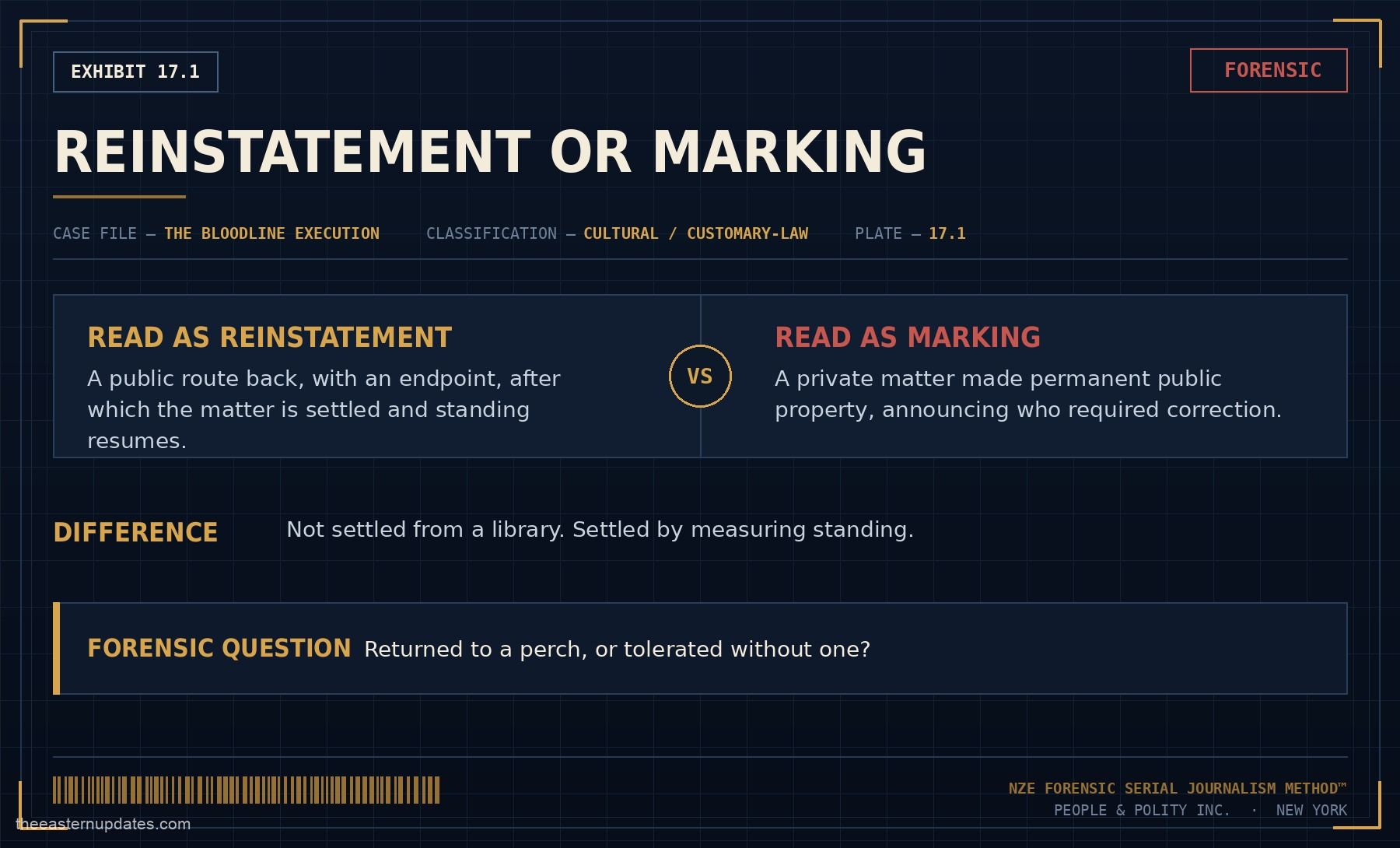
Scholarship reads these rites in two directions, and this part tries both against the same evidence rather than choosing in advance. Read one way, cleansing was reinstatement. A woman who had fallen outside the community’s order was given a route back into it, publicly, with an endpoint, after which the matter was settled and she resumed her standing. Nothing in the modern arrangement offers her anything comparable. Shame arrives without procedure and without conclusion, and she carries it privately for as long as she lives (Agbasiere, 2000; Bledsoe et al., 1998).
Understood differently, cleansing was marking. A private matter became permanent public property, her body was treated as the site of a pollution she had not caused alone, and the ceremony announced to everyone present that she was the party requiring correction. Whatever was restored, the announcement could not be unmade.
Both readings describe things that happened, which is why the finding cannot be settled from a library. Neither can it be settled by asking a woman how the ceremony made her feel, since feeling was never what the rite was organized around. Settling it requires a measurement, and the measurement this part uses is standing.
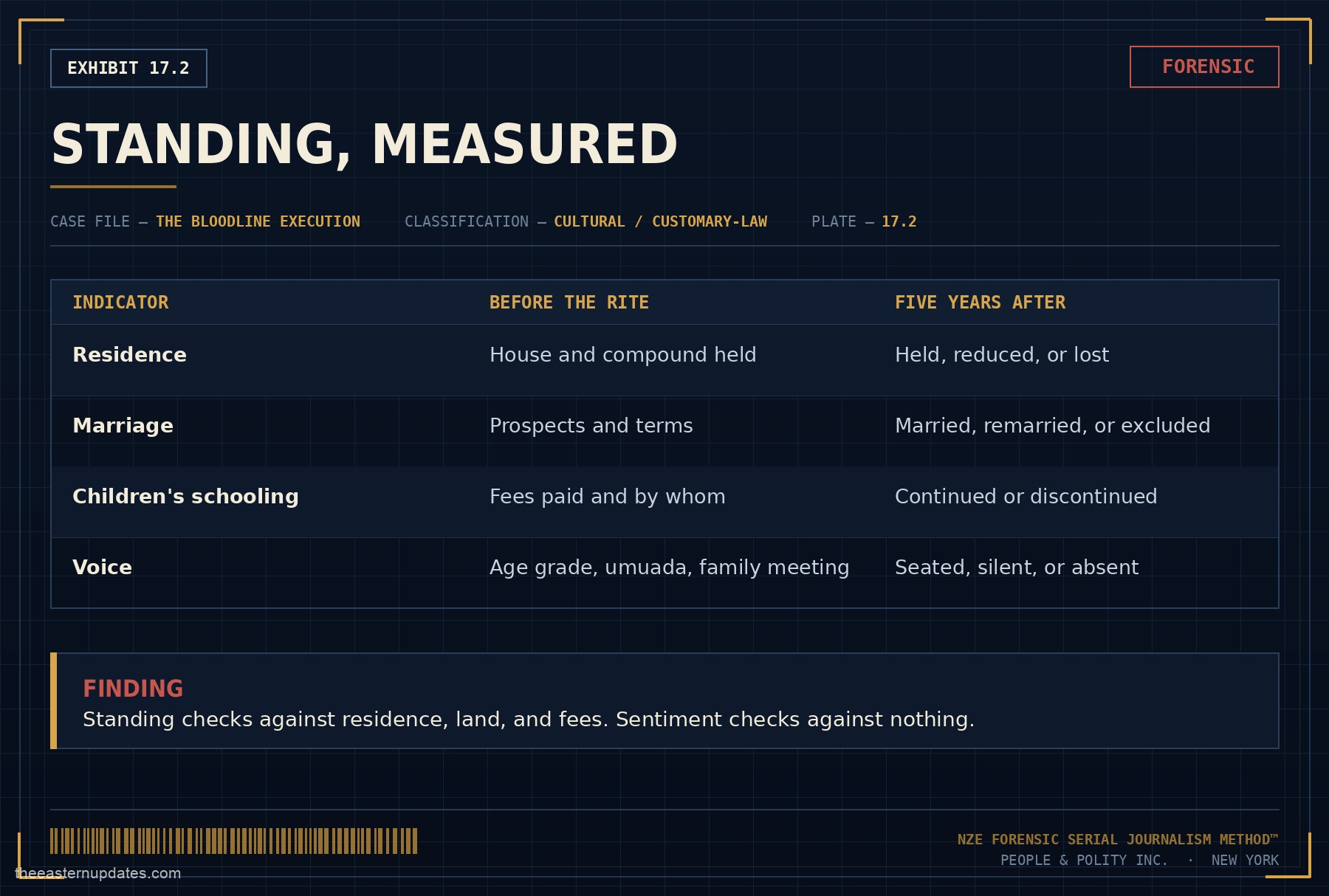
Standing is checkable where sentiment is not. Did she remain in her house or leave it? Did she marry, or marry again, and on what terms? Were her children schooled? Was she consulted when the family met, received by her husband’s kin, seated among the women of her age grade, permitted a role in ritual life? Each of those can be established from residence, land, fees, and the testimony of people who watched. Comparing her position before the rite with her position five years afterward converts an interpretive dispute into a finding a reader can check (Agbasiere, 2000; Uchendu, 1965).
Read also: The Bloodline Execution — Part 16
Ebe onye bi ka ọ na-awachi. Roofing belongs to the house a person actually lives in, and the saying assumes that having a place and tending it are the same act. Applying that assumption to the rite produces the question this installment exists to answer. Was she returned to a house she could mend, or merely permitted to remain under a roof everyone understood was no longer hers? Between reinstatement and tolerated presence lies the whole distance measured here, and communities differ, which is why localities are reported separately and never merged into a general account.
Women’s own institutions complicate any simple account of the rite, and leaving them out would misrepresent how these communities worked. Umuada, the daughters of a lineage, held real collective authority in many Igbo communities, intervening in disputes, enforcing standards on wives and on men, and carrying weight that no individual could ignore (Agbasiere, 2000; Uchendu, 1965). Their involvement means that a woman undergoing purification was frequently answering to other women rather than to a male hierarchy alone. Whether that made the rite more bearable or less is exactly the question to put to the women who experienced it, and the answers in the ethnographic record do not run all one way.
Marriage prospects supply a second measurable consequence and one the woman herself will usually raise before an interviewer does. Where the rite closed the matter, a woman could marry or remarry without the episode following her into the negotiation. Where it marked her, the episode entered every subsequent discussion between families and frequently settled it. Bridewealth negotiations are remembered in detail by the people who conducted them, which makes this among the most recoverable facts in the whole installment.
Read also: The Bloodline Execution — Part 15
rather than in a footnote. Rites addressed to the man, where they existed at all, were briefer, cheaper, and less public. Frequently no rite existed for him, since the pollution was understood to attach to the body that had carried the pregnancy rather than to the conduct that produced it. Custom held, in Part 15’s doctrine, that the offense was collective. Practice here located the stain on one person, and located it on the person with the least power to refuse the ceremony.
Modern practice deserves comparison, and the comparison is not flattering to either era. Churches in parts of southeastern Nigeria have developed their own purification and deliverance idioms, and the woman who submits to them is frequently the same woman her kin would once have sent to a shrine (Agadjanian, 2020; Chae & Agadjanian, 2022). Continuity of function under changed vocabulary is worth documenting precisely, since a series arguing that custom has been dismantled must notice where it has instead been rebranded and quietly kept.
Nothing at all is what the modern arrangement offers in place of the rite, and the void should be described precisely rather than mourned vaguely. A woman today carries the matter without acknowledgment, without procedure, without endpoint, and frequently without a single person who knows. Volume I found the compound making concealment expensive; here the cost of concealment is charged entirely to her interior life, over decades, with no mechanism by which it can ever be discharged. Naming that absence is not an argument for restoring the shrine. It identifies a function that was removed and never replaced, which is the question Volume III takes up.
that overrides the reporting itself. She is interviewed alone, unpaid, anonymized by default, with the right to withdraw her account after hearing it read back, and nothing she declines to discuss is pursued through a third party. Any installment that would injure the women it describes in order to describe them has failed by the standard this volume set for itself in its Overview.
Objection to this installment’s existence is the sharpest in the volume and belongs in its own paragraph. Documenting a rite that marked a woman risks marking her a second time, in print, before a readership her community may include. Detail that serves a scholarly purpose can serve a punitive one just as well, and no anonymization protocol is proof against a small town’s ability to identify a story. Weight of that objection is why this part reports standing rather than ceremony, aggregates wherever the argument permits, and treats any woman’s refusal as the end of the matter rather than an obstacle to route around.
Church idioms deserve description precise enough to be checked. Deliverance sessions, public testimony, periods of exclusion from communion, and requirements of confession before a named officer each carry acknowledgment, cost, and audience, which are the three components the customary rite also carried. Establishing what a particular congregation requires, of whom, and with what consequence for a woman’s standing within it produces a comparison Part 18 can use directly (Agadjanian, 2020).
Measurement over time is what separates this installment from commentary. A single interview captures a woman’s account of the rite; a reconstruction across years captures what the rite did. Residence, marriage, children’s schooling, participation in age-grade and family meetings, and presence or absence at burials all leave traces, and assembling them for five or ten years after the event yields a finding no interpretive argument can overturn.
Forensic question closing Part 17 keeps the burden on the record rather than on her. What was demanded, what did it cost, who administered it and who was paid, what was required of the man, and what happened to her standing, measured in residence, marriage, children, and voice, in the years that followed?
Field Protocol
Her account first, alone, with anonymity by default and a right of withdrawal after readback. Ritual authority second on what was prescribed. Kin third on what was paid. Standing measured from residence, land, school fees, marriage, and participation in family and ritual life, before the rite and five years after.
Evidence Docket
Seven authorities, five verified and two reserved. Reserved are a peer-reviewed study of post-abortion stigma in Nigeria and one on widowhood and purification rites in southeastern Nigeria.
Full bibliographic entries are not repeated here. Every source cited above is compiled once, in APA 7 form and alphabetically by author, in the Standing Record at the close of this volume and in the reference section of the PDF edition, each entry carrying a note of the parts that cited it and of the setting in which its fieldwork was conducted.

