





















|
Listen to article
|
The Testimony That Cannot Be Smoothed
What the Women Say, Set Against Everything This Volume Has Argued
Forensic classification: Testimonial record; cross-examination of the series’ own case.
Eight parts of argument now stand behind this one, and a man wrote all of them. He wrote about decisions women made, in rooms he never entered, under a weight he has not carried, and out of those decisions he assembled a case against concealment, against the men who arranged it, and against the institutions that let it pass. Before the volume moves to verdict, it owes the women a chance to answer, and this part was written in the expectation that on some counts they would answer against it.
Otu onye adịghị atụ izu. One head does not hold a council. However sound a lone reasoner, a conclusion he reaches alone is unsafe, and the Three-Voice Rule was built on nothing more than that mistrust. Here the rule turns on the book that has been wielding it. The writer is one voice, the women are the second, the documentary record is the third, and where they part company the parting is the evidence, not a seam to be sewn shut.
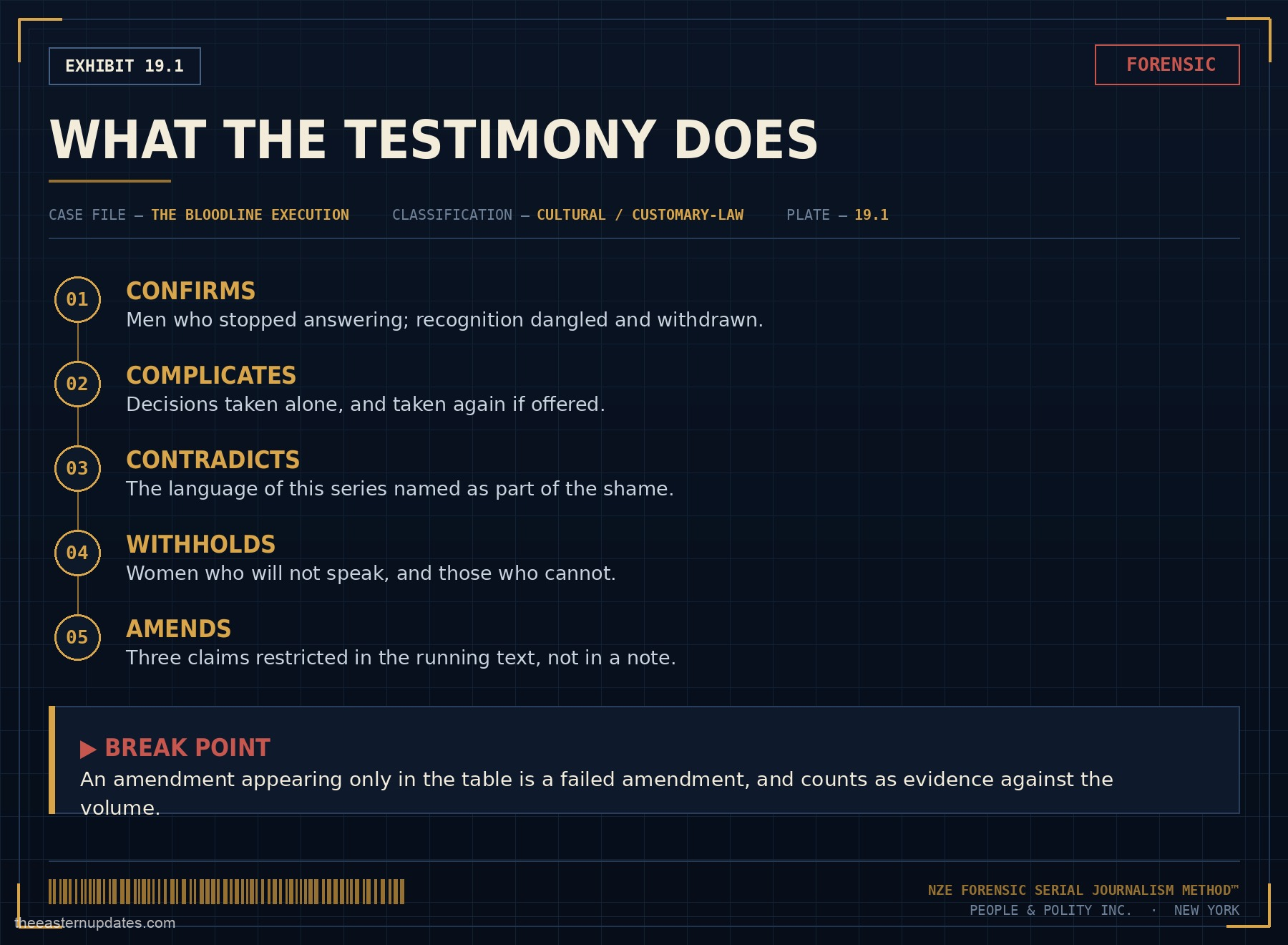
What women say, across the published record and across the interviews this series is bound to conduct, comes in four kinds, and each makes a different demand. Most of it confirms the case, and confirms it in detail no author could improve. A man who stopped taking her calls. A promise of recognition dangled, then withdrawn. Cash pressed into her hand on the sole condition of silence. A father whose face, when he heard, ended the discussion before anyone else had spoken. School fees set against a child no household had agreed to receive. These accounts need no interpreter, and the women name the people who built the trap without being prompted. Nigerian survey work confirms the shape of it at scale, tracking whether the partner was told, whether he helped secure care, and how his involvement bent the conditions she finally faced (Anjur-Dietrich et al., 2022). Women who bought pills across a counter and saw the rest through alone describe the same solitude from the inside (Stillman et al., 2020; Bledsoe et al., 1998).
Read also: The Bloodline Execution — Part 18
Testimony of a second kind refuses to confirm the case and complicates it instead. Some women say the decision was theirs entirely, reached with no man in the room and none in mind, and that they would reach it again without hesitation. Others discard the whole vocabulary of lineage, the careful version in Part 11 included, and treat any claim their kin might lay on a pregnancy as precisely the grip they had struggled free of. Demographers once reconstructed high fertility as a shrewd hedge against a world that offered no other security; heard from inside a single woman’s life, the same logic lands as a debt contracted in her name and without her consent (Caldwell & Caldwell, 1987; Uchendu, 1965). More than a few will say the compound would have been the worse place for them, not the better, and that they are grateful never to have lived inside the well-ordered household Volume I took such care to reconstruct (Agbasiere, 2000).
A third kind contradicts the volume to its face, and testimony of that kind is printed whole, with no reply set beneath it. When a woman says the shame she carries was handed to her by language of exactly the sort this series employs, she is not offering a finding to be set against other findings and weighed. She is naming an injury the writing itself inflicts, and the only clean response is to write it down and leave it unanswered.
Read also: The Bloodline Execution — Part 17
Hardest of all to bring onto the page, and the kind that governs the worth of the other three, is the fourth, which is made of silence. Some women will not speak because the matter is closed and they mean it to stay closed. Some will not speak because they are still inside an arrangement that a word would detonate. Some cannot speak, because they did not live, and no quantity of interviews with the surviving ever reaches the woman whose pregnancy ended in a ward or on the road to one. Every finding in this volume rests on women who remained in a position to testify, and no method corrects that selection. It can only be confessed, which is done here, in the body of the argument, rather than left for a reader to uncover on her own.
An account is shaped by the conditions of its telling as surely as by the thing told, and to pretend otherwise is to forge it. Who arranged the meeting. Whether anyone at home knew it was happening. How many years lay between the event and the words. Whether the story had been told before, and to whom. A woman recounting an old grief through the church that received her afterward tells a different story from the same woman speaking to a stranger bound to no one she knows, and neither telling is the counterfeit. The conditions are set down beside the account, so the reader weighs the two together or not at all.
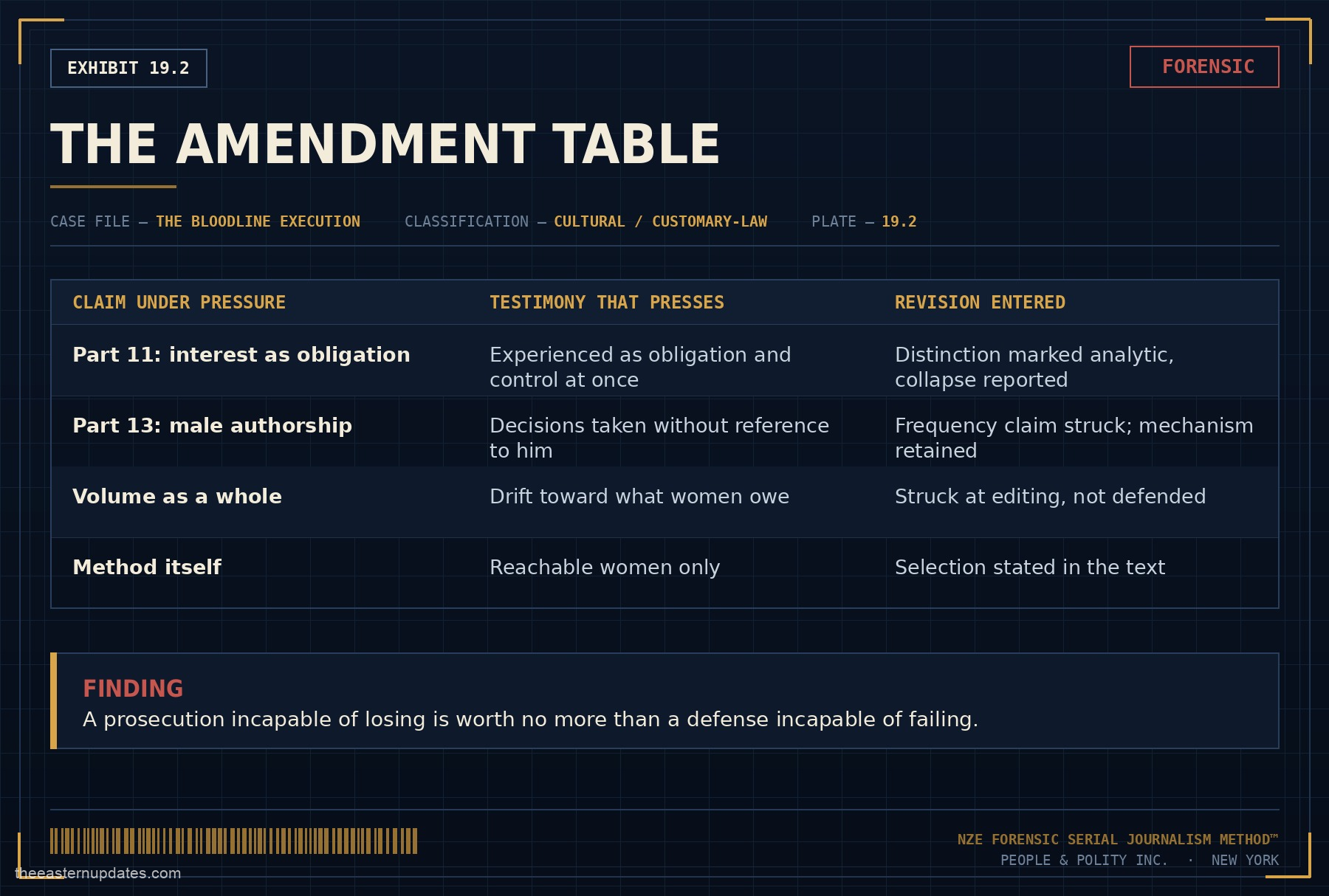
Gathering testimony that presses on the case is idle work unless the case then yields, and it yields here in three places, entered as the minimum the evidence compels. The first repairs Part 11. That part treated a lineage’s interest as an obligation and stood it opposite control, as though a clean seam ran between them. Women describe no seam at all. The help and the claim on the body arrive together, from one relative, in one conversation, spoken almost in a single breath. Part 11 now concedes what they report: the line between obligation and control is one an analyst draws for his own convenience, it dissolves in ordinary households, and its dissolving belongs in the finding rather than beneath it.
A second repair falls on Part 13. Male authorship of the decision is real and can be documented, but it does not fill every case, and Part 13 was written as though it did. Where a woman states plainly that nothing the man could have done would have moved her, her word is taken as final, not shelved as an exception propping up a rule. Part 13 keeps its account of how the pressure operates and surrenders every implication about how often, a figure it never possessed and had no business suggesting.
Widest of the three, the last repair reaches the whole book. Nowhere in Parts 11 through 18 is it settled what a woman owes, yet the prose drifts more than once toward the suggestion. This is a volume about the debts of men, of kin, and of institutions. Every sentence that slides across the line into an audit of her conduct is struck in the edit, not defended in a note.
Onye jụrụ ajụjụ adịghị efu ụzọ. The one who keeps asking does not lose the road. A book assembled out of interviews it was willing to lose to earns a trust no book assembled to prove a thesis can buy, and Part 19 is where that willingness has to be shown and not merely claimed. Showing it comes down to one hard rule. Each repair above is cut into the body of the part it repairs, before the volume is published, and a table marks the place. A repair that lives in the table alone and never touches the prose it claims to have changed is a false one, and the volume enters it as evidence against itself, since Volume I already held that an argument incapable of losing is not an argument but flattery.
Duty owed to the women outranks anything the part might prove. She is interviewed alone and unpaid, her name withheld by default, the account read back to her, her right to pull it good even after the schedule is fixed. No husband, elder, pastor, or interviewer her family knows sits in the room. What she declines to discuss is not pursued through anyone else, and nothing reaches print that would let a small town assemble her from three details. A part that injures the women it sets out to defend has already failed by the standard the Overview raised, whatever else it manages to establish.
One question closes the part, and it is put to the author, not to any woman. Which claim in this volume did the testimony overturn, in which part was the correction actually cut in, and what must a reader examine to be certain it was cut in and not merely promised?
Field Protocol
Her account comes first: alone, unpaid, anonymized, read back to her, with a right of withdrawal that outlasts the publication schedule. The interviewer is someone her family did not introduce her to. Corrections drawn from the testimony are cut into the affected parts before publication, and the table records where each one landed.
The Standing Record
Seven authorities stand behind this installment. Anjur-Dietrich and colleagues and Stillman and colleagues carry Nigerian women’s own reported accounts. Bledsoe and colleagues and Agbasiere carry the qualitative record against which the volume’s claims are tested. Caldwell and Caldwell, Uchendu, and Chae and Agadjanian carry the frameworks the testimony here presses against.
Full bibliographic entries are not repeated here. Every source cited above is compiled once, in APA 7 form and alphabetically by author, in the Standing Record at the close of this volume and in the reference section of the PDF edition, each entry carrying a note of the parts that cited it and of the setting in which its fieldwork was conducted.