



















|
Listen to article
|
Provision Before Birth
Reopening the Doors That Poverty, Abandonment, and Stigma Shut
Forensic classification: Cultural, customary-law, and public-health analysis; documentary synthesis.
Volume II showed a woman driven toward the back room by a row of doors shut one at a time — abandonment, poverty, stigma — until only the secret one was left. Part 23 is about reopening them. The plainest truth of this whole series is also the most practical: most of the pressure that ends a pregnancy in secrecy is material, and material pressure can be answered with material provision. A great many of the crises that reach the clinic would never reach it if the woman were not facing them alone and unfunded.
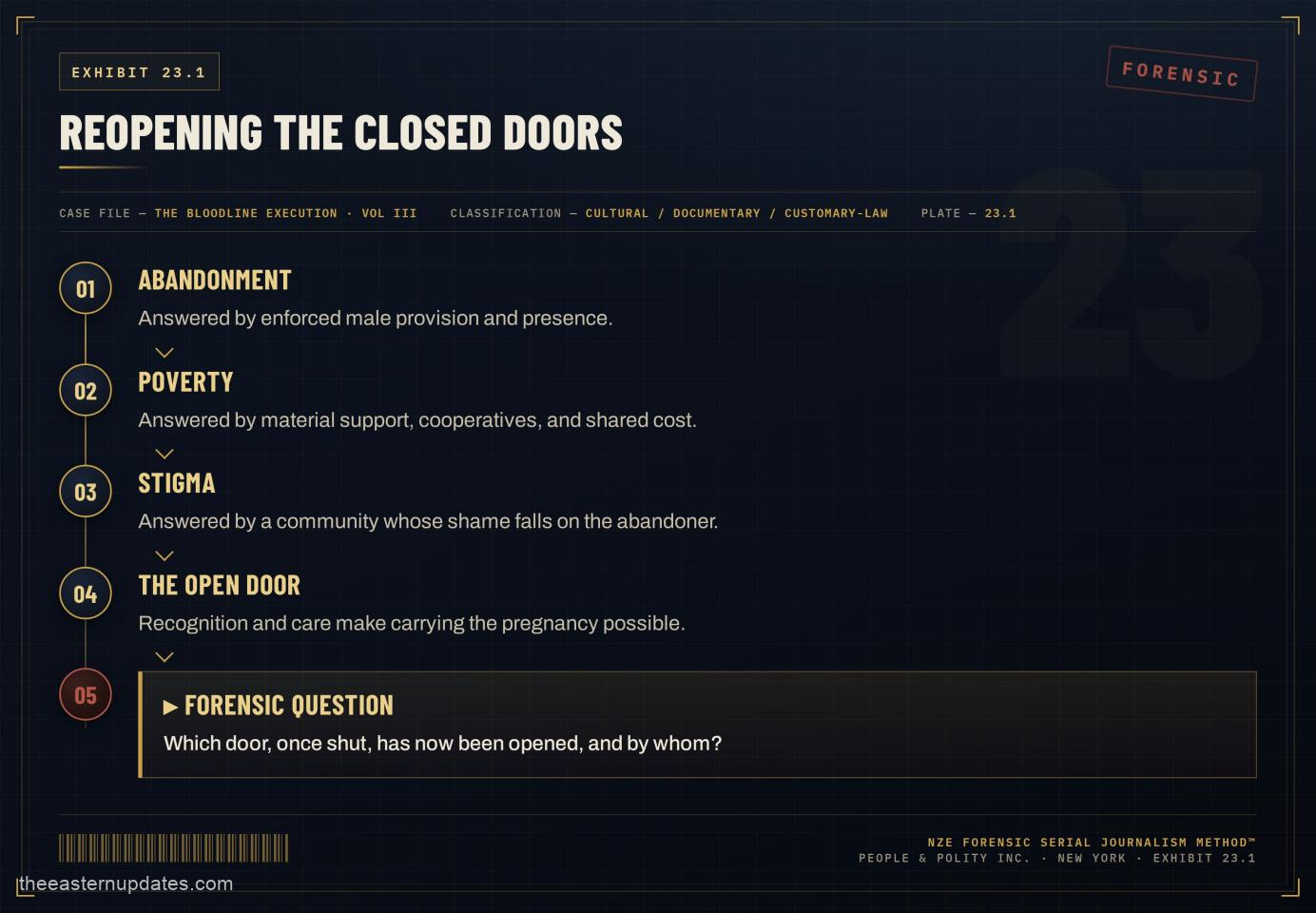
Take the doors in order. Abandonment is answered by the accountability of Part 22 — a father who provides and stays removes at a stroke the largest single pressure toward concealment. Poverty is answered by support that does not depend on a single man’s goodwill: the shared cost of a pregnancy carried by kin, by cooperative and mutual-aid societies, by churches and community associations, and, where it can be built, by the state — antenatal care, food, housing, and the means to keep a mother and child alive and in place. Stigma is answered not by lecturing the pregnant girl but by turning the community’s judgment where it belongs, onto the man who left and the family that would cast her out rather than shelter her. Each answered door is a woman not driven to the dark.
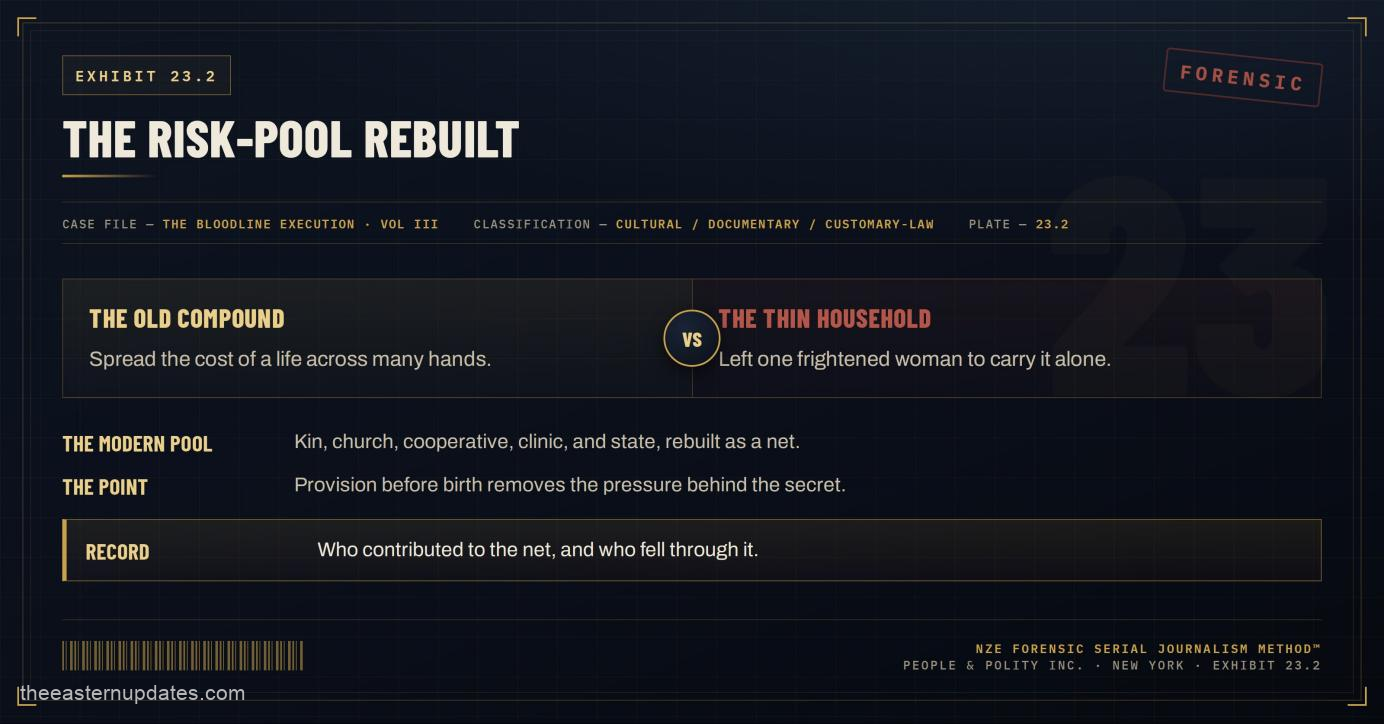
This is not a new invention so much as a recovery, and the recovery has a documented precedent. The old compound was, in effect, a provisioning and risk-pooling institution: it spread the cost of a child across many hands, so that mortality, hardship, and the arrival of a new life did not fall on one household alone (Radcliffe-Brown & Forde, 1950; Caldwell & Caldwell, 1987). The high value the culture placed on children was bound up with a social apparatus for supporting them; fertility and provision traveled together (Bledsoe et al., 1998). The city kept the fertility and dismantled the provision, leaving the pregnant woman with the old expectation to bear and none of the old support for bearing. Part 23’s proposal is to rebuild the support in modern dress — to reassemble the pool from the pieces that still exist.
Read also: The Bloodline Execution — Part 22
The public-health record confirms that provision before birth is not soft charity but hard prevention. Where women can plan their pregnancies and are supported through them — through family planning that meets unmet need, and through antenatal and maternal care — the crises that drive unsafe abortion fall, and so do the deaths (Sully et al., 2020; World Health Organization, 2025). The money spent catching a woman before she falls is smaller, by every measure, than the cost of the fall — the emergency treatment, the near-miss, the funeral, the orphaned child. Provision before birth is the least sentimental item in the whole restoration: it is the cheapest way to keep women alive, and it happens to be the humane one as well.
Unaffordability, the objection raised most often, deserves a direct answer. The claim that a poor society cannot afford to provide for pregnant women sits oddly beside the fact that the same society already pays — in emergency wards treating complications, in the productive lives of women lost, in children left without mothers — the far higher price of not providing (Sully et al., 2020). The compound was not a wealthy institution, yet it managed to pool the cost of children across a community too poor for anything else; the modern claim of impossibility is often a claim about will, not means. And much of the net costs little that is not already present: kin who choose to carry rather than cast out, congregations that shelter rather than shame, associations that share a burden — these are matters of arrangement more than of money.
Read also: The Bloodline Execution — Part 21
What is asked, and of whom, follows from the doors themselves. The father is asked to provide; the kin and congregation and cooperative are asked to pool; the clinic is asked to meet the woman with planning and care rather than judgment; and the community is asked to move its shame from the girl to the man. The forensic question that closes the part is a test of the whole apparatus: which door, once shut, has now been opened — and by whom? Where the doors stand open, the secret loses its power, because a pregnancy that can be carried in the light is not one that has to be ended in the dark.
Forensic Diagram Set
Evidence Docket
THE STANDING RECORD
Each claim advanced in this installment rests on a seven-source record held on file and verified for authorship, place of publication, and identifier. In keeping with the practice of this series, those records are not printed part by part. The consolidated Evidence Docket — the complete Standing Record for every installment of every volume, set out in full APA form — will be published at the close of the entire publication, so that the reader may weigh the whole file at once rather than a fragment at a time. Sources are named inline throughout, and any reader may test a claim against them before that docket appears.
Full bibliographic entries are not repeated here. Every source cited above is compiled once, in APA 7 form and alphabetically by author, in the Standing Record at the close of this volume and in the reference section of the PDF edition, each entry carrying a note of the parts that cited it and of the setting in which its fieldwork was conducted.