

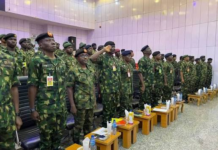















Major General Maxwell Dangana opened a five-day operations planning course for military commanders in Jos on Monday, telling participants that Nigeria’s security environment now demands officers capable of rapid, coordinated responses across multiple agencies rather than single-service action.
Dangana, appointed General Officer Commanding of the Nigerian Army’s 3 Division and Commander of Joint Task Force Operation Enduring Peace in a leadership reshuffle in late June, declared the cadre open at the 3 Division Auditorium inside Maxwell Khobe Cantonment. The program is titled “Building the Capacity of Operational Level Commanders to Meet Contemporary Security Challenges in a Joint and Multi-Agency Environment” and draws commanders from formations under 3 Division alongside personnel from other security and intelligence agencies.
“Contemporary security challenges include terrorism, insurgency, banditry, communal violence, violent extremism and other threats to national security,” Dangana said, adding that such threats are often interconnected and can shift quickly enough to require flexible planning and coordinated responses across agencies.
The Eastern Update understands the course reflects a wider push within 3 Division’s command to formalise joint planning after a series of operations this year against kidnapping and banditry networks in Plateau State, where Operation Enduring Peace has reported rescues, arrests and gun battles with armed groups in Jos South, Bassa, Kanam, Riyom and Wase local government areas since January. The division’s outgoing GOC before Dangana’s appointment, Eyitayo Foluso Oyinlola, had overseen the deployment of a Chief of Army Staff Intervention Battalion to Plateau in mid-2026 as attacks in the state persisted.
Read Also: Tinubu Vows To Hunt Down Jos Attackers, Orders 5,000 CCTV Cameras
Dangana told commanders that developments in technology, information management and social media, together with the range of state and non-state actors now involved in local conflicts, carry direct implications for how military operations are planned and executed. He said the ability of the division to protect communities and support civilian authorities depends on effective leadership and close cooperation among security agencies, and that translating plans into results on the ground would depend on the quality of commanders’ operational planning.
Brigadier General Adiyu Aminu, Commander of the 3 Division Garrison, spoke earlier at the same event and described the training as a rare opportunity to strengthen the knowledge and professional competence of operational-level commanders. He said the course would let participants compare notes on lessons learned during past operations within the division’s area of responsibility and work through practical solutions to recurring problems.
Aminu argued that genuine joint operations require more than occasional cooperation between agencies. He listed intelligence sharing, logistics, communications, operational execution and post-operation assessment as the elements that separate coordinated multi-agency work from ad hoc collaboration. “The security of our communities requires close cooperation among the Nigerian Army, Nigerian Air Force, Navy, Police, Civil Defence Corps, DSS, other security and intelligence agencies and relevant civil authorities,” he said.
The course arrives as 3 Division continues operations under Chief of Army Staff Lieutenant General Waidi Shaibu’s direction to sustain pressure on armed groups in Plateau while pairing military action with dialogue and reconciliation efforts. Shaibu visited the division’s headquarters in mid-September and inspected construction of a Remotely Piloted Aircraft System control station intended to give commanders real-time surveillance data for faster decision-making, part of a broader intelligence push that officers say complements the kind of coordinated planning this week’s cadre is meant to instil.
Organizers say the five-day program is structured to improve joint planning and operational coordination
Read Also: Enugu: Gunmen Kill Nigerian Soldier In Commercial Bus Attack
among the army, sister services and civil authorities operating in the 3 Division area, which covers Plateau State and parts of Bauchi. Participants are expected to work through planning exercises alongside case reviews of recent operations before the course concludes later this week, with commanders returning to their formations to apply the coordination framework in ongoing operations against banditry, kidnapping and communal violence across the region.
Nigeria’s military has increasingly framed joint, intelligence-led planning as central to its strategy in Plateau, where recurring attacks on rural communities have prompted repeated troop deployments and, at times, criticism from local groups pressing for more sustained patrols rather than reactive responses to individual incidents.
The record from earlier this year illustrates why commanders describe the threat picture as interconnected rather than confined to a single category of crime. In January, troops rescued a retired army colonel abducted from his home in Bassa local government area without paying the ransom his captors demanded. In July, soldiers repelled an attempted attack on the National Institute for Policy and Strategic Studies in Jos South, killing one assailant and recovering a rifle later traced to a soldier killed in an earlier, separate encounter. Community groups in Barkin Ladi have separately credited rapid troop response with limiting casualties in attacks on Razat and other villages, while also pressing security agencies to sustain patrols rather than respond only after violence has already begun. Commanders at this week’s cadre are expected to draw on cases such as these during the course’s planning exercises.