













|
Listen to article
|
Two Kinds of Money
“A state that lives on allocations needs a governor who has lived on earnings.”
By Prof. MarkAnthony Nze
Imo’s governor says the state’s finances have turned, and he credits Abuja for the turn. He has also pledged that his successor will come from Owerri, the zone that has held the office for seven months since 1999. This part asks which Owerri candidate is fit to run a treasury that must learn to raise its own money, and sets out what Martin Agbaso’s record brings to that task.
The Governor’s Account
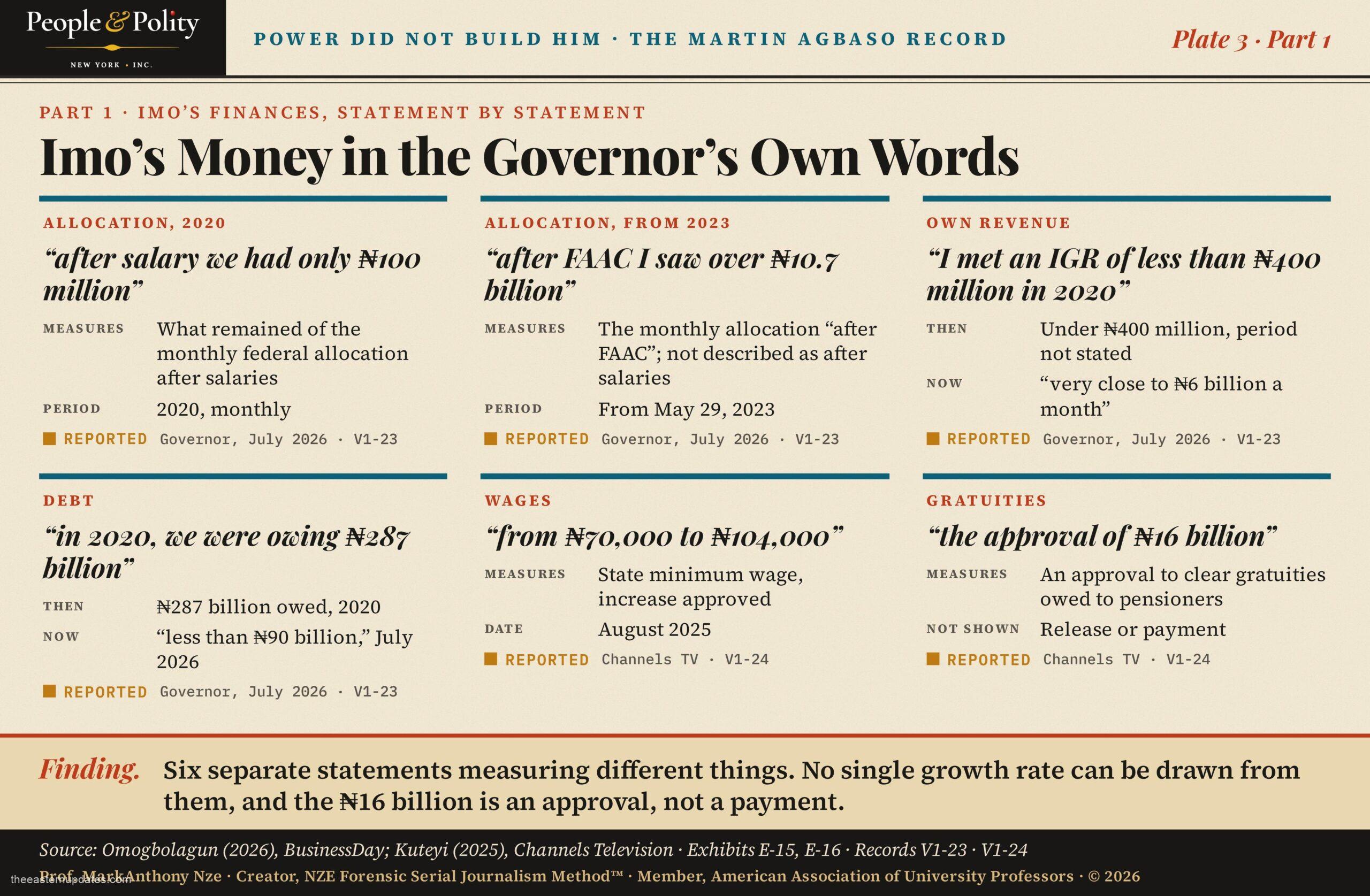
A payroll falls due in Owerri at the end of every month, and for most of this century Imo has met it with money sent from Abuja. Speaking in July 2026, Governor Hope Uzodimma said that when he took office in January 2020, “after salary we had only ₦100 million” from the monthly federal allocation, and that once May 29, 2023, came, “after FAAC I saw over ₦10.7 billion” (Omogbolagun, 2026). He put internally generated revenue at “less than ₦400 million” in 2020 and “very close to ₦6 billion a month now,” and state debt at ₦287 billion in 2020 against “less than ₦90 billion” when he spoke, and he credited federal policy, chiefly the removal of the petrol subsidy. [Reported]
His own words locate the source of the recovery. A subsidy decision taken in Abuja enlarged every state’s allocation at once, and the money it released reached Owerri by formula; Imo did not have to earn it. What one federal policy delivered, a later federal policy, a fall in oil output or a new sharing formula can withdraw in a single budget year. [Inference]
Obligations, meanwhile, are local, and they only grow. In August 2025 the governor raised the state minimum wage from ₦70,000 to ₦104,000 and approved ₦16 billion “for the immediate clearance of all outstanding gratuities owed to pensioners in the state” (Kuteyi, 2025). Wages and pensions, once raised, fall due every month whatever the allocation brings. [Reported] [Inference]
Imo’s dependence sits inside a national pattern. As TheCable reported BudgIT’s 2025 States of States report, 28 states relied on federal allocations for at least 55 percent of their total revenue in 2024; internally generated revenue fell from 25.27 percent of total recurrent revenue in 2023 to 20.27 percent in 2024; and Imo’s gross federal transfers grew by 225.25 percent between 2015 and 2024 (Lawal, 2025). [Reported]
Received and Raised
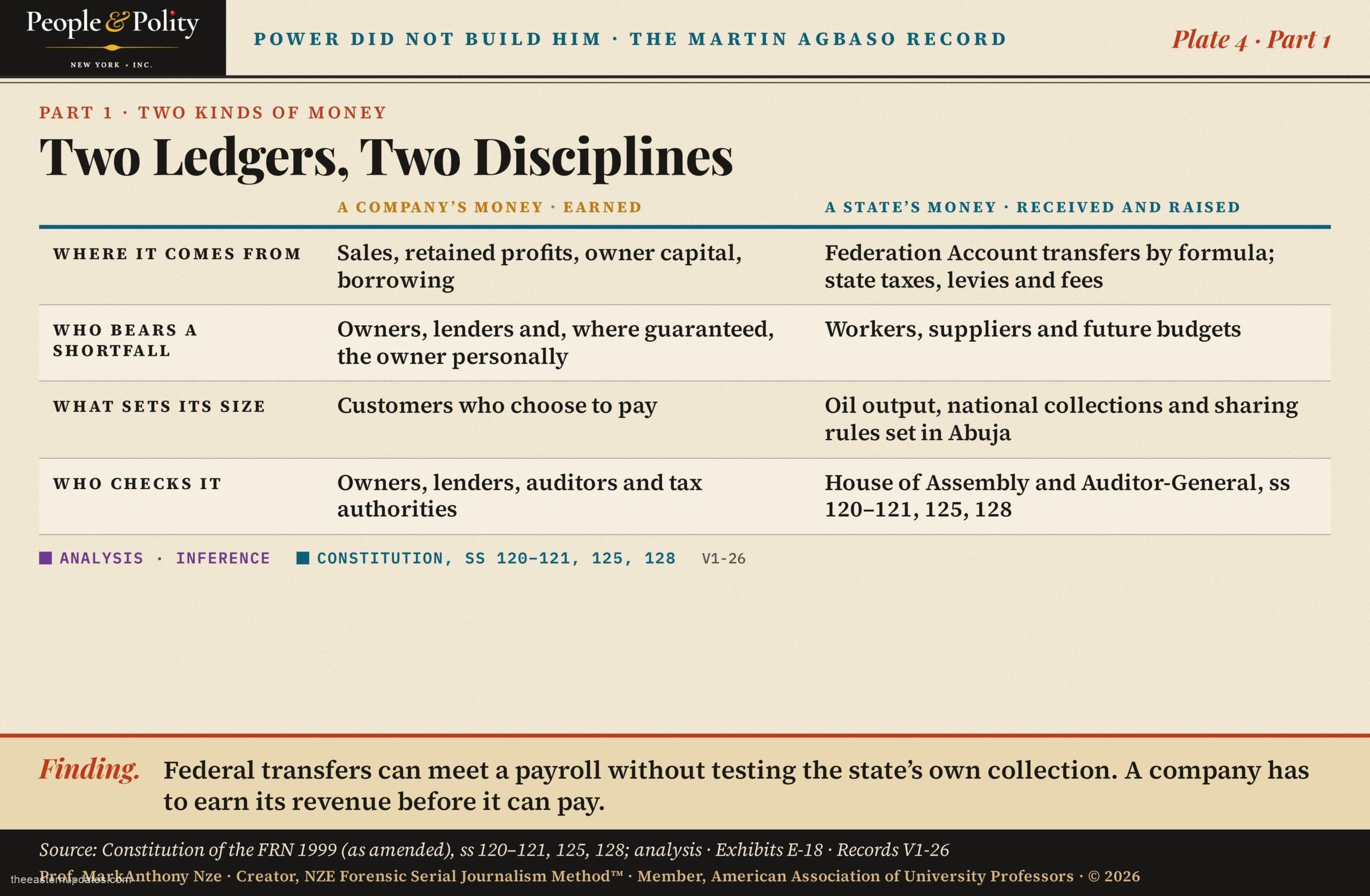
A state’s money arrives in two forms. Federal transfers come from the Federation Account under a sharing formula, and their size turns on oil output, national tax collections and rules settled in Abuja. Internally generated revenue comes from the state’s own taxes, levies and fees, and its size turns on the strength of the local economy and the competence of the people collecting it. A treasury fed by transfers can meet a payroll for years without once testing its own capacity to raise a naira. [Inference]
Companies have no formula to lean on. Their money comes from customers who choose to pay, from profits kept back, from capital their owners risk and from lenders who must be persuaded, and when sales fall short the founder answers for it personally. Every month of a company’s life tests the discipline that a transfer-fed treasury has never been made to learn. [Inference]
Owerri’s Turn
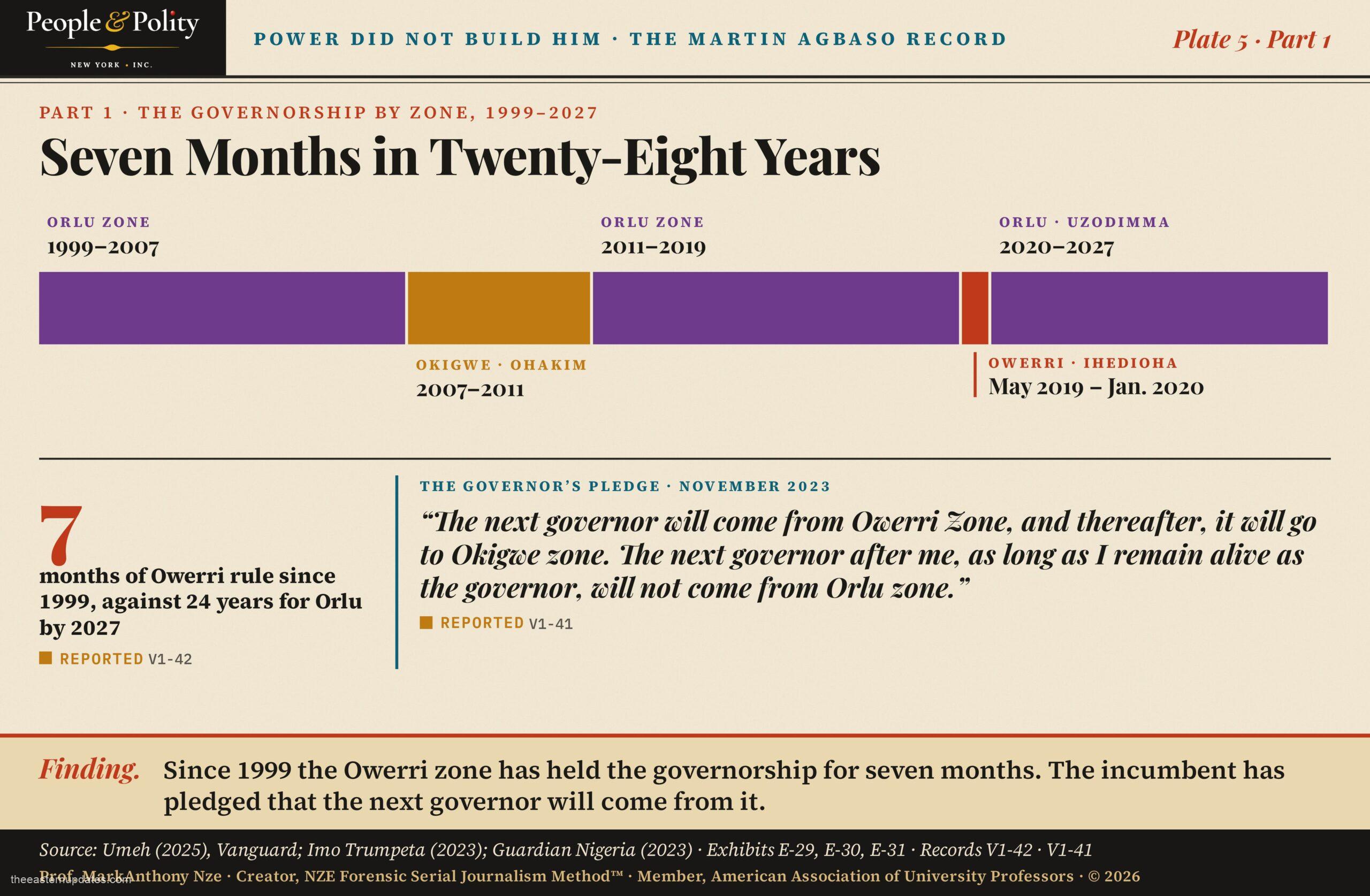
On the question of who governs next, and for once, Governor Uzodimma has done the noble thing. Within a week of his re-election on November 11, 2023, he told the Imo State Council of Elders at Government House: “The next governor will come from Owerri Zone, and thereafter, it will go to Okigwe zone. The next governor after me, as long as I remain alive as the governor, will not come from Orlu zone” (Imo Trumpeta, 2023). Meeting Owerri zone leaders of his party days later, he “restated his commitment to ensuring his successor in 2027 comes from Owerri zone” (Guardian Nigeria, 2023). [Reported] [Inference]
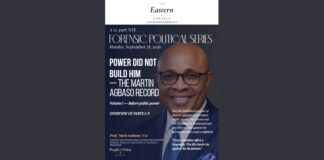
Read also: Power Did Not Build Him — The Agbaso Record, Vol. I Overview
His pledge answers a long grievance. Since the return to civilian rule in 1999, Vanguard reported in April 2025, “the Orlu zone has maintained a stronghold on the governorship, with the exception of a brief seven-month tenure by Emeka Ihedioha of Owerri”; by the end of the incumbent’s second term, “Orlu would have governed the state for 24 years, while Okigwe had its turn with Ikedi Ohakim serving a single four-year term” (Umeh, 2025). Seven months in twenty-eight years: that is the Owerri zone’s share of the governorship since democracy returned. [Reported] [Inference]
In April 2026 the governor received the Imo Charter of Equity from the state’s Elders’ Council, chaired by Eze Cletus Ilomuanya, and urged stakeholders to “respect zoning arrangement and avoid divisive politics” (Realnews Magazine, 2026). He has attached one condition, stated in August 2025: the office is “not an automatic right because any zone that wants to produce the next governor must work with the other zones” (Business Hallmark, 2025). The condition is fair, and it defines the candidate Owerri must offer. [Reported] [Inference]
The Owerri Candidate Who Has Raised Money
If 2027 belongs to Owerri, the choice narrows to a question Imo has seldom been able to put so plainly: which son or daughter of the zone can run a treasury that must learn to raise its own money. The answer lies in how each aspirant has earned a living, and Martin Agbaso, born in Emekuku in Owerri North, has spent his working life on the earning side of the ledger (Chima, 2023). [Reported] [Inference]
His published profiles place him in finance at Prudential in New York from 1983 to 1991, rising from management trainee to financial analyst, and then at the head of companies he founded in Nigeria from 1992: AGAD Nigeria Limited, SudRiva Construction Company Limited, SudRiva Oil and Gas Limited and, from 1997, a controlling stake in a New York firm (Chima, 2023; Nwafor, 2017). A fish farm bearing his name was running in Emekuku in 2024 and 2025, on the account set out in Part 5. [Reported]
A governor who has priced risk inside an American financial house and met a private payroll in Nigeria arrives knowing what a state that lives on allocations has forgotten: revenue is built, collected and accounted for, month after month, or it does not exist. Volume I sets that record out in full; Volume III will set it beside every declared aspirant’s before this series reaches its judgment. [Inference]
His case begins where his record begins, in Rome in 1980, where a twenty-one-year-old from Emekuku first asked strangers for their votes and won them. [Reported]
Source note. Omogbolagun (2026); Kuteyi (2025); Lawal (2025); Imo Trumpeta (2023); Guardian Nigeria (2023); Umeh (2025); Realnews Magazine (2026); Business Hallmark (2025); Chima (2023); Nwafor (2017).
Still open. How much of the ₦16 billion approved for gratuities has been paid.
|
➜ SEE THE EVIDENCE This installment’s Evidence Docket indexes the 10 records it relies on and links each one to the passage that supports it. It holds 11 exhibits: E-03, Periscope NGA profile, April 10, 2023; E-04, Vanguard profile, April 5, 2017; E-15, BusinessDay report, July 18, 2026; E-16, Channels Television report, August 27, 2025; E-17, TheCable on BudgIT, October 28, 2025; E-18, Constitution of Nigeria 1999 (as amended); E-29, Imo Trumpeta report, November 17, 2023; E-30, The Guardian report, November 21, 2023; E-31, Vanguard report, April 3, 2025; E-32, Realnews Magazine report, April 22, 2026; E-33, Business Hallmark report, August 25, 2025. Figures appear in tables that give each one’s period, basis and coverage. Open the Evidence Docket (PDF) ➜ Evidence Docket, Part 1 Complete Volume I docket, every exhibit ➜ Master Evidence Docket |
|
RIGHT OF REPLY Any person or institution named in this installment may respond in writing to [email protected]. Material responses are published separately or appended to this installment, with the date of receipt recorded. |