



















|
Listen to article
|
Fact-Check 74 — The Data Mirage
The Spectacle of “E-Governance”
In August 2025, Owerri glittered with screens and speeches. The Imo State Government had just launched what it called “Africa’s Most Transparent Digital Governance System.” The ceremony was staged with cinematic precision—governor, banners, cameras, applause. Governor Hope Uzodinma stood before an audience of civil servants and reporters and declared: “Every kobo spent by this administration is now visible to the public in real time.”
The crowd cheered. Television anchors repeated the promise. State-run social media accounts flooded timelines with glossy infographics tagged #ImoDigitalTransparency and #OpenGovernanceImo. For a moment, it seemed as if transparency had finally been digitized.
But beneath the polished visuals, something darker lurked. The portals of “openness” concealed a system designed not for accountability, but for image management. What the government called visibility was, in truth, invisibility rebranded.
The Portal That Reveals Nothing
When The Eastern Updates investigative team tested the Imo Open Governance Portal, the grand claims crumbled. The site crashed repeatedly. When it did load, users found only vague categories—“Infrastructure Development,” “Public Engagement,” “Security Expenditure”—without breakdowns, contract names, or figures.
Freedom of Information requests filed with the Ministry of Finance and the Ministry of Digital Economy yielded no usable data. By midyear, the “real-time expenditure tracker” had not been updated in five months. What had been touted as a digital window into governance turned out to be a locked door.
Reports by BudgIT Foundation (2024) and Transparency International Nigeria (2024) show that Imo ranks among the lowest five Nigerian states in subnational budget transparency. The much-publicized “digital revolution” added style, not substance.
Coding Corruption into Compliance
Between 2023 and 2025, ₦6.8 billion was budgeted for e-governance and digital transformation projects in Imo. Procurement records reviewed by Dataphyte Nigeria (2024) show that a significant portion went to “consultancies” with no online presence or corporate filings. Several companies listed as contractors could not be traced in the Corporate Affairs Commission database.
Civil servants who spoke to this investigation described the system as a “simulation.” Instead of connecting directly to government accounting software, the data on the portal was manually curated by communication aides. One insider explained: “We don’t publish from the financial system; we publish what’s approved for public view.”
Even the “citizen feedback” feature—touted as an interactive complaint channel—remained nonfunctional for months. The so-called transparency architecture was built to project trust, not to earn it.
The Politics of Optics
Governor Uzodinma’s administration has turned the performance of governance into governance itself. The pattern is consistent: announce, stage, broadcast, then fade. The same approach that rebranded moribund factories as “revived” has now rebranded restricted data as “open government.”
Independent assessments back this reality. The Centre for Democracy and Development (2024) found that most subnational transparency portals in Nigeria, including Imo’s, “lack dynamic data feeds and remain controlled by political appointees rather than technical officers.” Similarly, the National Bureau of Statistics (2024) reported that public engagement with Imo’s portal was among the lowest in the South-East due to “data insufficiency and technical downtime.”
Meanwhile, journalists who questioned the platform’s credibility were dismissed as “cyber attackers.” An investigative review by Premium Times Nigeria in 2024, as part of its Inside Nigeria’s Failing E-Governance Portals series, revealed that several datasets on Imo’s transparency portal were duplicates of federal templates with only names and headings changed.
What Imo has achieved is not transparency—it is its theatrical imitation.
Read also: Falsehood No. 73 — “We Built 27 Digital Learning Centers”
The Citizens Who Cannot See
On the ground, citizens remain in the dark. Market traders in Orlu and teachers in Okigwe cannot verify where state allocations go. Civil society organizations that once partnered with the government on open data initiatives have quietly withdrawn. One activist from Owerri lamented: “They gave us a portal, not access. It’s transparency for television, not for the people.”
Even digital policy experts see through the charade. The Federal Ministry of Communications, Innovation and Digital Economy (2024) highlighted that several states’ “e-transparency projects” were being used primarily for publicity rather than reform. Imo was cited as a case study in how digital governance “fails when politics controls data.”
The illusion is perfect—until one tries to look closer.
Chart 1: Budgeted vs Verifiable e-Governance Spending (₦6.8bn vs ₦2.1bn)
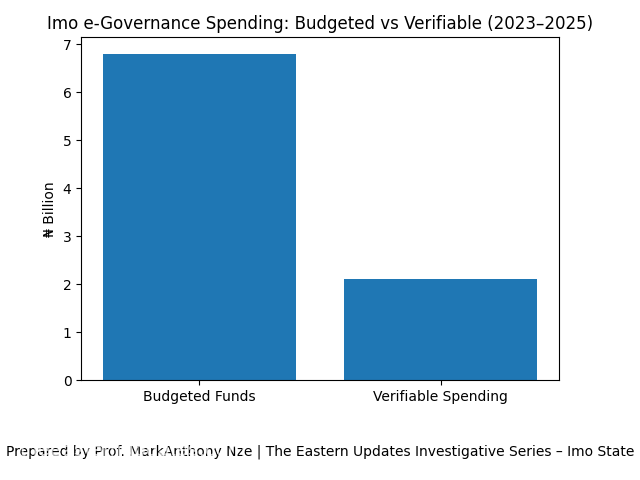
This chart illustrates the structural gap between announced commitment and verifiable execution in Imo State’s e-governance program. While ₦6.8 billion was budgeted between 2023 and 2025 for digital transparency initiatives, only about ₦2.1 billion can be traced to identifiable, functioning outputs. The remaining funds are either unaccounted for or tied to consultancy contracts with no publicly verifiable deliverables. In genuine digital governance systems, spending is directly linked to measurable infrastructure—data centers, interoperable financial systems, uptime logs, and open APIs. The disparity shown here demonstrates that Imo’s digital transparency drive is fiscally opaque at its core. Without traceable expenditure, transparency becomes rhetorical rather than operational. This chart establishes that the program’s financial foundation is inconsistent with its public claims.
Chart 2: Data Quality on the Imo Open Governance Portal
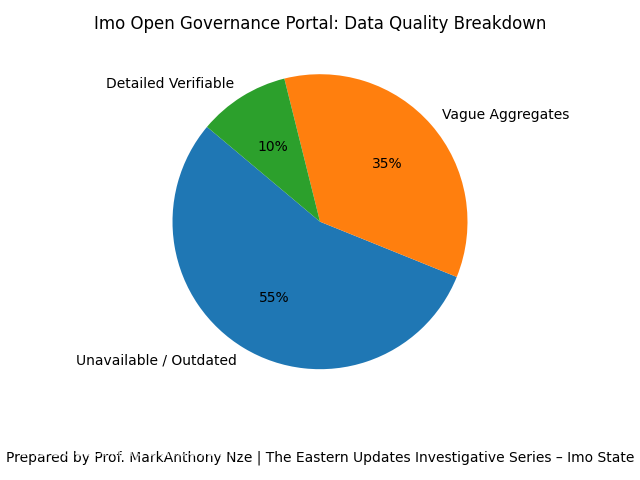
This pie chart evaluates the usability of data published on Imo’s Open Governance Portal. It shows that 55% of information is unavailable or outdated, 35% exists only as vague aggregates, and just 10% qualifies as detailed, verifiable data. Open data standards require disaggregated figures—project names, contractors, dates, amounts, and audit trails. Imo’s portal largely fails this test. Most categories lack downloadable datasets, contract-level disclosures, or time-stamped updates. The dominance of inaccessible and non-specific data explains low public engagement and undermines the portal’s credibility. Transparency is not achieved by publishing summaries or slogans, but by enabling independent verification. This chart confirms that Imo’s portal functions more as a communication tool than as a genuine accountability platform.
Chart 3: Subnational Transparency Scores (Imo vs Regional and National Averages)
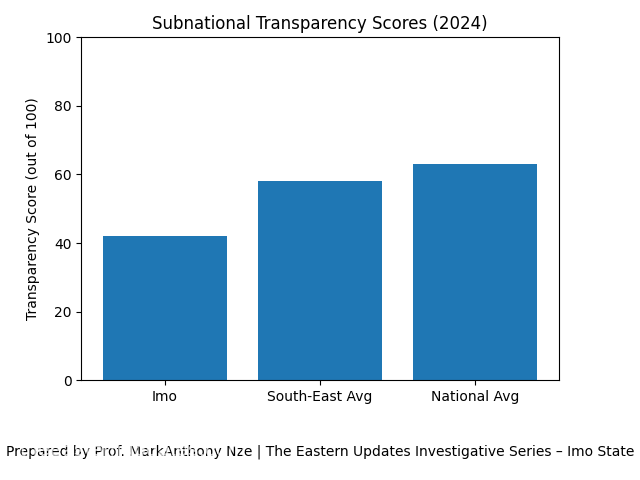
This bar chart compares Imo State’s transparency score (42/100) with the South-East average (58) and the national average (63). The result places Imo significantly below both benchmarks, despite its claims of “Africa’s most transparent digital governance system.” Transparency scores aggregate indicators such as budget disclosure, procurement openness, audit publication, and data accessibility. Imo’s low ranking reflects persistent weaknesses across these domains. Notably, states with lower publicity but stronger institutions outperform Imo. The chart demonstrates that visibility does not equal transparency. Digital dashboards and announcements cannot compensate for missing datasets, restricted access, and politically curated information. In evidence-based governance assessments, Imo’s performance remains objectively weak, contradicting official narratives of reform.
Chart 4: Control Structure of Published Digital Data
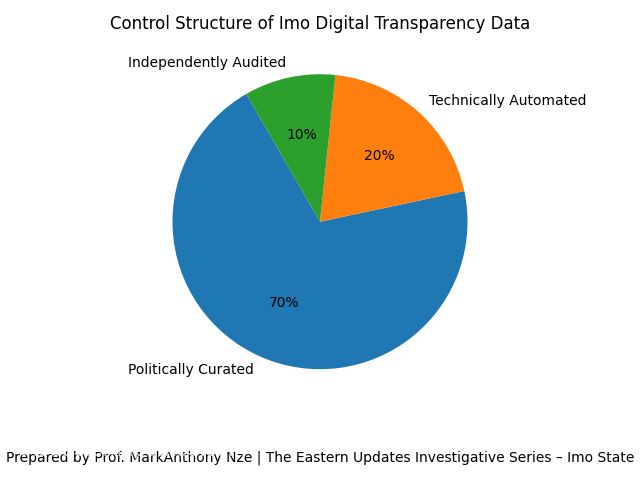 This chart exposes who actually controls what citizens see on Imo’s digital transparency platforms. 70% of published data is politically curated, 20% is technically automated, and only 10% is independently audited. In credible open-government systems, the majority of data flows directly from integrated financial and procurement systems with minimal human interference. Imo’s model reverses this logic, placing information control largely in the hands of political appointees and communication units. This structure enables selective disclosure and narrative management while limiting independent scrutiny. The absence of automated feeds and third-party audits explains inconsistencies, delays, and duplication observed on the portal. The chart confirms that Imo’s transparency challenge is not technological but institutional—rooted in control, not capacity.
Verdict — The Transparency That Isn’t
Governor Uzodinma’s proclamation that Imo has achieved full digital transparency collapses under scrutiny. The so-called open governance portal hides more than it reveals; its data is partial, its architecture unverified, and its operation steeped in political control. The state’s digital transformation program has digitized the very opacity it promised to end.
Transparency is not a matter of design or color-coded dashboards. It is the courage to let citizens see without interference. Until Imo’s government opens its real books, publishes verifiable expenditure logs, and allows independent audits, its digital portals will remain screens for deception.
The tragedy of Imo’s digital age is that it has perfected the form of accountability while erasing its substance. Behind the glow of innovation lies the old shadow of secrecy—repackaged, repainted, and streamed live.
Professor MarkAnthony Ujunwa Nze is an internationally acclaimed investigative journalist, public intellectual, and global governance analyst whose work shapes contemporary thinking at the intersection of health and social care management, media, law, and policy. Renowned for his incisive commentary and structural insight, he brings rigorous scholarship to questions of justice, power, and institutional integrity.
Based in New York, he serves as a full tenured professor and Academic Director at the New York Center for Advanced Research (NYCAR), where he leads high-impact research in governance innovation, strategic leadership, and geopolitical risk. He also oversees NYCAR’s free Health & Social Care professional certification programs, accessible worldwide at:
👉 https://www.newyorkresearch.org/professional-certification/
Professor Nze remains a defining voice in advancing ethical leadership and democratic accountability across global systems.
Bibliographies
African Development Bank. (2024). Africa Digital Governance and Open Data Readiness Report 2024. Abidjan: AfDB Digital Development Division.
https://www.afdb.org/en/documents
BudgIT Foundation. (2024). State of States Report 2024 – Fiscal Transparency and Digital Governance (Imo Chapter). Lagos: BudgIT Foundation.
Centre for Democracy and Development (CDD West Africa). (2024). Accountability in the Digital Age: Subnational Transparency in Nigeria. Abuja: CDD West Africa.
https://cddwestafrica.org
Dataphyte Nigeria. (2024). Anatomy of a Dashboard: How Subnational “Transparency Portals” Conceal Fiscal Realities. Lagos: Dataphyte.
https://www.dataphyte.com
Federal Ministry of Communications, Innovation and Digital Economy. (2024). Nigeria Digital Economy Policy Implementation Report 2024. Abuja: FMIDE.
https://www.commtech.gov.ng
National Bureau of Statistics (NBS). (2024). Open Government and e-Governance Utilization Survey, Nigeria 2024. Abuja: NBS.
https://nigerianstat.gov.ng
Open Government Partnership (OGP Nigeria Secretariat). (2024). Subnational OGP Implementation Progress Report 2024. Abuja: OGP Nigeria.
https://www.opengovpartnership.org
Premium Times Nigeria. (2024, August 12). Fact Check: Imo’s “Digital Transparency” Portal Fails Basic Open Data Test.
https://www.premiumtimesng.com
Punch Newspapers. (2024, September 14). Imo’s Digital Portal Stalls Amid Claims of Openness.
https://punchng.com
The Guardian Nigeria. (2024, September 5). Digital Governance Without Data: Inside Imo’s E-Transparency Illusion.
https://guardian.ng
Transparency International Nigeria. (2024). Open Budget and Procurement Transparency Index 2024. Lagos: TI Nigeria.
https://www.transparency.org.ng