












|
Listen to article
|
The case against him
The final installment places the hardest objections to Agbaso’s candidacy beside the strongest facts of his record, and asks what public responsibility requires of a contender who has spent so much of his career outside elective office.
“The strongest case must answer its hardest questions.”
A long political career tempts admirers to treat persistence as proof, and critics to count every reversal as a verdict. Years of study, private enterprise and repeated electoral contest have given Martin Agbaso a substantial public history, and the difficult parts of that history carry their own weight. His record includes commercial responsibility and continuing political engagement, together with alliances that failed, court decisions that went against his faction and years without an administration of his own to assess. Any closing judgment must consider how those experiences may bear on executive decisions. The questions are serious because the responsibilities of a governor are serious: public money must be accounted for, institutions must function even under disagreement, and residents must receive services whether or not they belong to the governing coalition. Agbaso’s qualifications merit attention; so do the risks a voter would reasonably wish to understand before entrusting him with office.
Read also: Power Did Not Build Him — The Agbaso Record, Vol. II Part 13
Preparation and the limits of credentials
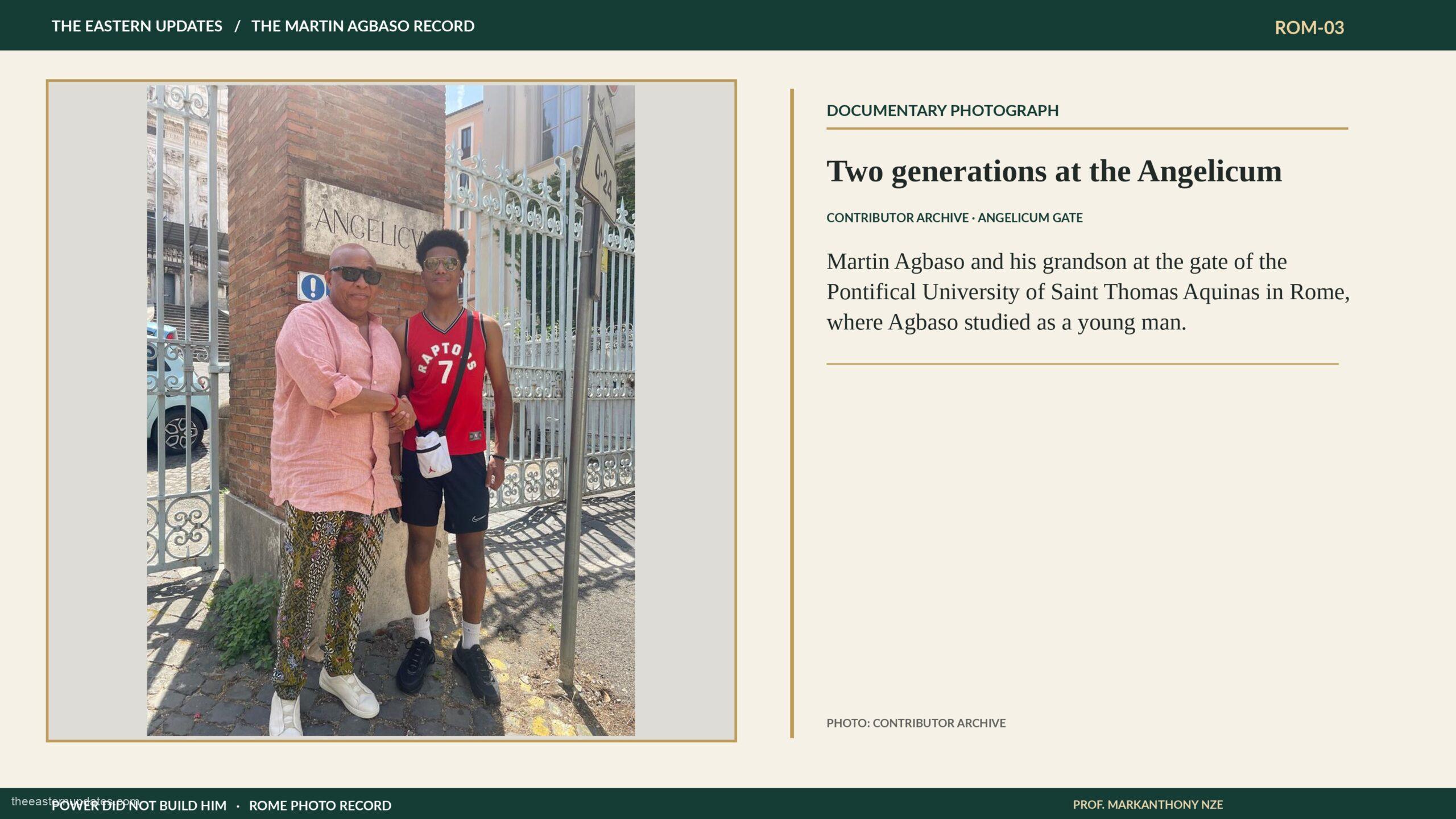
At the Angelicum in Rome, Agbaso studied in an international academic setting before pursuing his later professional life in the United States. Published profiles also describe an elected role among international students. That early exposure to different institutions and experiences deserves a place in his political biography. [1][2][3] The photographs accompanying the series make the chapter personal: a student portrait and later images of his return to the university, including a visit with his grandson, connect the beginning of his adult education with subsequent generations. Such details convey the span of a life, while the responsibility of governing remains a different subject. Voters may value preparation gained through study and employment, then examine separately the ability to make defensible decisions about public resources.
Professional work under established standards, followed by responsibility in enterprise, gives Agbaso experience outside the familiar cycle of campaign promises. That history deserves consideration through the judgment it required, particularly when obligations to employees, customers and business partners competed for limited resources. It is a useful beginning for assessing competence, although a governorship would impose legal and constitutional duties of a different order.
The weight of earlier elections
Imo East’s reported Senate result in 1998 and the canceled governorship election of 2007 belong to different political and legal circumstances, both examined in earlier installments. Their relevance to the final assessment is the persistence of Agbaso’s electoral engagement and his exposure to institutional decisions he could not ultimately control. [1][2][4][5] A Senate seat that never became a tenure cannot be counted as legislative service. Similarly, the Supreme Court’s jurisdictional decision in the 2007 litigation resolved the route through which the dispute had been brought, without awarding the canceled ballot to Agbaso as a matter of judicial finding. Exactness about those events protects the political significance that the record does carry. He remained active after disappointment and continued seeking public trust, a history that now deserves to be weighed against the responsibilities he proposes to assume.
In June 2026 Agbaso publicly declared his intention to put earlier disappointments behind him and focus on the future. [6] Citizens are entitled to consider those words as a commitment that should shape conduct. Respect for binding judgments, openness to criticism and restraint in the use of public institutions would give that declaration practical substance. A governor’s duty extends to critics and political opponents, particularly when disagreement concerns lawful oversight of the executive.
Read also: Power Did Not Build Him — The Agbaso Record, Vol. II Part 12
Influence and executive responsibility
Participation in the coalition that elected Rochas Okorocha demonstrated Agbaso’s ability to commit influence and political resources to an outcome that did not place him in office. His subsequent break with those allies also revealed how quickly understandings formed during a campaign can deteriorate in government. APGA’s later leadership litigation brought another adverse outcome, culminating in the Supreme Court’s 2018 decision affirming Victor Oye. [7][8][12] Those episodes raise legitimate questions about judgment, the choice of associates and the treatment of institutional rules when they favor somebody else. Yet political participation also gives a prospective executive firsthand experience of organization, negotiation and conflict. The governing issue is whether that experience produces confidence in lawful procedure and allows independently qualified officials to perform their duties, even when their advice is unwelcome.
Competent commissioners and career officials need authority within the law to warn a governor about errors or unaffordable commitments. Experience with political factions becomes useful when it teaches the executive to distinguish personal allegiance from public duty. Agbaso would be judged through the people he appointed, the advice he tolerated and the decisions he corrected, rather than through the number of alliances formed before taking office.
Private wealth and public obligation
Agbaso’s business history provides another substantial element of his case for consideration. Published accounts associate him with enterprises across different fields, placing commercial responsibility beside his political pursuits. [1][2][9] Private interests, however, require careful handling when their owner assumes public authority. Asset disclosures where required by law, impartial procurement, conflict-of-interest safeguards and access to public expenditure records would matter directly to citizens. Business experience may help an officeholder recognize costs and waste, while transparent procedures protect public decisions from the suspicion that personal relationships governed them. The earlier employment and community-service reports should remain in their original dockets, where the figures and underlying sources are presented. Repeating them here would conceal the central governing distinction: a private enterprise serves people who transact with it, while a state owes lawful services to all its residents.
For a governor with significant commercial experience, independent review can protect both the public and the integrity of official decisions. Clear procurement criteria, disclosed interests capable of causing conflicts and published records of major expenditures would give citizens a way to examine performance beyond speeches. Agbaso’s background would deserve governing credit if its practical habits were applied consistently within those safeguards.
From experience to public results
Imo’s public services would provide the final test of any candidate’s preparation. Roads must become usable, clinics must have staff and supplies, classrooms must function and public accounts must withstand examination. Familiarity with business costs could help Agbaso identify delayed payments or wasteful purchasing, but useful instincts would have to be translated into lawful contracts and sustained services. His June 2026 declaration includes a first-year commitment, creating a measurable standard for that translation. [6][11] A capable executive would publish a starting fiscal position, assign responsibility for priorities and permit independent reporting on their progress. What voters would eventually judge is the work accomplished under the rules of government, after political intentions have been subjected to the delays and demands of actual administration.
Ndi Imo will decide
Imo’s electorate will decide how much weight to place on Agbaso’s professional preparation, years of commercial activity and experience in political conflict. Several strengths are relevant to the office he seeks, but his record also carries burdens deserving frank examination: no prior administration as governor, alliances that failed, adverse rulings and the expense of ambitions yet to be costed in full. Those considerations can be weighed together without treating a setback as a permanent verdict or an achievement as a guarantee. Citizens gain little from an immaculate political biography. They gain more from a record that permits comparison, scrutiny and a reasonable expectation that the person elected will answer for decisions made in office.
This newspaper can examine Martin Agbaso’s record and describe its significance; the authority to choose a governor belongs to the people of Imo. His experience warrants serious public consideration, with the same demands for evidence and responsibility applied to every other contender. Whatever judgment voters reach, the central obligation will survive the election: public power must answer to the people who confer it. The series ends where public office ought to begin, with an account of responsibility owed to Ndi Imo.
References
[1] Nwafor. (2017, April 5). Chief Martin Agbaso MFR: A journey on courage and leadership. Vanguard.
[2] Nwafor. (2021, April 5). Chief Martin Agbaso: 62 cheers for Ochoudo. Vanguard.
[3] Pontifical University of Saint Thomas Aquinas. (2026). Our campus. Angelicum.
[4] Chief Ikedi Ohakim v. Chief Martin Agbaso & Ors. (2010), Supreme Court of Nigeria, SC.3/2010 (consolidated).
[5] Eze, P. (2026, July 29). Martin Agbaso declares 2027 Imo governorship bid, says mandate delayed, not denied. TheCable.
[6] Agbaso, M. (2026, June 21). A mandate delayed, not denied: My renewed commitment to the service of Ndi Imo [Signed statement].
[7] Aziken, E. (2013, December 17). Imo: The story of Okorocha’s betrayal, by Agbaso. Vanguard.
[8] Njoku, L. (2017, August 17). Appeal court restores Oye as APGA’s national chairman. The Guardian Nigeria.
[9] Nwosu, N. (2023, March 23). Race for Douglas House. ThisDay.
[10] Medeme, O. (2021, June 26). Martin Agbaso empowers Nigerian youths with agribusiness. Independent.
[11] Debt Management Office. (2026). Sub-national debts: States and FCT domestic debt stock as at June 30, 2026.
[12] Onochie, B. C. (2018, July 14). APGA: Supreme Court affirms Oye as national chairman. The Guardian Nigeria.
Source note: the historical accounts are attributed to their named publishers, judicial rulings are cited for the issues they decided, and the 2026 declaration records Agbaso’s stated intentions. The Rome images reproduce contributor photographs and an officially published Angelicum campus view with their proper captions and credits.