

















|
Listen to article
|
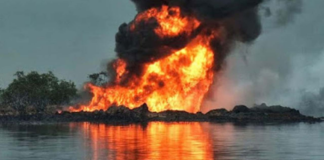
President Donald Trump threatened Thursday to destroy the entirety of Iran’s South Pars gas field — the world’s largest natural gas reserve — if Tehran launched further missile strikes against Qatar’s energy infrastructure, a sweeping ultimatum delivered on social media that simultaneously contradicted his own administration’s account of how the previous day’s strikes on the same field had been authorized, while global energy markets recorded their sharpest single-day surge since the war began on February 28.
“NO MORE ATTACKS WILL BE MADE BY ISRAEL pertaining to this extremely important and valuable South Pars Field,” Trump posted on his Truth Social platform in the early hours of Thursday. “Unless Iran unwisely decides to attack a very innocent, in this case, Qatar — in which instance the United States of America, with or without the help or consent of Israel, will massively blow up the entirety of the South Pars Gas Field at an amount of strength and power that Iran has never seen or witnessed before.” He added that he did not want to authorize “this level of violence and destruction because of the long term implications that it will have on the future of Iran,” but stated he would not hesitate to act if Qatar’s LNG facilities were struck again.
The statement carried an internal contradiction that Israeli and American officials moved quickly to expose. Trump claimed on Truth Social that Israeli forces had “violently lashed out” at South Pars “out of anger for what has taken place in the Middle East” and insisted that the United States “knew nothing about this particular attack.”
U.S. and Israeli officials, speaking on condition of anonymity, told Axios that Trump’s account was inaccurate. Prime Minister Benjamin Netanyahu and Trump had coordinated the strike in advance, with the aim of deterring Iran from continuing to restrict tanker traffic through the Strait of Hormuz. Qatar was not informed beforehand.
After the first Iranian missile strike on Ras Laffan, Qatari officials contacted White House envoy Steve Witkoff and CENTCOM commanders, demanding to know whether the U.S. had prior knowledge of the Israeli attack. Witkoff conducted a series of calls with Qatari officials to organize an urgent call between Trump and Qatar’s Emir, Sheikh Tamim bin Hamad Al Thani. The phone call took place Wednesday night. French President Emmanuel Macron separately called both leaders and publicly demanded an immediate halt to strikes on civilian energy infrastructure.
Iran’s response to the South Pars strike was extensive and double-barreled. QatarEnergy confirmed that in addition to Wednesday’s first missile strike on Ras Laffan Industrial City — which it said caused “extensive damage to the Pearl GTL Gas-to-Liquids facility” — several other LNG facilities at the complex were struck in a second wave of Iranian missile fire in the early hours of Thursday, causing significant fires and extensive further damage. Qatar’s interior ministry said all fires had subsequently been brought under control with no casualties reported. A vessel was reported struck approximately four nautical miles east of Ras Laffan by the United Kingdom Maritime Trade Operations Center early Thursday morning.
All crew were said to be safe. A second vessel was reported hit off the UAE coast near the Strait of Hormuz the previous night — part of a sustained pattern of maritime incidents that has accumulated to more than 20 reported vessel strikes since the conflict began.
Iran escalated further overnight, setting two Kuwaiti oil refineries ablaze, striking a Saudi refinery on the Red Sea, and targeting energy facilities in Abu Dhabi. Mobile phone alerts sounded in Dubai on Thursday morning as incoming Iranian missiles were tracked by UAE air defenses. Bahrain activated its missile sirens. Kuwait confirmed it had shot down Iranian drones headed toward the country’s oil infrastructure.
Brent crude surged past $116 a barrel in Thursday morning trading — an increase of nearly 10 percent in a single session and approximately 70 percent above pre-war levels. The European TTF benchmark for natural gas prices rose 24 percent. World equity markets retreated sharply on the combined fears of uncontrolled energy supply destruction and potential further military escalation. South Asian economies including India, Pakistan, and Bangladesh, which rely on Ras Laffan for the bulk of their LNG imports, were bracing for power cuts and industrial slowdowns, according to reporting by CNN.
Read Also: Gabbard Dodges Iran Threat Question At Senate Hearing
The South Pars field holds an estimated 1,800 trillion cubic feet of usable natural gas — enough to supply the world’s total consumption for approximately 13 years. Iran draws approximately 80 percent of its domestic energy supply from the field. Unlike oil storage infrastructure that can be rebuilt on short timelines, LNG production and processing facilities require extended periods and enormous capital expenditure to repair, making the damage inflicted both immediate and long-lasting.
Russia has emerged as one of the financial beneficiaries of the energy crisis the war has generated. The U.S. Treasury issued a 30-day sanctions waiver on Russian energy sales the previous week, allowing Moscow to sell oil already loaded onto tankers. Treasury Secretary Scott Bessent described it as a narrowly tailored short-term measure to promote energy market stability. Some analysts disagreed with that framing, noting that the combination of Strait of Hormuz closure and Gulf energy infrastructure damage has driven demand for Russian crude at premium prices.
Saudi Arabia’s Foreign Minister Prince Faisal bin Farhan, speaking Thursday at a joint press conference alongside French Foreign Minister Jean-Noel Barrot in Riyadh, escalated the kingdom’s public posture.
Read Also: ‘Murderers’ Must Pay For Killing Iran’s Larijani – Khamenei
“What little trust there was has completely been shattered, on multiple levels,” he said, adding that military options remained on the table. Iran’s strikes on Gulf neighbors, he said, appeared to have been “premeditated, preplanned and well thought out.” Austrian Chancellor Christian Stocker, speaking from Brussels, said Europe would not be “blackmailed” into the U.S.-Israeli military campaign. “Intervention in the Strait of Hormuz is not an option for Austria anyway,” he said, calling for stabilization of energy supply and prices. Czech Prime Minister Andrej Babis, one of Israel’s closest allies within the EU, described the South Pars strike as “incomprehensible,” saying it had “totally damaged the markets.”
The U.S. military’s Central Command separately confirmed that American forces had “successfully employed multiple 5,000-pound deep penetrator munitions on hardened Iranian missile sites along Iran’s coastline near the Strait of Hormuz” on Tuesday — a disclosure that underlined the scale and ongoing intensity of direct American military engagement in the war, independent of Israel’s operations. Reuters separately reported Thursday that the U.S. government was considering deploying thousands of additional American forces to the Middle East, raising the prospect of a significant expansion of the ground-level American military presence in the region.
Iran’s President Masoud Pezeshkian, addressing the country on Wednesday following the South Pars strike, warned of “consequences beyond control, the scope of which would engulf the entire world.” No ceasefire negotiations are publicly underway. No party to the conflict has proposed a framework for de-escalation, and no mediating country has announced a formal diplomatic initiative as of Thursday morning.