

















|
Listen to article
|
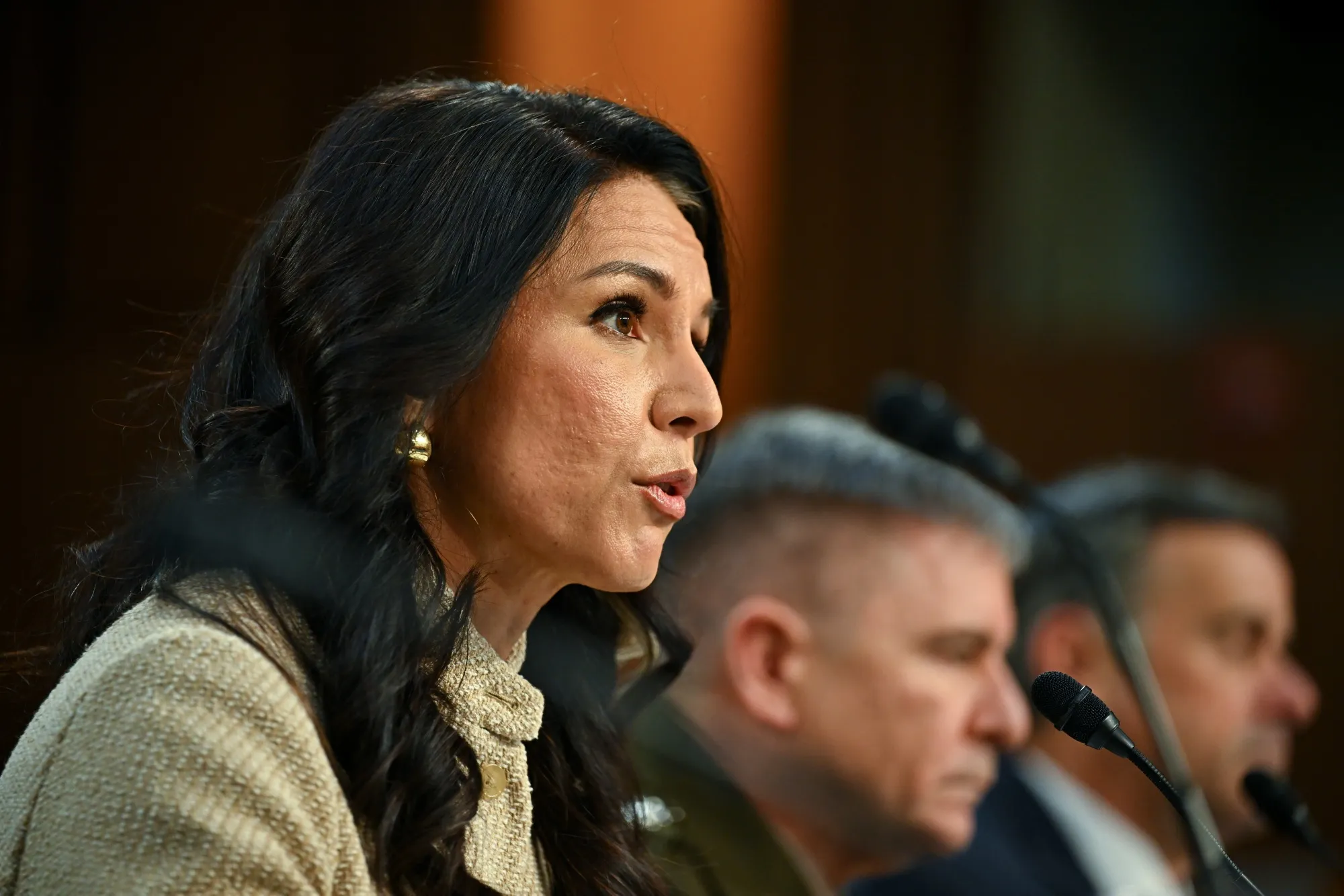
Director of National Intelligence Tulsi Gabbard told a Senate committee Wednesday that Iran’s government remained functional despite more than three weeks of American and Israeli bombardment, while declining to answer repeated congressional demands that she state publicly whether Iran had posed an imminent threat to the United States before the war began — the central legal and political justification the Trump administration has used to defend its decision to strike.
“The regime in Iran appears to be intact but largely degraded by Operation Epic Fury,” Gabbard said in her opening statement to the Senate Intelligence Committee’s annual hearing on worldwide threats, referring to the joint U.S.-Israeli military campaign against Iran. She added that Iran and its proxies remained capable of attacking American and allied interests across the Middle East, and warned of longer-term consequences if the regime survived. “If a hostile regime survives, it will likely seek to begin a years-long effort to rebuild its military, missiles and UAV force,” she said.
The hearing was the first public intelligence briefing before Congress since the war began on February 28 and came one day after Joe Kent, Gabbard’s own deputy and director of the National Counterterrorism Center, resigned in protest, writing publicly that Iran had posed “no imminent threat” to the United States and that the administration had gone to war under pressure from Israel and its allies. The question of whether that threshold had ever been met became the session’s most contested and revealing fault line.
Senator Jon Ossoff, a Democrat from Georgia, pressed Gabbard repeatedly on whether she assessed Iran to have constituted an imminent threat. She declined to answer each time.
“The only person who can determine what is and is not an imminent threat is the president,” she said. Ossoff pushed back directly. “It is precisely your responsibility to determine what constitutes a threat to the United States. This is the worldwide threats hearing, where, as you noted in your opening testimony, you represent the intelligence community’s assessment of threats,” he said. Gabbard did not alter her response.
The deflections drew a sharp reaction from the committee’s Democratic members, who argued the hearing represented one of the few available forums to extract accountability from the administration on a conflict that has cost billions of dollars, closed the Strait of Hormuz, and sent global energy prices surging.
“The complete lack of clarity should matter to everybody,” said Democratic Senator Michael Bennet of Colorado, following a pointed exchange with CIA Director John Ratcliffe over the administration’s strategy for neutralizing the Iranian threat.
Ratcliffe did not share Gabbard’s caution on the imminent threat question. He told the committee that Iran had in fact posed an “immediate threat” at the time of the strikes, outlining what he described as a series of provocative Iranian actions, including a missile buildup during ongoing nuclear negotiations with the United States. The divergence between Gabbard’s non-answer and Ratcliffe’s affirmative response left the committee without a unified intelligence community position on the central question lawmakers had traveled to the hearing to resolve.
The session also surfaced a significant contradiction at the core of the administration’s stated rationale for the war. President Trump has repeatedly asserted that Iran was within two weeks of acquiring a nuclear weapon when the strikes began.
“If we didn’t hit within two weeks, they would’ve had a nuclear weapon,” he told congressional leaders on March 4. But Gabbard’s written testimony told a markedly different story. Her prepared remarks stated that following Operation Midnight Hammer — the joint U.S.-Israeli strike on Iranian nuclear facilities in June 2025 — Iran’s nuclear enrichment program had been “obliterated,” with no subsequent efforts to rebuild, and that the entrances to underground facilities had been sealed with cement. If Iran’s enrichment program had been fully destroyed nine months before the current war, the nuclear imminent threat argument could not apply to the decision to strike in February 2026.
Read Also: ‘Murderers’ Must Pay For Killing Iran’s Larijani – Khamenei
Gabbard did not read that portion of her prepared statement aloud. When Senator Mark Warner, the top Democrat on the committee, asked her why she had omitted it, she said she had skipped it because her remarks were “running long.” “So you chose to omit the parts that contradict the president,” Warner replied. Gabbard did not respond to the characterization.
On the Strait of Hormuz, the testimony revealed that the intelligence community had long assessed that Iran would move to close the waterway in the event of a conflict. Gabbard acknowledged it had been a “longstanding assessment” of the intelligence community that Iran “would likely hold the Strait of Hormuz as leverage” in any armed conflict with the United States or Israel. Senator Ron Wyden of Oregon pressed Gabbard on whether she had briefed the president on that assessment before strikes commenced. “Every problem we’re seeing now was not only foreseeable but was predicted by the intelligence agencies,” Wyden said. Gabbard declined to describe any specific conversations with the president, saying only that the intelligence community had provided the White House with ongoing briefings before and throughout the operation.
Senator Chris Murphy, a Democrat, said the administration had no contingency plan for the closure of the strait when the war began.
“They had no plan to address the crisis in the strait. The fact that these guys didn’t have a plan ahead of time, and a week into the war still didn’t have a plan, was pretty shocking,” he said, citing what he described as a classified briefing he had received from administration officials. The Pentagon has said it took “pre-emptive planning measures” in response to the intelligence assessment on Hormuz, without detailing what those measures entailed.
Read Also: Israel Strikes Iran’s Gas Field In Major War Escalation
Since the conflict began on February 28, the price of crude oil has risen above $100 per barrel on multiple occasions, up from approximately $67 before the first strikes. The Strait of Hormuz, through which roughly a fifth of global oil and liquefied natural gas supplies transit, remains effectively closed.
Ratcliffe told the committee he briefs the president on intelligence multiple times a day and had participated in dozens of meetings related to the Iran operation, but said he could not identify a single moment where a final decision had been formally made. Gabbard, similarly, declined to characterize the nature or content of her intelligence exchanges with the president.
Vice President JD Vance, speaking separately on Wednesday, said it was “a good thing” that Kent had resigned if he did not support the president’s decision to go to war with Iran. White House Press Secretary Karoline Leavitt, asked before the hearing whether Trump retained full confidence in Gabbard, said that he did.
Democrats on the committee have separately demanded public testimony from Secretary of State Marco Rubio and Defense Secretary Pete Hegseth — the officials most directly involved in the decision to strike — neither of whom appeared Wednesday. No timeline for any such testimony has been established, and the administration has not indicated it intends to comply with that request.