















|
Listen to article
|
Iran’s new supreme leader Mojtaba Khamenei said Wednesday in a written message that the killers of security chief Ali Larijani, who died in an Israeli strike, “will have to pay for it”.
“Without a doubt, the assassination of such a figure attests to his importance and to the hatred that the enemies of Islam harbour toward him,” Mojtaba Khamenei said, in a message published on his official Telegram channel on the day of Larijani’s funeral in Tehran.
Read Also: Israel Strikes Iran’s Gas Field In Major War Escalation
“Every drop of spilled blood comes at a price, and the criminal murderers of these martyrs will soon have to pay it,” added Mojtaba Khamenei, who has yet to appear in public after taking office following the killing of his father, ex-supreme leader Ali Khamenei at the start of the war.
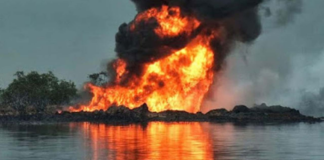
Israel struck Iran’s South Pars gas field on Wednesday in a coordinated attack approved by the United States, destroying storage tanks and refinery infrastructure at the world’s largest known natural gas reserve and triggering an immediate Iranian threat to attack energy installations across the Gulf region. The strike marked the most significant economic assault of a 19-day war that has already produced the largest disruption to global energy supplies in recorded history.
Four gas treatment facilities in the port area of Assaluyeh, in Iran’s Bushehr Province, were damaged in the strikes. The affected plants process gas from Phases 3, 4, 5, and 6 of the offshore South Pars field. The governor of Assaluyeh said the facilities had been taken offline to contain and prevent the spread of fire. Workers were evacuated before emergency and firefighting crews moved in. According to sources with knowledge of the operation, the strike knocked out roughly one-fifth of Iran’s gas processing capacity — an impact with consequences extending to the country’s electricity sector.
Two senior Israeli officials confirmed the strike was coordinated with and approved by the Trump administration. A U.S. Defense official also confirmed that. The Israeli military did not respond to requests for comment. Sources familiar with the operation said it was “coordinated down to the last detail with President Trump and his team” and assessed to be part of a larger campaign. President Trump, posting on his social media platform, wrote: “We are rapidly putting them out of business.”
Iran’s response was immediate and sweeping. The Islamic Revolutionary Guard Corps issued formal evacuation warnings directed at energy installations across three neighboring states. Named as targets were Saudi Arabia’s Samref Refinery and Jubail Petrochemical Complex, the UAE’s Al Hosn Gas Field, and Qatar’s Mesaieed Petrochemical Complex and Ras Laffan Refinery.
“These centres have become direct and legitimate targets and will be targeted in the coming hours,” Iranian state media reported.
Oil and European natural gas prices surged on news of the strike. Brent crude climbed as much as 6.1 percent to a high of $109.75 a barrel, while Europe’s gas benchmark jumped as much as 9.1 percent. The South Pars field supplies approximately 70 percent of Iran’s domestic natural gas and represents a foundational asset of the Iranian economy. Qatar, which shares the deposit across the Gulf under the name North Dome, is both a co-stakeholder in the field and a close American ally hosting the largest U.S. airbase in the region. Its Foreign Ministry called the strike “a dangerous and irresponsible step,” warning that targeting energy infrastructure “poses a threat to global energy security and to the peoples of the region.”
The attack on South Pars was not the only major escalation of the day. Israeli Defense Minister Israel Katz announced Wednesday that Iran’s intelligence minister, Esmail Khatib, had been killed in an overnight airstrike — the second senior Iranian official eliminated in two days, following the killing of national security chief Ali Larijani on Tuesday.
“No one in Iran has immunity and everyone is in the crosshairs,” Katz said, announcing that Prime Minister Benjamin Netanyahu had authorized the military to strike any senior Iranian official without requiring additional political approval for individual missions. Iran did not immediately confirm Khatib’s death.
Read Also: Israel Is ‘Crushing’ Iran, Hezbollah – Netanyahu Declares
The open-ended targeting authorization appeared to represent a formal policy shift. It is the first publicly stated instance of Israel explicitly delegating lethal targeting authority for enemy officials to the military without requiring case-by-case political clearance.
In Lebanon, Israel struck multiple apartment buildings in central Beirut, killing at least 10 people according to Lebanon’s Health Ministry. One building in the Bachoura district was flattened after residents received an evacuation notice. Israel’s military said the structure had been used by Hezbollah to store funds, without providing evidence. No warnings were issued before strikes on buildings in two other central districts. A journalist with Hezbollah’s Al-Manar television was among those killed in Beirut.
Iranian attacks struck Saudi Arabia’s Eastern Province, as well as Kuwait, Bahrain, Qatar, and the UAE on Wednesday. A projectile caused a small fire at an Australian military base at Al Minhad Air Base near Dubai, though no injuries were reported. Missile alerts sounded in Dubai as interceptors fired overhead.