














|
Listen to article
|
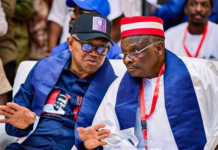
The African Democratic Congress (ADC) has condemned the movement of the Minister of the Federal Capital Territory, Nyesom Wike, around various polling units in Abuja under the guise of “monitoring.”
It said Wike’s monitoring exercise, after unilaterally imposing a curfew on potential voters, represents direct interference in the election.
It said Wike is not a registered voter in the FCT, and as a known partisan and cabinet minister, he has no constitutional role in the election process, stressing that his presence during active voting is therefore not only vexatious and meddlesome but also risks intimidating voters and officials.
In a similar vein, the ADC said it has received reports of voter suppression and intimidation in parts of the FCT, including alleged collaboration between APC agents and some security personnel.
In a statement by its National Publicity Secretary, Mallam Boloji Abdhllahi, the party said: “We also note disruptions to the INEC Result Viewing Portal (IReV), which has remained inaccessible even as results are being collated. We find this a curious coincidence and call on INEC to urgently restore full IReV functionality, with a clear public explanation of the disruption.”
“We urge all our party agents and voters to remain calm but vigilant, and to document all incidents.”
As at 9:04 pm The Eastern Updates gathered that the results from polling units in the six local councils of the FCT have started trickling in, a few hours after the Commission conducted the elections.
The results for the Kwali chairmanship election is 56.72% completed as of 9:04 pm on Saturday.
Read Also: APC Targets All Six Abuja Councils Amid Low Turnout, Wike Row
In the same way, the Gwagwalada Area Council chairmanship seat is 65.68 per cent uploaded.
The Commission, apart from results for the councillorship and the chairmanship posts in the FCT, is also uploading results of the Kano and Rivers State bye-elections on the IReV portal.
Residents of Nigeria’s Federal Capital Territory went to the polls on Saturday to elect chairmen and councillors across all six area councils in Abuja, in an election conducted under heavy security, a controversial movement restriction imposed by the FCT minister, and persistently low voter participation, patterns that have defined every council election in the capital since at least 2019 and that election observers said showed no clear sign of improvement.
Polls opened at 8:30 a.m. across 2,822 polling units in the six area councils of Abaji, Abuja Municipal Area Council, Bwari, Gwagwalada, Kuje, and Kwali. A total of 637 candidates from 17 political parties contested 68 positions, six chairmanship seats and 62 councillorships across 62 wards. The Independent National Electoral Commission deployed 4,345 Bimodal Voter Accreditation System machines to verify voters and accredit ballots, with results to be transmitted electronically to INEC’s Result Viewing Portal, the same framework used in all federal elections since 2022.
The exercise carried institutional weight beyond its local significance. Saturday’s polls were the first electoral test of INEC’s new leadership under Professor Joash Amupitan, appointed chairman by President Bola Tinubu in October 2025, and analysts said the commission’s performance in the capital would set expectations for its management of the far larger and more consequential 2027 general elections.
The stakes for the ruling All Progressives Congress were equally specific: having split the six councils evenly with the Peoples Democratic Party in 2022, the party entered the day with public declarations from senior officials that a clean sweep was both achievable and politically necessary as a statement of national strength ahead of 2027.
That ambition was prosecuted openly and, critics said, improperly. FCT Minister Nyesom Wike, a former governor of Rivers State appointed to administer Abuja by President Tinubu in 2023, declared publicly in the weeks before the election that he would support only those who backed the president’s agenda and would work against candidates who did not. At a campaign event in Abuja, Wike stated that he would block candidates who do not back the president, describing the council elections as a loyalty test for the ruling party and framing his own role in the outcome as a direct expression of that test. He went further, directly facilitating the withdrawal of at least one opposition candidate in favour of their APC opponent. Zadna Dantani, the PDP chairmanship candidate for AMAC, announced his withdrawal from the race on Thursday, citing Wike’s intervention in support of the APC incumbent Christopher Zakka Maikalangu.
Read Also: Tinubu Calls For Orderly Conduct As FCT, Rivers, Kano Vote
The PDP’s national leadership publicly disowned the withdrawal. The party’s National Working Committee said through spokesperson Ini Ememobong that the withdrawal of PDP candidates was carried out without the party’s consent and that the national leadership had not authorised any such move. The episode inflamed an already tense pre-election atmosphere and gave the ADC, which had entered the race with support from former presidential candidates Atiku Abubakar and Peter Obi, a line of attack it used extensively in the final days of campaigning.
Wike’s movement restriction, imposed from 8 p.m. on Friday through 6 p.m. on Saturday, drew a formal legal and political challenge before polls opened. FCT Senator Ireti Kingibe described the measure as “authoritarian, ill-considered, and unacceptable in a democratic society,” questioning whether a ministerially appointed official held the constitutional authority to restrict movement across the entire territory for an electoral exercise.