


















|
Listen to article
|
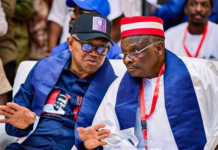
Former Abia State governor and senator representing Abia North, Orji Uzor Kalu, has declared that he will oppose the re-election of Abia State Governor, Alex Otti, in the 2027 governorship poll.
Kalu insisted that party loyalty must come before personal friendship.
He made the remarks in an interview on Channels Television’s Sunrise Daily.
The senator stressed that he maintains a strong relationship with Otti, noting that political differences should not destroy personal ties.
According to him, he remains committed to the All Progressives Congress, APC, while Otti is a member of the Labour Party.
“I always believe if he wants to be his party, be your party and vote for your party. I’m a member of APC. I will work for APC. He should work for Labour Party. We should not lose friendship,” Kalu said, adding that his priority is to maintain peace and political stability in Abia State.
Read Also: House of Reps. Erupts Over Electoral Act Transmission Clause
Despite pledging to give the governor room to work, Kalu was firm about his stance ahead of the 2027 election.
“I will oppose it because my party will be fielding a candidate. That’s it. It is about the interest of the party,” he stated.
The House of Representatives descended into disorder on Tuesday after Speaker Tajudeen Abbas ruled in favour of a motion to stop the passage of the Electoral Act Amendment Bill despite a majority of lawmakers voting against it, leading to protests, a walkout, and a contested closed-door session.
The motion was introduced by Francis Waive, Chairman of the House Committee on Rules and Business, who urged the Green Chamber to take back its earlier approval of the amendment bill passed on December 23, 2025. Waive framed the move as necessary to align the House version with the Senate’s position on real-time electronic transmission of election results, a provision that has divided the National Assembly, civil society, and the broader electorate for months.
When Abbas subjected the motion to a voice vote, the “nays” were louder than the “ayes,” but he ruled that the ayes had it. The decision immediately sparked loud protests on the floor, with several lawmakers openly challenging the ruling. They stood on their feet and prevented the Deputy Speaker, Benjamin Kalu, from continuing with the proceedings.
Abbas subsequently called for an executive session, but the proposal was also initially rejected, plunging the chamber into another rowdy session over the matter. Despite the resistance, the speaker eventually moved the House into a closed-door session. On return from the executive session, members again stood on their feet and prevented the Deputy Speaker from continuing with proceedings. Some members subsequently walked out of the green chamber in protest against the move to rescind the bill.
The legislative crisis centres specifically on Clause 60(3) of the proposed legislation, which as passed by the House in December mandated the direct, real-time upload of polling unit results to the Independent National Electoral Commission’s Result Viewing Portal, known as IReV. When the House passed the electoral act in December, it adopted a proposal mandating the real-time transmission of election results to IReV. The Senate’s position has been different and shifting. The upper legislative chamber on Tuesday revoked its earlier decision and approved the electronic transmission of election results to IReV, with a clause that manual collation should serve as a fallback if technology fails. The Senate had earlier adopted a revised Clause 60(3), mandating electronic transmission of results only after Form EC8A, the result sheet, has been signed and stamped at polling units, stopping short of making real-time upload compulsory.
Senate President Godswill Akpabio subsequently announced a 12-member Conference Committee to harmonise the Senate’s version of the bill with that of the House of Representatives, urging members to conclude their work within one week to enable President Bola Tinubu to assent to the bill this month.
“This is a matter of urgency. If you conclude within one week, the President should be able to sign the bill into law within the month,” Akpabio said. Senator Simon Lalong will chair the committee.Tuesday’s turmoil in the House now complicates that timeline.
The stakes are high and extensively documented. Previous Senates and Houses have experienced legislative turnover rates of between 59 and 79 percent, patterns that electoral reform advocates attribute partly to result manipulation at collation stages, a practice that mandatory real-time uploads to IReV would, in their view, structurally prevent by making polling unit results publicly verifiable before collation begins. Opponents of the real-time mandate have argued that Nigeria’s network infrastructure, with mobile broadband coverage and internet penetration well below the thresholds required for guaranteed nationwide uploads, makes the provision operationally unenforceable and legally dangerous.
The Arewa Consultative Forum warned against alleged alterations to the Electoral Act by the National Assembly, describing developments as dangerous to Nigeria’s democracy. ACF National Publicity Secretary Professor Tukur Muhammad-Baba expressed concern over allegations of tampering with bills after passage.
“Most worrying is the evidence of tampering with provisions after legislation has been duly passed,” he said, adding that decisions of the National Assembly as passed by elected representatives must be treated as sacrosanct.
Read Also: INEC Seeks N874bn To Conduct 2027 Elections
Civil society groups have maintained continuous pressure outside the National Assembly complex. Protesters returned to the gates of the compound on Monday, the day before Tuesday’s session, specifically demanding that mandatory real-time transmission be preserved in any final version of the bill. Their presence reflects a broader public mobilization around electoral integrity that has given the legislative dispute an intensity beyond its procedural dimensions.
President Tinubu has not publicly stated his preference for either version of the bill. Both the Senate and the Presidency have signaled urgency around finalizing the legislation before the Electoral Timetable for 2027 takes effect, given that INEC has fixed the general elections for February of that year and that a 360-day notice provision in the proposed law creates a scheduling constraint that several lawmakers have flagged as requiring resolution before the bill is signed.
Whether Tuesday’s closed-door session produced agreement among House members on whether to proceed with the rescission, or whether the walkouts and continued protests signal a deeper breakdown in the majority caucus’s discipline, had not been confirmed publicly by the time deliberations concluded. The outcome of those behind-doors negotiations will determine whether the conference committee process can proceed on Akpabio’s one-week timeline or whether the House must undergo further internal deliberations before it can present a consolidated position to its Senate counterpart.