




















|
Listen to article
|
Ngozi Orabueze, who describes herself as deputy prime minister and chief of staff of the United States of Biafra (USB), posted on Tuesday a letter she said she received from the White House acknowledging a message she had sent to U.S. President Donald Trump.
The document, shared on the social media platform X, carries a White House letterhead and what appears to be an autopen signature attributed to the president.
The short note thanks the recipient for writing but does not refer to Biafra, separatist demands, or any specific political request.
“Thank you for your letter. I appreciate you taking the time to share your views and concerns with me. Your thoughts are important, and I value the opportunity to hear from citizens like you,” the letter states.
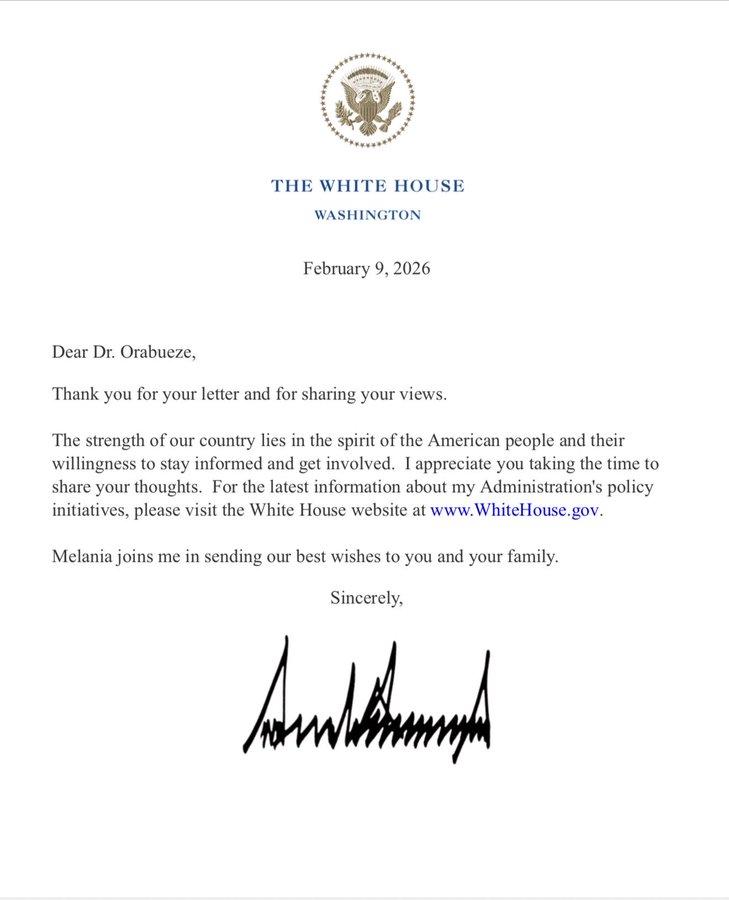
It continues: “As we work to make America great again, your input helps guide our efforts. For more information on my administration’s policies and priorities, please visit the White House website. Melania joins me in sending our best wishes to you and your family.”
The language and format resemble a standard acknowledgement often issued by the White House correspondence office. U.S. administrations routinely respond to large volumes of mail with prepared templates confirming receipt of messages from members of the public.
These replies are typically generated through administrative processes and may carry an autopen signature rather than a personally written one.
The White House did not immediately comment on the specific exchange, and the content of the original message Orabueze said she sent was not publicly available. She did not indicate that she had received further communication from U.S. officials beyond the acknowledgement.
Read also: Nnamdi Kanu: IPOB Finally Cancels Sit-At-Home In South-East
The United States does not recognise any entity known as the United States of Biafra. Biafra was a secessionist state declared in southeastern Nigeria in 1967, a move that triggered a civil war between federal forces and the breakaway region. The conflict ended in 1970 with the territory reintegrated into Nigeria.
Since then, separatist sentiment has persisted in parts of the southeast, periodically resurfacing through various organisations and advocacy campaigns. Nigerian authorities maintain that the country’s unity and territorial integrity are not negotiable and have in past years taken legal action against groups promoting secession.
Some pro-Biafra organisations operate largely from diaspora networks in Europe and North America, where activists have organised rallies, fundraising drives and online campaigns. Nigerian security agencies have accused certain factions of incitement and unlawful activities, allegations activists dispute.
Washington has consistently affirmed its support for Nigeria as a unified state. U.S. State Department statements over the years have emphasised respect for Nigeria’s sovereignty and encouraged peaceful dialogue to address grievances in the region. The acknowledgement letter posted by Orabueze contains no indication of recognition, mediation, or policy engagement by the U.S. government.
White House correspondence offices traditionally handle mail sent to the president by citizens, foreign nationals, advocacy groups and organisations worldwide. Standard replies are often sent even when the writer resides outside the United States or raises issues unrelated to U.S. domestic policy.
Officials familiar with the process say such letters are administrative responses and do not signify that the president has personally reviewed the correspondence.
The autopen, a mechanical device used for decades by U.S. presidents to sign large volumes of documents, is commonly employed for routine communications, holiday greetings and acknowledgements. Its use has been publicly documented in previous administrations and does not necessarily imply direct presidential involvement in each reply.
The circulation of the letter drew attention online, with some supporters interpreting it as evidence of international engagement.
However, diplomats and policy analysts note that acknowledgement correspondence is standard procedure and distinct from formal diplomatic communication, which would normally occur through the U.S. State Department or official diplomatic channels.
Read further: Sit-At-Home: Non-Member Cannot Speak For IPOB – Powerful
Nigeria and the United States maintain longstanding bilateral relations, including cooperation on security, trade and public health. U.S. officials have regularly expressed concern about violence in Nigeria’s southeast and have called for restraint by both security forces and armed actors, while reiterating support for constitutional processes.
No further action or statement from U.S. authorities has been announced regarding the exchange, and there is no indication that the correspondence changes Washington’s position on Nigeria’s territorial status.

